What Happens When You Ask Tarot the Same Question Repeatedly?
TL;DR
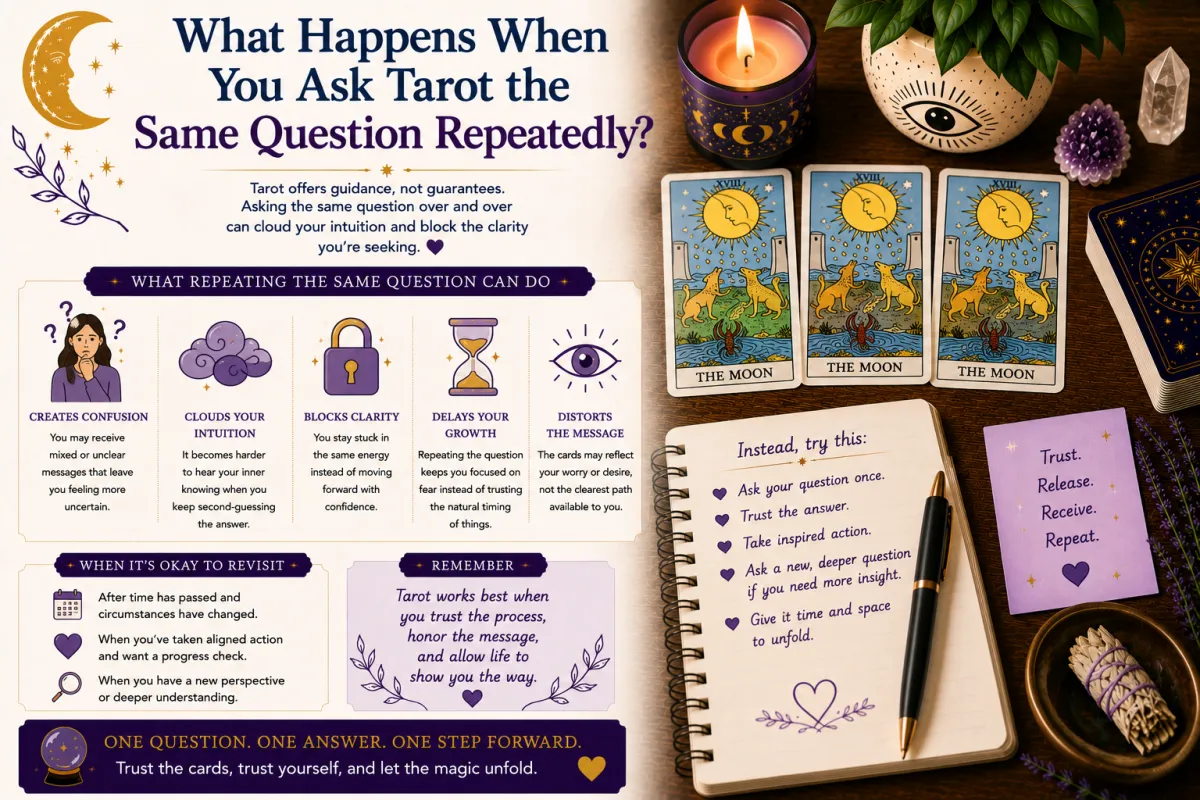
Asking Tarot the same question repeatedly often creates confusion rather than clarity. Instead of gaining new insight, you may begin second-guessing yourself and interpreting the cards through hope or fear.
IN SHORT
It is natural to seek reassurance when facing uncertainty.
After a reading, you may find yourself wondering:
• "Should I ask again?"
• "Maybe I shuffled incorrectly."
• "Perhaps the cards will give a different answer."
While this is understandable, repeatedly asking the same question rarely produces a clearer reading.
More often, it creates mixed messages and uncertainty.
REAL TALK
Most people who ask the same question repeatedly are not looking for more information.
They are looking for a different answer.
This usually happens when the first reading wasn't what they hoped to see.
Tarot works best when it encourages reflection—not when it becomes a search for reassurance.
Trust Your First Reading
Your first reading is usually the most honest.
It reflects:
• Your question
• Your mindset
• Your circumstances at that moment
Constantly repeating the reading can make it harder to recognise the original message.
Why Repeating The Question Creates Confusion
Every shuffle changes the order of the cards.
That means each new reading may highlight different aspects of the same situation.
Instead of providing certainty, multiple readings often leave you wondering which one to believe.
This can increase anxiety rather than reduce it.
Give Yourself Time To Reflect
After a reading, allow yourself time to think about what you've learned.
You might:
• Write in your Tarot journal
• Reflect over the next few days
• Notice recurring themes in everyday life
Often, the meaning becomes clearer with time.
Ask A Different Question Instead
If you genuinely need more guidance, try changing the focus.
Instead of repeating:
"What will happen?"
Ask:
• What have I not considered?
• What lesson can I learn from this?
• What should I focus on next?
These questions encourage growth rather than repetition.
Accept That Some Uncertainty Is Normal
Not every question has an immediate answer.
Tarot encourages patience as well as insight.
Sometimes the most valuable lesson is learning to sit with uncertainty while continuing to move forward.
WHY THIS WORKS
Reflection allows insight to develop naturally.
Giving yourself time between readings helps you process the message instead of becoming overwhelmed by multiple interpretations.
COMMON MISTAKE
Mistake:
Repeating the same reading several times because you dislike the original answer.
Fix:
Trust the first reading, reflect on its message, and only return to the cards when your situation has genuinely changed or you have a new question.
COFFEE CUP TIP ☕
If you feel tempted to ask again, pause and ask yourself:
"Am I looking for new insight, or simply hoping for a different answer?"
The honest answer often tells you whether another reading is necessary.
FAQ QUICK FIX
If you ask Tarot the same question repeatedly:
The message may become less clear.
Conflicting interpretations can appear.
Anxiety may increase.
Reflection becomes more difficult.
Trust in your own interpretation may decrease.
QUICK RECAP
Tarot is most helpful when it encourages thoughtful reflection.
Rather than repeating the same question, trust the first reading, give yourself time to reflect, and return to the cards when you have a genuinely new perspective or question.
RELATED QUESTIONS
→ How Do You Avoid Fear-Based Tarot Reading?
→ Can Tarot Help Reduce Overthinking?
→ Why Do Tarot Readings Sometimes Feel Confusing?
NEXT STEP
One reason people repeatedly ask the same question is fear.
The next step is learning how to recognise fear-based Tarot reading and avoid letting anxiety influence your interpretations.
