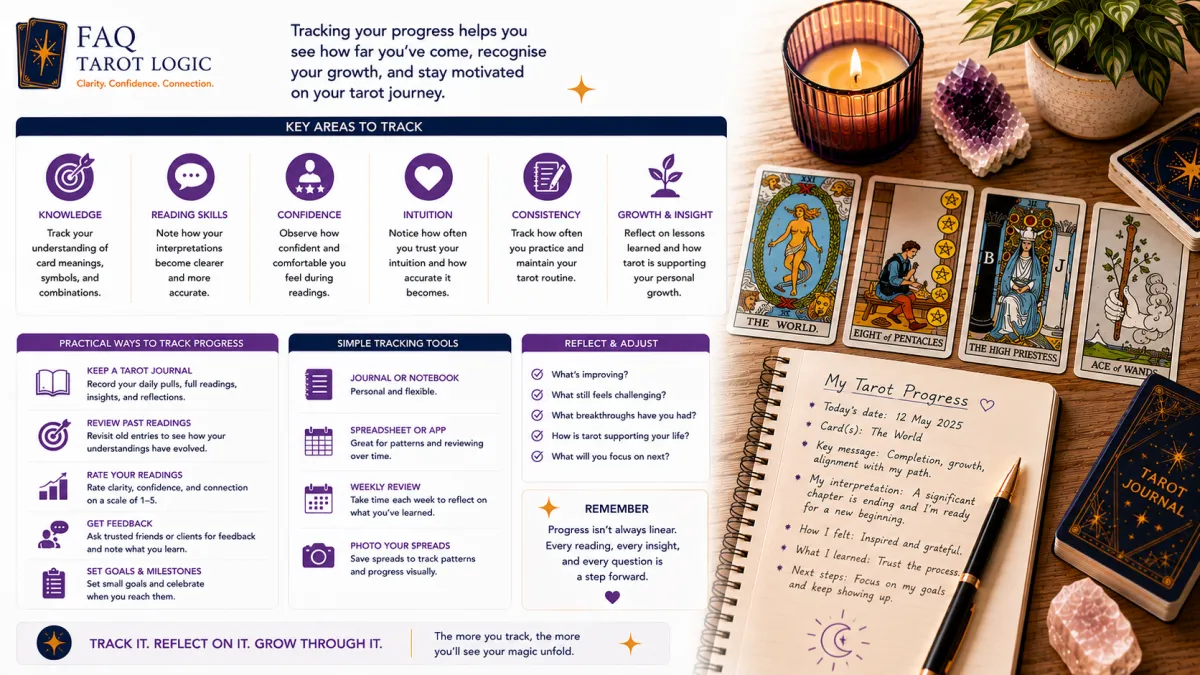
How Can You Track Your Progress as a Tarot Reader?
TL;DR
You can track your progress as a tarot reader by recording your readings, reviewing older interpretations and noticing how your confidence and understanding develop over time. Progress isn't about memorising every card or getting every reading "right." It's about becoming more comfortable interpreting the cards, recognising patterns and trusting your own judgement.
IN SHORT
Tarot progress can be difficult to measure.
There isn't an exam to pass or a point where you've suddenly "learned tarot."
Instead, improvement tends to happen gradually.
You begin recognising cards without reaching for the guidebook.
Connections between cards become easier to see.
Your interpretations become more detailed.
And eventually, you realise you're spending less time worrying about whether you're doing it correctly.
The key is knowing what signs to look for.
Why Track Your Tarot Progress?
When you're learning tarot regularly, it's easy to overlook how much you've improved.
You see your current uncertainties but forget the things that once seemed difficult.
Tracking your progress gives you something to compare.
It can help you recognise:
Cards you've become more comfortable interpreting.
Areas that still need practice.
Changes in your reading style.
Improvements in your confidence.
Recurring themes within your readings.
Most importantly, it provides evidence that your practice is actually making a difference.
Use Your Tarot Journal
A tarot journal is one of the easiest ways to track your development.
You don't need to write pages after every reading.
Simply record useful details such as:
The date.
The question.
The cards drawn.
Your first impressions.
Your interpretation.
Anything you found difficult.
What you learned from the reading.
After several weeks, you'll have a record you can look back through.
If you've recently started journaling, you'll probably begin noticing progress sooner than you expect.
Review Older Readings
Recording readings is useful.
Reviewing them is where things become particularly interesting.
Choose a reading from a few months ago and look at the cards again.
Ask yourself:
Would I interpret these cards differently today?
Do I notice connections I missed before?
Does the reading make more sense with hindsight?
Would I explain the message more clearly now?
You may be surprised by how differently you see the same cards.
That difference is progress.
Notice When You Need The Guidebook Less
Guidebooks are useful learning tools and there's nothing wrong with using them.
But one of the clearest signs of progress is that you gradually become less dependent on them.
You may look at a familiar card and immediately recognise its general theme.
You might notice a symbol and understand how it relates to the question.
Or you may interpret several cards together before checking their traditional meanings.
You haven't necessarily memorised the cards.
You've simply become familiar with them through experience.
Pay Attention To Connections Between Cards
Beginners often read tarot one card at a time.
Card one means this.
Card two means that.
Card three means something else.
As your skills develop, you begin noticing relationships between them.
You might recognise:
Repeated suits.
Similar imagery.
Contrasting cards.
Repeating numbers.
A progression through the spread.
A strong Major Arcana presence.
Instead of seeing several separate cards, you begin seeing one connected message.
That's an important step forward.
Track Your Confidence Too
Progress isn't only about knowledge.
Confidence matters just as much.
Think back to your earliest readings.
Perhaps you constantly checked the guidebook or questioned every interpretation.
Now ask yourself:
Am I more comfortable with uncertainty?
Do I trust my first impressions more often?
Can I explain why I've interpreted a card in a particular way?
Am I less worried about finding the "correct" answer?
These changes may seem small, but they're important signs that you're developing as a reader.
Don't Measure Progress By Accuracy Alone
It's tempting to judge a tarot reading by whether something later "came true."
That's not a particularly useful measure of progress.
Tarot isn't simply about predicting outcomes.
A thoughtful reading might help you:
See a situation differently.
Recognise an overlooked concern.
Understand your feelings.
Consider another option.
Make a more thoughtful decision.
If the reading encouraged useful reflection, it achieved something valuable.
Progress should therefore be measured by the quality of your interpretation and reflection, not simply by whether you predicted what happened next.
Set Small Learning Goals
You can also make progress easier to recognise by setting simple goals.
For example:
This month: Become more comfortable with the Court Cards.
Next month: Practise reading three-card combinations.
After that: Spend more time interpreting symbolism before checking the guidebook.
Small goals give your practice direction without turning tarot into another task you have to complete.
They also give you something tangible to look back on.
Compare Yourself With Yourself
It can be tempting to compare your readings with someone who has been practising tarot for years.
That rarely tells you anything useful.
Instead, compare your current reading ability with where you were:
One month ago.
Three months ago.
Six months ago.
Your own development is the measurement that matters.
Someone else's tarot journey doesn't need to look anything like yours.
Coffee Cup Tip ☕
Every month, choose one old journal entry and read it again. Don't change what you originally wrote. Instead, add a few notes about what you see differently now. Over time, those comparisons become a simple record of how much your reading skills have developed.
QUICK RECAP
You can track your progress as a tarot reader by:
Recording your readings.
Reviewing older interpretations.
Noticing when you rely less on guidebooks.
Looking for stronger connections between cards.
Tracking changes in your confidence.
Setting small learning goals.
Measuring insight rather than prediction.
Comparing yourself with your earlier ability rather than other readers.
Tarot progress usually happens gradually.
Sometimes the easiest way to realise how far you've come is simply to look back at where you started.
NEXT STEP
Tracking your progress helps you see what's changing, but improvement also depends on what you do consistently.
Next, we'll look at the simple habits that can strengthen your skills, deepen your understanding and help you become a better tarot reader over time.
→ What Habits Help You Become a Better Tarot Reader?
