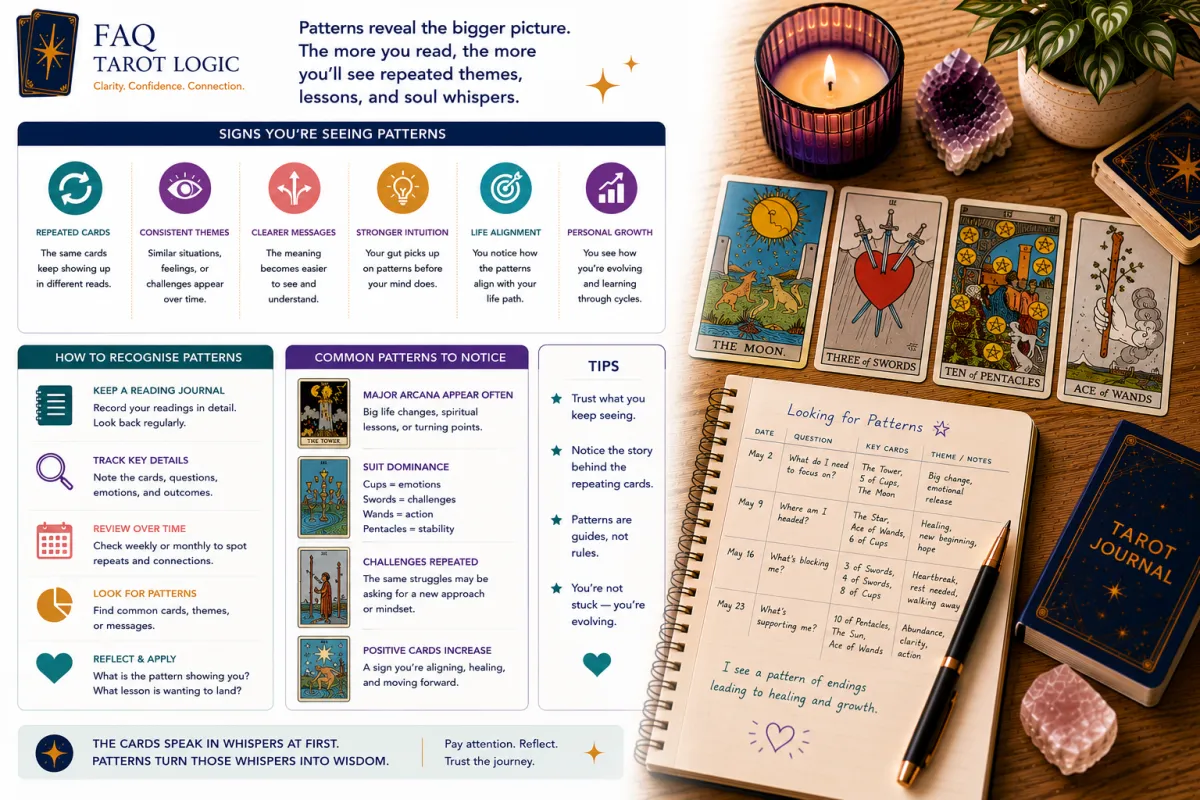
How Do You Recognise Patterns Across Multiple Tarot Readings?
TL;DR
You can recognise patterns across multiple tarot readings by looking for recurring cards, suits, numbers, themes and questions over time.
Rather than treating every reading as a separate event, reviewing previous readings can reveal repeated messages, changing circumstances and areas that may deserve more attention.
A tarot journal makes these patterns much easier to spot.
IN SHORT
One tarot reading gives you a snapshot.
Several readings can reveal a pattern.
Perhaps the same card keeps appearing.
Maybe Cups dominate your readings for several weeks.
Or different cards seem to keep returning to the same underlying theme.
These repetitions don't necessarily predict that something specific will happen. Instead, they can encourage you to notice issues, emotions or decisions that continue to appear in your life.
Learning to recognise these patterns adds another layer to your tarot practice.
Why Patterns Matter
When you're concentrating on individual readings, it's easy to miss the bigger picture.
You might perform a reading today, another next week and another later in the month without considering how they relate to each other.
But when you look back, connections may become obvious.
Patterns can help you recognise:
Recurring concerns.
Emotional themes.
Areas where you feel stuck.
Decisions you keep returning to.
Changes in your perspective.
Lessons that haven't yet been fully explored.
Sometimes the most useful insight isn't contained within one reading.
It emerges when several readings are considered together.
Start With Recurring Cards
The easiest pattern to notice is a card that appears repeatedly.
Perhaps The Hermit keeps appearing.
Maybe the Two of Swords seems to turn up whenever you're considering a particular situation.
Before assuming the repeated card carries some dramatic message, look at the context.
Ask yourself:
What questions was I asking when this card appeared?
Was I thinking about similar situations?
Did the card occupy similar positions in different spreads?
Has my interpretation of it changed?
A recurring card can become particularly useful when you compare the circumstances surrounding each appearance.
Look At Repeating Suits
Individual cards aren't the only patterns worth noticing.
Sometimes an entire suit becomes prominent.
If you repeatedly draw Cups, your readings may be focusing heavily on emotions, relationships or intuition.
Frequent Pentacles may suggest practical concerns such as work, money, health or stability.
Repeated Swords could highlight thought patterns, decisions, communication or conflict.
And frequent Wands may draw attention to creativity, ambition, energy or action.
Looking at suit patterns helps you step back from individual cards and see which areas of life are receiving the most attention.
Notice Repeating Numbers
Numbers can create patterns too.
You may notice several Twos appearing across different readings.
Or perhaps Fives keep showing up.
Rather than immediately searching for a fixed numerological meaning, begin with the tarot itself.
Consider what the cards have in common.
For example, several Twos may encourage you to explore themes involving:
Choices.
Balance.
Partnerships.
Opposing possibilities.
Several cards with the same number can reveal a shared theme even though they belong to different suits.
Look Beyond Identical Cards
Patterns aren't always obvious repetitions.
Different cards can communicate similar ideas.
You might draw several different cards over a month that all relate to:
Patience.
Boundaries.
Communication.
Letting go.
Taking action.
Rest.
Making a decision.
None of the cards needs to repeat for the theme to repeat.
This is why reviewing the meaning of entire readings can sometimes be more useful than simply counting individual cards.
Pay Attention To The Questions You Keep Asking
Sometimes the pattern isn't in the cards.
It's in your questions.
Look back through your readings and ask:
Am I repeatedly asking about the same situation?
Do my questions keep returning to the same concern?
Am I seeking reassurance about something I've already explored?
Is there a decision I keep postponing?
Recognising repeated questions can be extremely revealing.
You may discover that the cards aren't repeatedly bringing you back to a subject.
You are.
That distinction can provide valuable insight into what may need your attention.
Use A Tarot Journal To See The Bigger Picture
This is where keeping a tarot journal becomes particularly useful.
Individual entries record what happened during each reading.
Reviewing several entries allows you to see what happened across your readings.
Every few weeks, look back through your journal and make a note of:
Cards that appeared several times.
Dominant suits.
Repeating numbers.
Similar questions.
Recurring themes.
Changes in your interpretations.
You don't need complicated charts or tracking systems.
A simple page of observations is often enough.
Notice How Patterns Change
Patterns aren't only about repetition.
Their disappearance can be just as interesting.
Perhaps Swords dominated your readings during a period of uncertainty, but gradually appear less often.
Maybe a recurring card stops appearing after you make a particular decision.
Or perhaps the questions you're asking begin to change.
These shifts can reflect changes in your circumstances, attention or perspective.
Tracking what stops appearing can sometimes tell you as much as tracking what continues.
Don't Turn Every Repetition Into A Sign
Once you start looking for patterns, it's easy to find them everywhere.
Try to remain balanced.
Drawing the same card twice doesn't automatically mean something extraordinary is happening.
Sometimes cards repeat simply because tarot decks contain a limited number of cards.
A useful pattern usually becomes clearer through:
Repetition over time.
Similar circumstances.
Related questions.
Consistent themes.
Personal relevance.
Stay curious without feeling that every repeated card must carry a hidden message.
Consider How Your Interpretation Has Changed
One particularly useful pattern to track is your own development.
Suppose the same card appeared three months ago and again today.
Would you interpret it differently now?
Perhaps you notice more symbolism.
Maybe you understand its relationship with surrounding cards more clearly.
Or perhaps your personal experience has changed how you see it.
Patterns across readings don't only reveal information about the situations you're exploring.
They can also reveal how you're developing as a tarot reader.
Use Patterns To Ask Better Questions
Once you've noticed a recurring theme, you can use it to guide future readings.
If communication repeatedly appears as an issue, you might ask:
"What could help me communicate more clearly in this situation?"
If several readings highlight hesitation, you could explore:
"What is making me reluctant to move forward?"
This is more useful than repeatedly asking the original question.
The pattern helps you move the conversation forward.
Let Patterns Develop Naturally
You don't need to search for connections after every reading.
Sometimes there won't be any.
Patterns become useful when they emerge naturally over time.
Keep reading.
Keep recording.
Occasionally look back.
The more experience you collect, the easier it becomes to recognise which repetitions are meaningful and which are simply coincidence.
Coffee Cup Tip ☕
At the end of each month, spend ten minutes reviewing your tarot journal. Write down the three themes you noticed most often. Don't try to interpret them immediately. Simply seeing them together may reveal a bigger picture you hadn't noticed during the individual readings.
QUICK RECAP
To recognise patterns across multiple tarot readings:
Look for recurring cards.
Notice dominant suits.
Pay attention to repeating numbers.
Identify themes shared by different cards.
Review the questions you repeatedly ask.
Use your tarot journal to compare readings.
Notice when recurring patterns begin to change.
Avoid treating every repetition as a special sign.
Track how your own interpretations develop.
Use recurring themes to ask better questions.
A single reading can help you understand a moment.
A collection of readings can help you understand a pattern.
NEXT STEP
Recognising patterns teaches you to look beyond individual cards and consider the bigger picture.
But what happens when a reading feels unfinished, confusing or you aren't sure whether to keep working with the cards already drawn?
Next:
