How to Read Tarot Cards: A Complete Beginner's Reading Guide
TL;DR
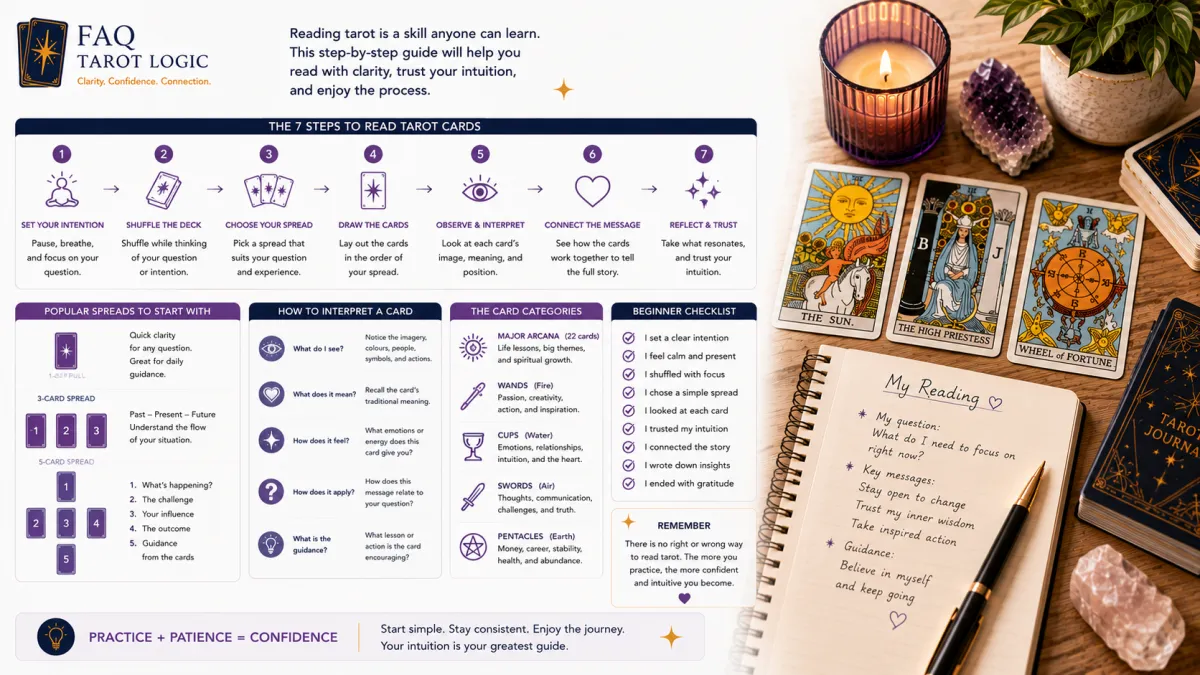
Reading tarot isn't about predicting the future—it's about asking thoughtful questions, interpreting the cards within their context and building confidence through regular practice. By understanding how to prepare for a reading, choose simple spreads and trust the process, anyone can learn to read tarot effectively.
IN THIS GUIDE
In this guide you'll learn:
How to prepare for a tarot reading
Why asking better questions leads to better readings
How to choose a tarot spread
How to interpret cards together
Tips for reading for yourself
How to build confidence through practice
Common mistakes beginners should avoid
Whether you're reading for yourself or someone else, this guide will help you approach tarot with clarity and confidence.
Introduction
Once you've learned the structure of the tarot deck and become familiar with the cards, the next step is putting that knowledge into practice.
For many beginners, this is where uncertainty appears.
You might wonder whether you're interpreting the cards correctly, whether you're using the right spread or whether you're asking the "right" questions.
The truth is that every experienced tarot reader has asked those same questions.
Reading tarot isn't about perfection. It's about learning to observe, reflect and connect the cards into a meaningful story. Like any skill, confidence develops through practice rather than instant expertise.
This guide will walk you through the essential steps for performing thoughtful, meaningful tarot readings.
Preparing for a Tarot Reading
Before you draw a single card, it's worth taking a few moments to prepare.
Preparation isn't about creating elaborate rituals or following strict rules. Instead, it's about giving yourself time to become present and focus on the purpose of the reading.
Many readers find it helpful to:
Minimise distractions.
Take a few slow breaths.
Shuffle the cards without rushing.
Think clearly about the question they want to explore.
This simple routine creates space for reflection and helps you approach the reading with intention rather than haste.
If you'd like more guidance, read:
→ What Should You Do Before a Tarot Reading?
Asking Better Questions
The quality of a tarot reading often depends on the quality of the question.
Questions that encourage exploration usually produce more useful insights than questions seeking simple yes-or-no answers.
For example, instead of asking:
"Will I get the job?"
You might ask:
"What can I do to improve my chances of success?"
Rather than predicting an outcome, tarot encourages reflection on the factors you can influence.
Thoughtful questions lead to thoughtful readings.
Choosing a Tarot Spread
A tarot spread provides structure for your reading.
Each card position has a purpose, helping you explore different aspects of the situation.
Beginners often assume they need to learn many complicated spreads.
In reality, a few simple layouts are more than enough.
A one-card draw can provide daily reflection.
A three-card spread can explore:
Past
Present
Future
or
Situation
Challenge
Guidance
As your confidence grows, you can experiment with more detailed spreads, but there's no need to rush.
Reading the Cards Together
One of the biggest steps in learning tarot is moving beyond interpreting cards individually.
Each card contributes to the overall story.
Imagine reading a sentence.
Each word has meaning, but it only makes complete sense when read alongside the surrounding words.
Tarot works in much the same way.
Look for:
Repeating themes.
Contrasting energies.
Emotional patterns.
Connections between suits.
Relationships between Major and Minor Arcana.
The more you practise recognising these patterns, the more naturally your readings will flow.
If you'd like to explore this further, read:
→How Do You Interpret Multiple Tarot Cards Together?
Reading for Yourself
Many people begin their tarot journey by reading for themselves.
This offers an excellent opportunity to become familiar with the cards because you already understand the situation you're exploring.
However, self-readings also require honesty.
It's easy to interpret cards according to what you hope will happen rather than what they're encouraging you to consider.
Approach your readings with curiosity rather than expectation.
Allow the cards to encourage reflection instead of seeking confirmation of a desired outcome.
For more guidance, read:
→ Can You Read Tarot for Yourself?
Building Confidence
Confidence grows through experience.
Every reading teaches something new.
Rather than worrying about making mistakes, focus on developing consistent habits.
Helpful practices include:
Keeping a tarot journal.
Recording your interpretations.
Reviewing readings later.
Noticing recurring themes.
Reading regularly instead of occasionally.
Over time, patterns become easier to recognise and your confidence naturally increases.
If confidence is something you're working on, you may also find these articles helpful:
→ How Do You Build Confidence in Tarot Readings?
→ How Do You Stop Doubting Yourself During a Reading?
When Readings Feel Confusing
Every tarot reader experiences confusing readings.
Sometimes the cards seem unrelated.
Sometimes the message isn't immediately clear.
This is completely normal.
Rather than forcing an interpretation, give yourself permission to pause.
Ask yourself:
Have I asked a clear question?
Am I considering the whole spread?
Is there another perspective I haven't explored?
Often, clarity develops after taking a break and returning to the reading later.
If this sounds familiar, read:
→ Why Do Tarot Readings Sometimes Feel Confusing?
Avoiding Common Beginner Mistakes
Most beginners experience similar challenges.
Common mistakes include:
Trying to memorise every card immediately.
Using overly complicated spreads too soon.
Asking vague questions.
Expecting instant accuracy.
Doubting every interpretation.
Fortunately, these improve naturally through regular practice.
Remember that tarot is a lifelong learning journey.
Every reading develops your understanding a little further.
Coffee Cup Tip ☕
Your first interpretation is often more insightful than you think. Before reaching for a guidebook, spend a few moments observing the card and trusting your own impressions.
QUICK RECAP
Reading tarot becomes easier when you:
Prepare calmly before each reading.
Ask thoughtful, open-ended questions.
Begin with simple spreads.
Read cards together instead of individually.
Practise regularly.
Accept that confidence develops over time.
View every reading as another learning opportunity.
There is no perfect tarot reader—only readers who continue learning.
NEXT STEP
Once you're comfortable performing readings, the next stage of your tarot journey is learning how to use the cards for self-reflection, personal growth and everyday decision-making. You'll explore that in the next cornerstone guide: Using Tarot for Clarity, Self-Reflection and Better Decision-Making.
