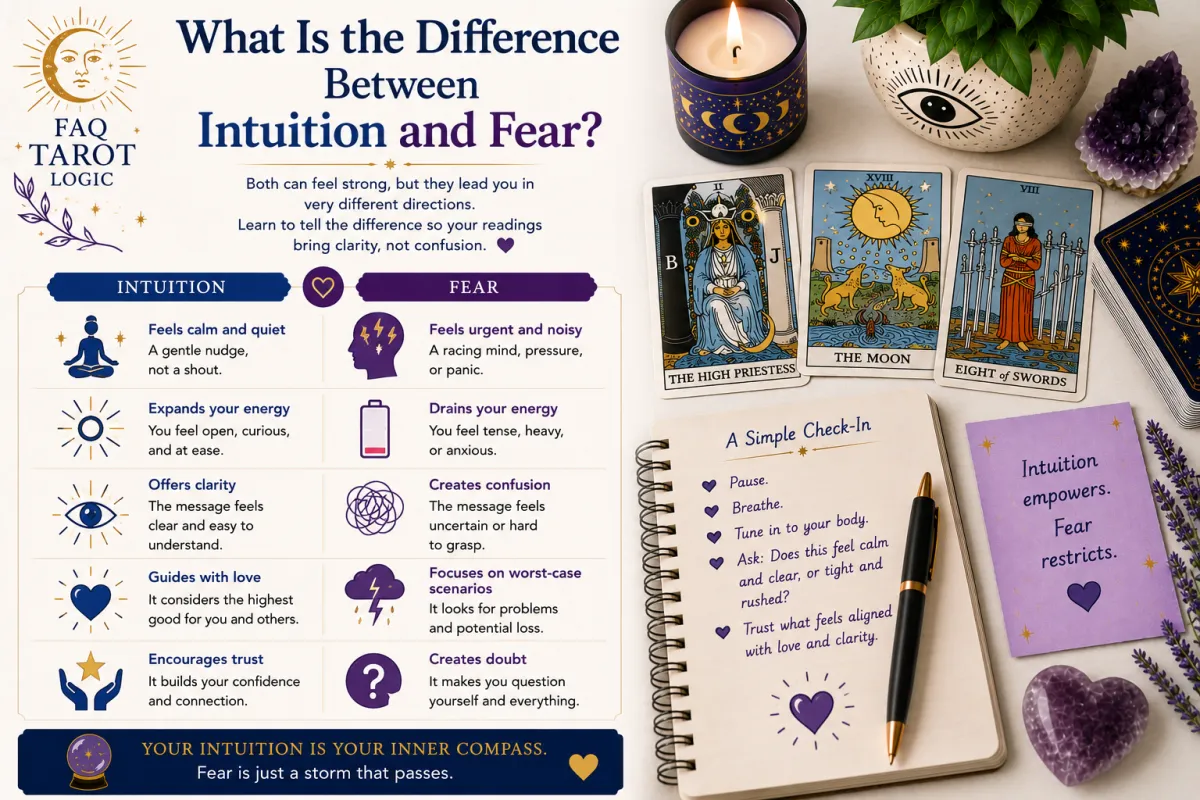
What Is the Difference Between Intuition and Fear?
TL;DR
Intuition and fear can sometimes feel similar, but they usually come from different places. Intuition tends to feel calm and quietly confident, while fear is often driven by anxiety, urgency, and worst-case thinking.
IN SHORT
One of the biggest challenges in Tarot is learning to recognise whether your interpretation is coming from intuition or fear.
Both can influence how you read the cards.
The difference is that intuition usually encourages understanding, while fear often creates uncertainty and doubt.
Learning to tell them apart is an important step towards becoming a more confident reader.
REAL TALK
Almost every Tarot reader experiences this.
You turn over a card and immediately think:
"Is this what the card is actually saying, or am I just worrying?"
That question is completely normal.
The more experience you gain, the easier it becomes to recognise the difference between a genuine intuitive impression and a fearful reaction.
What Intuition Feels Like
Intuition is often:
• Quiet
• Calm
• Clear
• Curious
• Balanced
It doesn't usually shout for attention.
Instead, it gently encourages you to notice something important.
Even when the message is challenging, intuition rarely feels overwhelming.
What Fear Feels Like
Fear often appears very differently.
It may sound like:
• "Something terrible is going to happen."
• "I've definitely interpreted this wrong."
• "I need to keep pulling more cards."
• "I must know the answer immediately."
Fear creates urgency.
It pushes you towards certainty instead of reflection.
Pause Before Reacting
If you're unsure whether you're experiencing intuition or fear, take a moment to pause.
Ask yourself:
• Am I feeling calm or anxious?
• Am I reacting or reflecting?
• Am I looking for understanding or reassurance?
These simple questions often provide surprising clarity.
Look At The Whole Reading
Fear tends to focus on one card.
Intuition looks at the entire spread.
Instead of becoming fixated on a challenging card, consider:
• The surrounding cards
• The overall theme
• The original question
• The message developing across the reading
Context usually reduces unnecessary worry.
Accept Some Uncertainty
One of the biggest differences between intuition and fear is how they respond to uncertainty.
Fear demands immediate answers.
Intuition is comfortable allowing the message to develop over time.
Not every reading needs to make perfect sense immediately.
WHY THIS WORKS
Recognising your emotional state makes it easier to separate genuine insight from anxious thinking.
This creates calmer, more balanced Tarot readings.
COMMON MISTAKE
Mistake:
Assuming every strong emotional reaction is intuitive guidance.
Fix:
Pause, reflect, and ask whether the feeling is encouraging understanding or simply reacting to uncertainty.
COFFEE CUP TIP ☕
Whenever you feel uncertain during a reading, ask:
"Is this thought helping me understand the cards, or is it simply feeding my worries?"
The answer often becomes obvious.
FAQ QUICK FIX
Intuition usually feels:
Calm
Balanced
Curious
Patient
Thoughtful
Fear usually feels:
Urgent
Anxious
Reactive
Uncertain
Focused on worst-case scenarios
QUICK RECAP
Intuition encourages thoughtful understanding.
Fear encourages immediate certainty.
Learning the difference helps you approach every Tarot reading with greater confidence and clarity.
RELATED QUESTIONS
→ How Do You Stop Doubting Yourself During a Reading?
→ Can Tarot Improve Self-Awareness?
→ How Do You Develop Your Own Tarot Reading Style?
NEXT STEP
Once you begin recognising the difference between intuition and fear, you'll naturally become more aware of your own thoughts, emotions, and patterns.
The next step is exploring how Tarot can help improve self-awareness.
