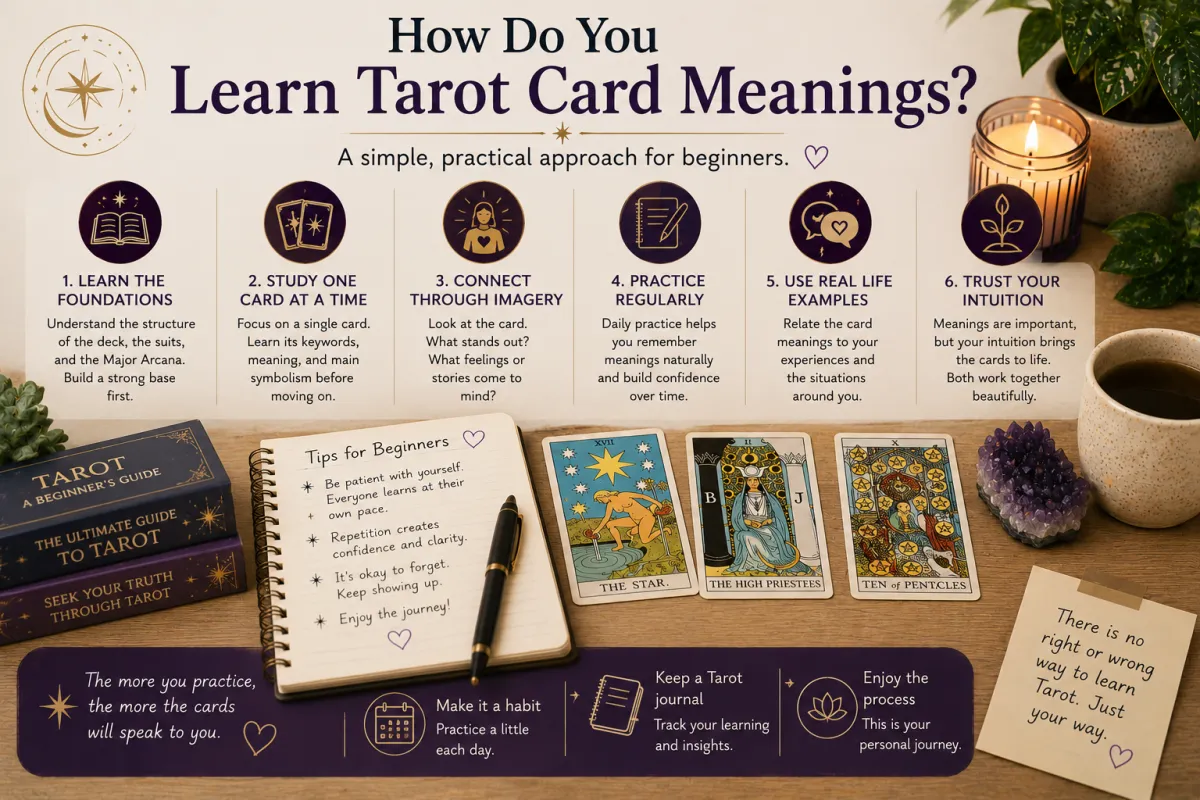
How Do You Learn Tarot Card Meanings?
TL;DR
You learn Tarot card meanings by combining traditional meanings, visual observation, intuition, and regular practice.
The best approach is not memorising endless keywords.
It is learning to understand the story each card is telling.
IN SHORT
Many beginners think learning Tarot means memorising 78 cards word-for-word.
That often makes Tarot feel overwhelming.
But Tarot becomes much easier when you stop trying to “study for a test” and instead learn:
• The symbolism
• The emotions
• The patterns
• The stories
• The connections between cards
Tarot is a visual language.
The cards are designed to speak through images, themes, and repeated symbols.
You do not need to become an expert overnight.
You simply need to spend time with the cards consistently.
REAL TALK
Most people quit Tarot too early because they think they are “bad” at it.
Usually they are just trying to memorise too much too quickly.
You are not supposed to know everything immediately.
Even experienced readers continue learning from the cards after many years.
Tarot develops through repetition.
The more often you see the cards, the more familiar they become.
Eventually you stop “remembering meanings” and start understanding them naturally.
That is where Tarot begins to feel alive.
Start With The Major Arcana
The easiest place to begin is with the Major Arcana.
These are the 22 cards that represent larger life lessons and important stages of personal growth.
Cards such as:
• The Fool
• The Magician
• The High Priestess
• The Lovers
• Death
• The World
These cards often carry stronger emotional themes and are easier to recognise.
Learning the Major Arcana first helps you understand the overall “language” of Tarot.
Study The Pictures First
Before reading a guidebook, look closely at the card itself.
Ask yourself:
• What emotions do I notice?
• Is the card calm or intense?
• What colours stand out?
• What symbols appear repeatedly?
• Does the character look confident, fearful, happy, or uncertain?
Tarot was designed visually for a reason.
The images help activate intuitive understanding.
Sometimes your first emotional response to a card tells you more than a memorised definition.
Learn Through Small Daily Draws
One of the best learning methods is drawing one card per day.
Pull a single card in the morning and ask:
“What energy should I pay attention to today?”
Then observe what happens during the day.
You may begin noticing:
• Conversations
• Feelings
• Situations
• Decisions
• Patterns
That reflect the meaning of the card.
This builds real-world understanding rather than textbook memorisation.
Use Keywords Carefully
Keywords can help in the beginning.
For example:
• The Fool = new beginnings
• The Magician = action and manifestation
• The Hermit = reflection
• Strength = courage
But keywords are only starting points.
Tarot meanings shift depending on:
• The question
• The surrounding cards
• The position in the spread
• The reader’s intuition
A card is never completely fixed.
That flexibility is part of what makes Tarot powerful.
Why Journaling Helps
Keeping a Tarot journal accelerates learning.
You can write:
• The cards you pulled
• Your first impressions
• Emotions you noticed
• What later happened
• Patterns appearing repeatedly
Over time you build your own relationship with the deck.
This becomes far more valuable than memorising somebody else’s interpretation.
WHY THIS WORKS
Tarot learning improves through exposure.
The brain recognises patterns naturally over time.
The more often you see the symbols and stories, the easier they become to understand.
This is why consistent practice works better than trying to study everything in one weekend.
Slow repetition creates confidence.
COMMON MISTAKE
Mistake:
Trying to memorise all 78 cards immediately.
Fix:
Start with the Major Arcana and focus on understanding themes before details.
Tarot becomes clearer when you learn gradually.
COFFEE CUP TIP ☕
If a card confuses you, ask:
“What would this card feel like if it were a person?”
That question often unlocks the meaning surprisingly quickly.
FAQ QUICK FIX
To learn Tarot card meanings:
Start with the Major Arcana
Study the pictures carefully
Pull one card daily
Keep a Tarot journal
Focus on themes rather than memorisation
QUICK RECAP
Tarot is not about perfect memorisation.
It is about understanding symbols, stories, emotions, and patterns.
The more consistently you work with the cards, the more naturally the meanings begin to flow.
RELATED QUESTIONS
→ What Do the Tarot Suits Represent?
→ What Does The Fool Card Mean?
NEXT STEP
Now that you understand how to begin learning Tarot meanings, the next step is understanding the structure of the deck itself.
Start with the four Tarot suits and what each one represents.
