Should You Keep a Tarot Journal?
TL;DR
Yes. Keeping a tarot journal is one of the best ways to improve your reading skills. Recording your readings helps you recognise patterns, build confidence, strengthen your intuition and reflect on how your understanding of the cards develops over time.
IN SHORT
Every tarot reading teaches you something.
The challenge is remembering those lessons weeks or months later.
A tarot journal gives you a place to record your readings, reflect on your interpretations and track your progress as your confidence grows.
It doesn't need to be complicated.
Even a few notes after each reading can become an invaluable learning resource.
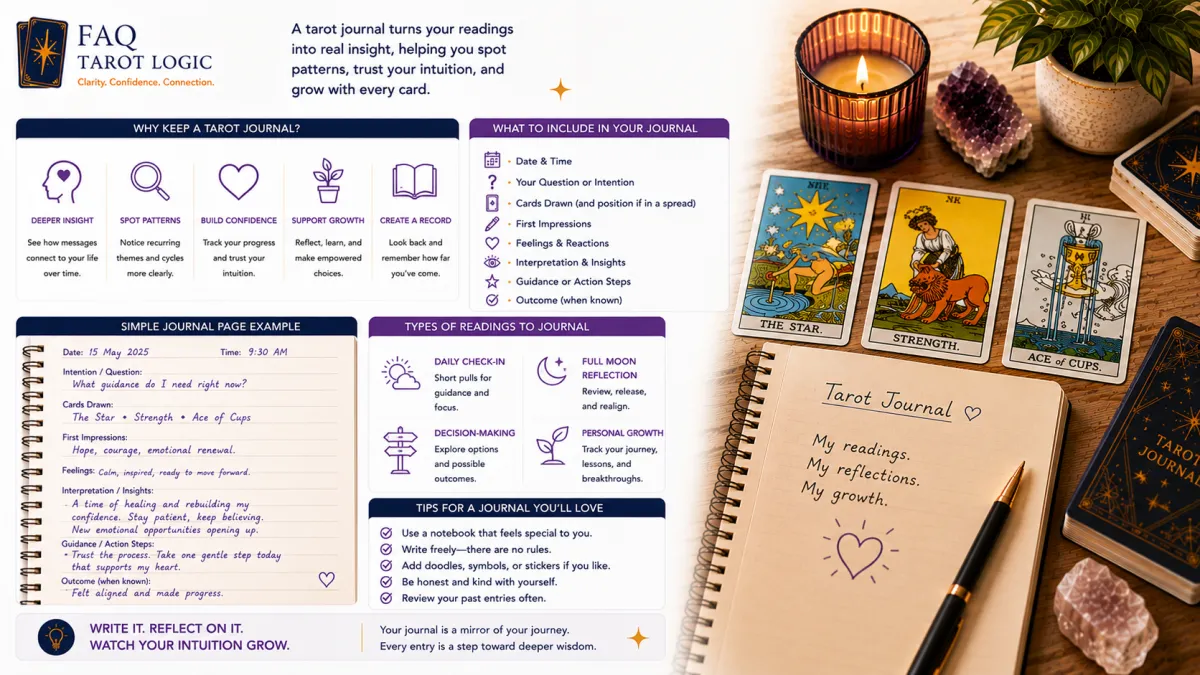
Why Keep A Tarot Journal?
Reading tarot is a skill that develops through experience.
A journal allows you to capture that experience instead of relying on memory alone.
Over time, you'll begin to notice:
Recurring themes.
Cards that appear frequently.
Changes in your interpretations.
Situations where your understanding has grown.
Personal insights that may otherwise have been forgotten.
Many experienced readers consider their journal just as valuable as their tarot deck.
What Should You Record?
There is no single "correct" way to keep a tarot journal.
Some people enjoy writing detailed reflections, while others prefer a simple checklist.
A useful journal entry might include:
The date.
The question you asked.
The cards you drew.
Your initial interpretation.
Your thoughts after the reading.
Any actions you decided to take.
The important thing is consistency rather than perfection.
Looking For Patterns
One of the biggest benefits of journaling is recognising patterns.
After several weeks or months, you may notice:
The same cards appearing during similar situations.
Certain themes returning regularly.
Changes in the way you interpret particular cards.
Areas where your confidence has grown.
These observations are often difficult to spot without written records.
Strengthening Your Intuition
Many beginners wonder whether their interpretations are improving.
A journal provides the answer.
By reviewing older entries, you'll often notice that your understanding has become:
More balanced.
More detailed.
More confident.
Less dependent on guidebooks.
This gradual development is one of the clearest signs that your intuition is growing through practice.
Paper Or Digital?
Both approaches work equally well.
Some readers enjoy writing by hand because it encourages slower reflection.
Others prefer digital journals that make searching previous readings easier.
Choose whichever method feels most comfortable.
The best journal is the one you'll actually use.
Review Your Older Readings
Keeping a journal isn't only about recording new readings.
It's also about revisiting older ones.
Looking back after a few weeks or months often reveals insights that weren't obvious at the time.
You may discover:
How situations developed.
Whether your interpretation proved helpful.
New meanings you didn't recognise originally.
Evidence of your own progress.
Reflection is where much of the learning happens.
Don't Worry About Getting Everything Right
Some beginners hesitate to keep a journal because they're worried their interpretations might be "wrong."
That's perfectly normal.
Your journal isn't a test.
It's a record of your learning journey.
Every entry, whether accurate or not, contributes to your development as a reader.
Coffee Cup Tip ☕
Don't just record what the cards said. Record what you noticed. Your personal observations are often where your intuition develops the most.
QUICK RECAP
Keeping a tarot journal helps you:
Track your progress.
Recognise recurring patterns.
Reflect on previous readings.
Strengthen your intuition.
Build confidence over time.
Develop your own understanding of the cards.
A simple journal kept consistently will teach you far more than trying to rely on memory alone.
NEXT STEP
Once you've established a regular tarot routine and started recording your readings, the next step is learning how to measure your progress and recognise how your skills are developing over time.
