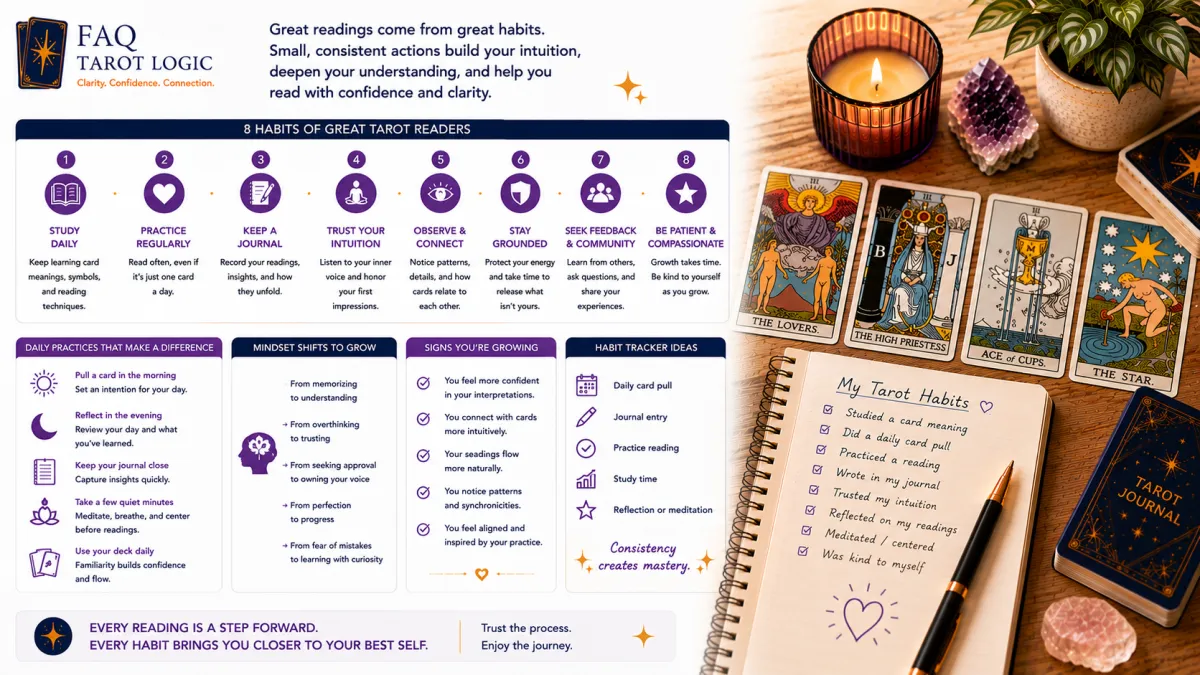
What Habits Help You Become a Better Tarot Reader?
TL;DR
The habits that help you become a better tarot reader are surprisingly simple: practise regularly, reflect on your readings, stay curious about the cards and give yourself time to learn. Improvement comes from consistent experience rather than trying to memorise everything or perform perfect readings.
IN SHORT
Becoming a better tarot reader isn't about discovering a secret technique.
It's mostly about what you do repeatedly.
Small habits help you become more familiar with the cards, strengthen your interpretations and build confidence in your own judgement.
You don't need to practise for hours.
A few thoughtful habits followed consistently can make a noticeable difference over time.
Practise Regularly
The simplest habit is also one of the most effective.
Use your cards regularly.
That doesn't mean you need to perform a full reading every day.
Practice might involve:
Drawing a single card.
Looking closely at a card's imagery.
Trying a simple three-card spread.
Revisiting an old reading.
Comparing two cards.
Writing a short journal entry.
Regular contact with your deck helps the cards become familiar.
Eventually, interpretations that once required considerable thought begin to feel much more natural.
Pause Before Reaching For The Guidebook
Guidebooks are valuable, especially when you're learning.
But try not to make them your first response whenever you're unsure about a card.
Before looking something up, spend a moment observing the card yourself.
Ask:
What catches my attention?
What emotion does the card create?
What appears to be happening?
How might the imagery relate to the question?
How does this card connect with the others?
Then check the guidebook.
This allows you to compare your interpretation with the traditional meaning rather than simply copying someone else's interpretation.
Reflect After Your Readings
The reading doesn't necessarily finish when you put the cards away.
Take a few minutes afterwards to consider what you've learned.
You might ask:
What was the strongest message?
Which card was hardest to interpret?
Did anything surprise me?
Was there a connection I nearly missed?
Is there anything I want to explore further?
Reflection turns each reading into a learning experience.
Even readings that initially seem confusing can teach you something.
Keep Notes
You don't need to record every detail of every reading.
A few useful notes are enough.
Recording your interpretations gives you something to revisit later and helps you recognise how your understanding changes.
Over time, you may discover that:
Certain cards become easier to interpret.
Your explanations become clearer.
You notice more symbolism.
You recognise patterns more quickly.
You depend less on reference material.
These small changes can be difficult to notice unless you have something to look back on.
Study The Cards In Context
Learning card meanings is useful, but tarot cards rarely appear alone.
Get into the habit of asking how each card relates to the reading around it.
For example, consider:
What question was asked?
What position does the card occupy?
Which cards surround it?
Are there repeating suits or numbers?
Are the cards supporting or challenging one another?
Context can change the emphasis of a card considerably.
The better you become at recognising context, the less you'll feel that every card needs one fixed definition.
Stay Curious About Difficult Cards
Everyone has cards they find harder to interpret.
Don't avoid them.
Use them as opportunities to learn.
If a particular Court Card continually confuses you, spend some time exploring it.
If a Major Arcana card feels difficult to understand, look at its symbolism and consider how it might appear in different situations.
Curiosity is more useful than frustration.
The cards you struggle with today may eventually become some of the cards you understand best.
Ask Clearer Questions
Good reading habits aren't only about interpreting cards.
They're also about asking useful questions.
A vague question can produce a reading that feels equally vague.
Instead of asking:
"What's going to happen?"
you might ask:
"What should I understand about this situation?"
or:
"What factors should I consider before making this decision?"
Clearer questions provide context, which makes interpretation easier.
Don't Keep Redrawing Cards
When a card doesn't make immediate sense, it's tempting to put it aside and draw another one.
Then another.
Before long, a simple reading becomes a table full of cards.
Instead, stay with the original card.
Look at the imagery.
Consider the question again.
Examine the surrounding cards.
Sometimes understanding takes a little time.
Learning to sit with uncertainty is an important reading habit in itself.
Review Your Progress Occasionally
Every few weeks, look back at some of your earlier readings.
You'll probably notice things you would interpret differently now.
That's valuable.
It shows that your understanding is developing.
You might also discover interpretations that were more insightful than you realised at the time.
Reviewing your progress helps you recognise both your strengths and the areas you'd like to develop further.
Give Yourself Permission To Be A Learner
Perhaps the most important habit is remaining curious.
There will always be another card combination to explore, another symbol to notice or another interpretation to consider.
You don't reach a point where every reading becomes effortless.
Instead, experience gives you more ways to approach uncertainty.
Good tarot readers aren't people who know everything.
They're people who remain willing to learn.
Coffee Cup Tip ☕
Choose one small tarot habit you can maintain easily rather than five habits you'll abandon within a week. Ten thoughtful minutes several times a week can teach you far more than an occasional marathon study session.
QUICK RECAP
Helpful tarot habits include:
Practising regularly.
Observing cards before checking a guidebook.
Reflecting after readings.
Keeping useful notes.
Reading cards within context.
Studying cards you find difficult.
Asking clearer questions.
Avoiding unnecessary redraws.
Reviewing your progress.
Remaining curious.
You don't become a better tarot reader through one breakthrough moment.
You improve through many small moments of practice, reflection and learning.
NEXT STEP
Good habits create steady improvement, but that improvement can sometimes be difficult to recognise while it's happening.
The final article in this series looks at the signs that show your tarot skills really are developing.
→ How Do You Know You're Improving as a Tarot Reader?
