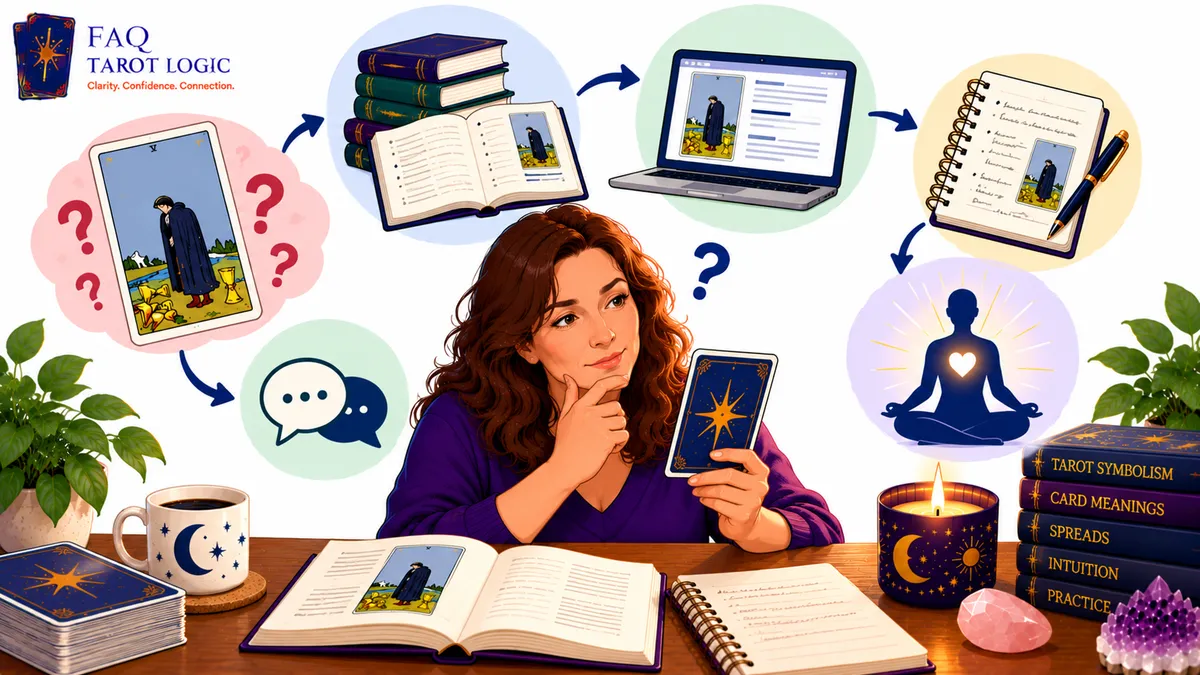
What Should You Do When You Draw a Card You Don't Understand?
TL;DR
When you draw a tarot card you don't understand, don't immediately assume you've made a mistake or need to start the reading again. Begin with what you already know about the card, examine its imagery, consider its position in the spread and look at how it relates to the surrounding cards.
If you're still uncertain, a guidebook can help you explore additional meanings. The important thing is to remain curious rather than forcing an interpretation. Not understanding a card immediately is a normal part of learning tarot.
IN SHORT
You're halfway through a tarot reading.
The first few cards make sense.
You understand how they relate to the question.
Then you turn over another card.
And your mind goes blank.
Perhaps you've forgotten its meaning.
Maybe you recognise the card but can't understand why it appeared.
Or perhaps it's a card you've always found difficult.
What should you do?
Start with what you know, explore what you can see and give yourself permission not to understand everything immediately.
A difficult card doesn't mean you've failed at the reading.
It simply gives you something to investigate.
First, Don't Panic
One of the biggest obstacles when learning tarot is the belief that you should instantly recognise and understand every card.
But even experienced readers encounter cards that make them pause.
Sometimes the traditional meaning doesn't seem relevant.
Sometimes the imagery is unfamiliar.
And occasionally you simply forget something you've learned before.
None of these situations means you're a poor reader.
The important thing is how you respond.
Instead of thinking:
"I should know this by now,"
try:
"What can I work out from what I already know?"
That small change encourages curiosity rather than frustration.
Work Out What You Don't Understand
Before searching for an answer, identify what's actually causing the difficulty.
There are several possibilities.
You might not remember the card's traditional meaning.
You might understand its meaning but struggle to connect it with the question.
Perhaps the card seems to contradict the others.
Or maybe you're unsure which part of its imagery deserves attention.
These are different problems.
And they require slightly different approaches.
Knowing what you're struggling with is often the first step towards understanding the card.
Start With The Card's Basic Meaning
If you recognise the card, begin with its central theme.
You don't need a complete explanation.
One or two familiar ideas are enough.
For example, you might associate:
The Hermit with reflection and solitude.
The Chariot with direction and determination.
The Four of Swords with rest and recovery.
The Two of Pentacles with balance and competing priorities.
These are starting points, not complete interpretations.
Once you've identified the general theme, ask how it might relate to the question.
→ How Do You Learn Tarot Card Meanings?
Look At The Card Before Looking It Up
If you can't remember the meaning, examine the artwork.
What is happening in the picture?
Is someone standing still or moving?
Does the scene appear peaceful or tense?
Are the figures interacting?
What objects are visible?
You may be able to identify a useful theme simply by describing what you see.
For example, a figure carrying several heavy objects might suggest responsibility, pressure or effort.
You don't need to know every traditional association to begin exploring the imagery.
Describe The Card In Your Own Words
A useful exercise is to imagine explaining the picture to someone who has never seen it.
Avoid tarot terminology for a moment.
Simply describe the scene.
For example:
"There's a person standing between two possible directions, and they appear to be considering what to do."
Now ask:
"How could that situation relate to my question?"
This approach can help you move from observing the artwork towards developing an interpretation.
It also reduces the pressure to remember a particular guidebook definition.
Look For One Important Detail
Tarot cards often contain several symbols, colours, figures and objects.
Trying to interpret all of them can make an unfamiliar card feel even more confusing.
Instead, identify one detail that stands out.
Perhaps it's a person's expression.
Maybe it's an object they're holding.
Or perhaps it's the contrast between two parts of the image.
Ask whether that detail helps explain the card's relevance.
You don't need every symbol to contribute to the interpretation.
One useful observation can be more valuable than ten disconnected details.
Remember The Question
A card's meaning becomes more useful when you connect it with the question being explored.
Imagine drawing a card associated with rest.
If you're asking about recovering from a stressful period, the connection may seem obvious.
But if you're asking about starting a new project, the card might initially feel confusing.
Within that context, however, rest could suggest:
Avoiding burnout.
Taking time to prepare.
Reviewing your workload.
Allowing space for planning.
Not rushing into unnecessary commitments.
The card's general meaning hasn't changed.
You're applying it to a different situation.
→ Why Does Context Matter More Than Individual Card Meanings?
Check The Card's Spread Position
If you're using a structured spread, the position can provide an important clue.
Suppose a card appears in:
"What is helping me?"
You might explore its strengths or supportive qualities.
But if it appears in:
"What am I overlooking?"
you may need to consider a less obvious aspect.
The card position tells you what role the card is supposed to play.
This can help narrow down the possible meanings.
Rather than asking:
"What does this card mean?"
ask:
"What could this card mean in this particular position?"
Look At The Surrounding Cards
Sometimes an unfamiliar card becomes easier to understand when you stop looking at it individually.
Consider the other cards in the spread.
Do they share a theme?
Are several cards suggesting change?
Perhaps there's a repeated emphasis on communication, responsibility or relationships.
The surrounding cards may provide enough context to understand the difficult one.
For example, a card associated with withdrawal might seem strange until you notice that the other cards suggest exhaustion or competing demands.
Now the idea of stepping back becomes more relevant.
→ How Do You Interpret Multiple Tarot Cards Together?
Don't Assume The Card Must Agree With The Others
A card can feel confusing because it introduces a different perspective.
Perhaps most of the spread seems encouraging.
Then a card associated with caution appears.
Your first instinct might be to question why it's there.
But the card doesn't necessarily contradict the reading.
It may be highlighting something important that the other cards haven't addressed.
Real situations often contain advantages and disadvantages.
Tarot readings can reflect that complexity.
→ What Should You Do When Tarot Cards Seem to Contradict Each Other?
Consider More Than One Meaning
Many tarot cards contain several related themes.
If the first meaning you remember doesn't fit, explore another.
For example, a card associated with change might also involve:
Transition.
Adaptation.
Uncertainty.
Letting go.
New opportunities.
You don't need to use every possibility.
You're looking for the interpretation that makes the most sense within the question and spread.
This is one reason memorising a single keyword for each card can eventually become limiting.
→ Should You Memorise Tarot Card Meanings?
Use A Guidebook When You Need One
There's nothing wrong with consulting a guidebook.
Even experienced readers use reference material.
The important thing is how you use it.
Rather than immediately searching for the correct answer, try developing your own initial interpretation first.
Then open the guidebook.
Look for ideas that expand your understanding.
Perhaps you've forgotten an important traditional association.
Maybe the author explains a symbol you hadn't noticed.
Or perhaps the description introduces another reasonable perspective.
Guidebooks are learning tools, not evidence that you aren't capable of reading independently.
Don't Keep Searching Until You Find An Answer You Like
There's a difference between researching a card and searching for reassurance.
Suppose the first guidebook offers an interpretation you find uncomfortable.
You check another.
Then another.
Eventually, you discover a meaning that feels more reassuring.
But does it genuinely fit the reading?
Or have you simply found the interpretation you wanted?
A more useful approach is to consider several possibilities without automatically choosing the most comfortable one.
→ How Do You Avoid Relying Too Much on Guidebooks?
Avoid Drawing Another Card Immediately
When a card doesn't make sense, drawing a clarifier can feel like the obvious solution.
But it isn't always necessary.
You may simply end up with two cards you don't understand instead of one.
Before drawing another card, ask:
"Have I properly explored the original card?"
Have you considered its traditional meaning?
Its imagery?
Its position?
The question?
The surrounding cards?
If not, there's probably more you can do before adding another card.
Give Clarifying Cards A Specific Purpose
Sometimes a clarifier genuinely helps.
But give it a clear question.
Instead of simply drawing another card and hoping it explains everything, ask:
"What aspect of this card should I focus on?"
or:
"What am I overlooking about this part of the reading?"
This gives the additional card a defined role.
Remember that the clarifier should help you understand the original card, not replace it.
Don't Restart The Entire Reading
One difficult card doesn't mean the whole reading has gone wrong.
If most of the spread makes sense, work with what you understand.
You can leave the uncertain card aside temporarily and return to it later.
Sometimes the overall interpretation becomes clearer once you've considered the remaining cards.
Starting again immediately may simply introduce more information and make the situation harder to understand.
Notice Whether Your Emotions Are Influencing You
Sometimes you understand the card perfectly well.
You simply don't like what you think it might mean.
Perhaps it challenges an assumption.
Maybe it raises an uncomfortable possibility.
Or it doesn't support the outcome you're hoping for.
Before rejecting the interpretation, ask:
"Am I confused by the card, or uncomfortable with the possibility it raises?"
Those are different experiences.
Recognising the difference can help you approach the reading more thoughtfully.
Give Yourself Permission To Say "I Don't Know"
You don't need an immediate explanation for every card.
Sometimes the most reasonable response is:
"I'm not sure how this fits yet."
That isn't a failure.
It's an honest assessment of your current understanding.
You can continue exploring the spread without forcing the uncertain card into an interpretation that doesn't feel convincing.
Confidence isn't about always knowing the answer.
It's about knowing how to respond when you don't.
→ How Do You Build Confidence in Tarot Readings?
Write Down The Difficult Card
If you're keeping a tarot journal, make a note of the card.
Record:
The question.
The card's position.
The surrounding cards.
Your first interpretation.
What confused you.
Any alternative meanings you considered.
Then leave it.
When you return later, you may see something you missed.
This is particularly useful for cards that repeatedly cause difficulty.
Return To The Reading Later
Some interpretations become clearer with time.
Perhaps you've gained more information about the situation.
Maybe your emotional reaction has settled.
Or perhaps you've simply had time to think.
Look at the original cards again without immediately consulting your previous interpretation.
Ask:
"What do I notice now?"
You may discover a connection that wasn't obvious before.
And even if the card remains unclear, reviewing it can still help you develop your interpretation skills.
Learn From The Cards You Find Difficult
If the same card repeatedly causes problems, make it part of your learning practice.
Spend some time exploring it outside a reading.
Look at:
Its traditional meanings.
Its imagery.
Its symbolism.
How different decks portray it.
Previous readings where it appeared.
Different questions it could relate to.
The aim isn't to memorise every possible interpretation.
It's to become more familiar with the card so that it feels less intimidating next time.
Don't Confuse Difficulty With Lack Of Progress
As your tarot skills develop, you may actually become more aware of how many interpretations are possible.
A beginner might confidently assign one keyword to a card.
An experienced reader may pause because they recognise several reasonable possibilities.
That hesitation isn't necessarily a weakness.
Sometimes it shows that you're considering the context more carefully.
Learning tarot involves becoming comfortable with complexity without allowing it to overwhelm you.
Use Difficult Cards To Improve Your Reading Process
When a card doesn't make sense, you have an opportunity to practise several important skills.
You can:
Examine the imagery.
Review traditional meanings.
Consider the spread position.
Explore card combinations.
Question your assumptions.
Use context.
Practise patience.
Explain your reasoning.
These are the same skills that make familiar cards easier to interpret.
A difficult card can therefore become a useful part of your development rather than something to avoid.
Coffee Cup Tip ☕
Try the Five-Question Card Check whenever you draw a card you don't understand.
1. What do I already know about this card?
2. What stands out in the imagery?
3. What does its position ask me to consider?
4. How does it connect with the surrounding cards?
5. What is one reasonable interpretation I can explore?
Work through those questions before opening a guidebook or drawing another card.
You may find that you already have more information than you realised.
QUICK RECAP
When you draw a tarot card you don't understand:
Don't panic or assume you've made a mistake.
Identify what you're struggling with.
Start with the card's basic meaning.
Examine the imagery.
Describe what you see in your own words.
Focus on one useful detail.
Return to the original question.
Check the spread position.
Look at the surrounding cards.
Accept that cards don't always agree.
Explore alternative meanings.
Use guidebooks thoughtfully.
Avoid searching only for reassuring interpretations.
Don't automatically draw clarifying cards.
Give clarifiers a clear purpose.
Avoid restarting the reading.
Recognise emotional reactions.
Allow yourself to remain uncertain.
Record difficult cards.
Return to the reading later.
Study cards that repeatedly confuse you.
Use difficult interpretations as learning opportunities.
You don't need to understand every tarot card immediately to become a capable reader.
What matters is developing a thoughtful way to explore the cards you don't understand, rather than assuming that uncertainty means you've done something wrong.
NEXT STEP
Understanding unfamiliar cards is one part of developing your tarot skills.
Another challenge is recognising when you're thinking too much about a reading.
Sometimes you begin with a reasonable interpretation, then question it, search for alternatives and eventually become less certain than when you started.
Learning to recognise when careful reflection has turned into overthinking can help you develop greater trust in your interpretation process.
Next topic: How Can You Tell When You're Overthinking a Tarot Reading?
