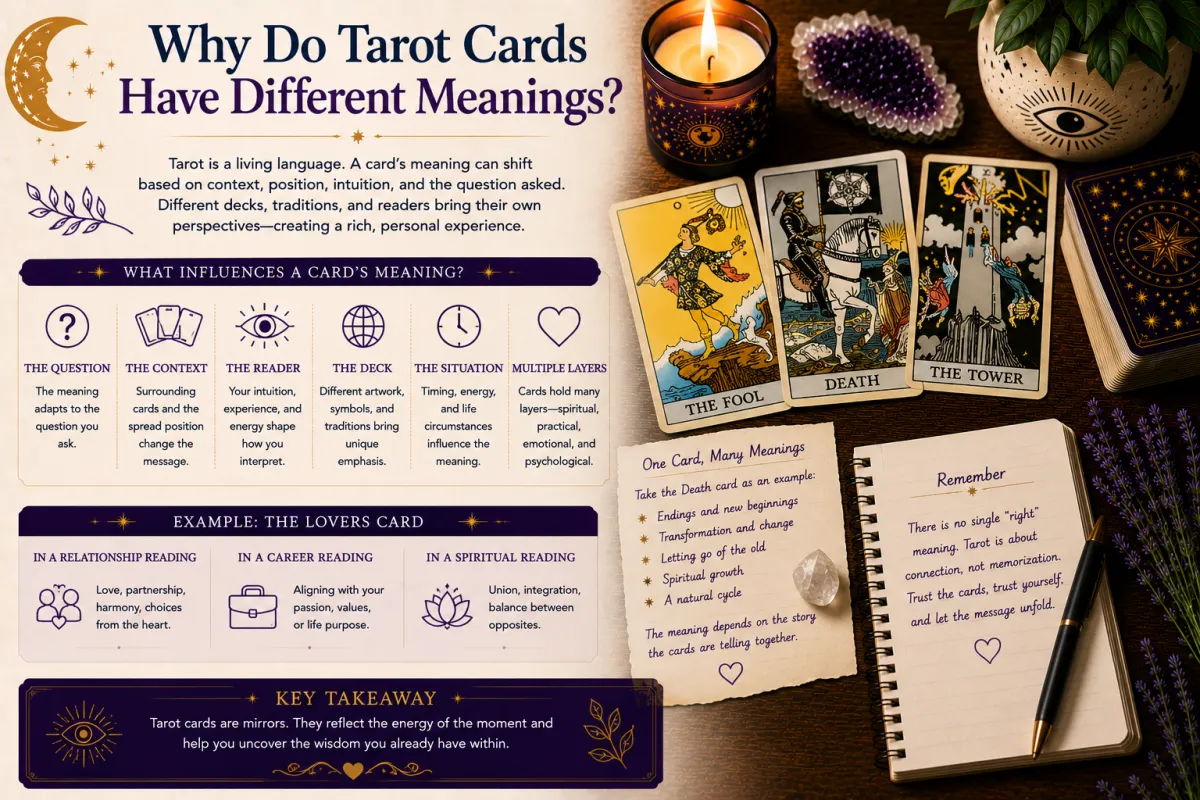
Why Do Tarot Cards Have Different Meanings?
TL;DR
Tarot cards can have different meanings because interpretation depends on context, the question being asked, the surrounding cards, and the reader's perspective. A single card can communicate several related ideas at the same time.
IN SHORT
One thing that surprises many beginners is discovering that Tarot cards do not have one fixed meaning.
A card may mean one thing in one reading and something slightly different in another.
This can feel confusing at first.
In reality, it is one of Tarot's greatest strengths.
The cards are flexible enough to apply to many different situations and experiences.
REAL TALK
Many beginners want certainty.
They hope every card has a simple definition they can memorise.
Unfortunately, life is rarely that straightforward.
People experience situations differently.
Relationships differ.
Questions differ.
Tarot reflects this complexity by allowing cards to carry multiple layers of meaning.
Context Changes Everything
Imagine pulling The Hermit.
Depending on the reading, it could suggest:
• Reflection
• Wisdom
• Solitude
• Self-discovery
• Withdrawal
Which interpretation fits best depends on the situation being explored.
This is why context matters so much.
The Question Influences The Meaning
Consider these questions:
• What should I focus on right now?
• What is affecting this relationship?
• What lesson am I learning?
The same card may offer a different perspective depending on the question.
Tarot responds to the context of the reading rather than existing as a fixed dictionary.
Surrounding Cards Matter
Cards influence one another.
For example:
A card suggesting caution may feel very different when surrounded by positive cards than when surrounded by challenging cards.
Experienced readers often look at the spread as a whole rather than interpreting cards individually.
The bigger picture provides important clues.
Symbolism Creates Multiple Layers
Tarot cards contain symbols designed to communicate broad themes.
A single symbol might relate to:
• Growth
• Change
• Challenge
• Opportunity
depending on the reading.
This flexibility allows Tarot to remain relevant across many situations.
Personal Experience Plays A Role
Readers bring their own experiences and perspectives to the cards.
As a result, two people may notice different aspects of the same card.
Neither interpretation is necessarily wrong.
Both may reveal useful insight.
WHY THIS WORKS
Human experiences are complex.
Tarot remains useful because it allows different meanings to emerge depending on the situation being explored.
COMMON MISTAKE
Mistake:
Searching for one permanent meaning for every Tarot card.
Fix:
Focus on context, patterns, and how the card relates to the overall reading.
COFFEE CUP TIP ☕
When a card seems to have multiple meanings, ask:
"Which interpretation feels most relevant to this situation?"
The answer is often clearer than you expect.
FAQ QUICK FIX
Tarot cards have different meanings because:
Context matters
Questions vary
Cards influence each other
Symbols contain multiple layers
Personal experience affects interpretation
QUICK RECAP
Tarot cards are flexible by design.
Their meanings change according to context, symbolism, surrounding cards, and the question being explored.
RELATED QUESTIONS
→ How Do You Read Tarot Symbolism?
→ What Are Court Cards in Tarot?
→ Should You Memorise Tarot Card Meanings?
NEXT STEP
Now that you understand why meanings can vary, it's time to explore one of the most misunderstood groups of cards in the deck: the Court Cards.
