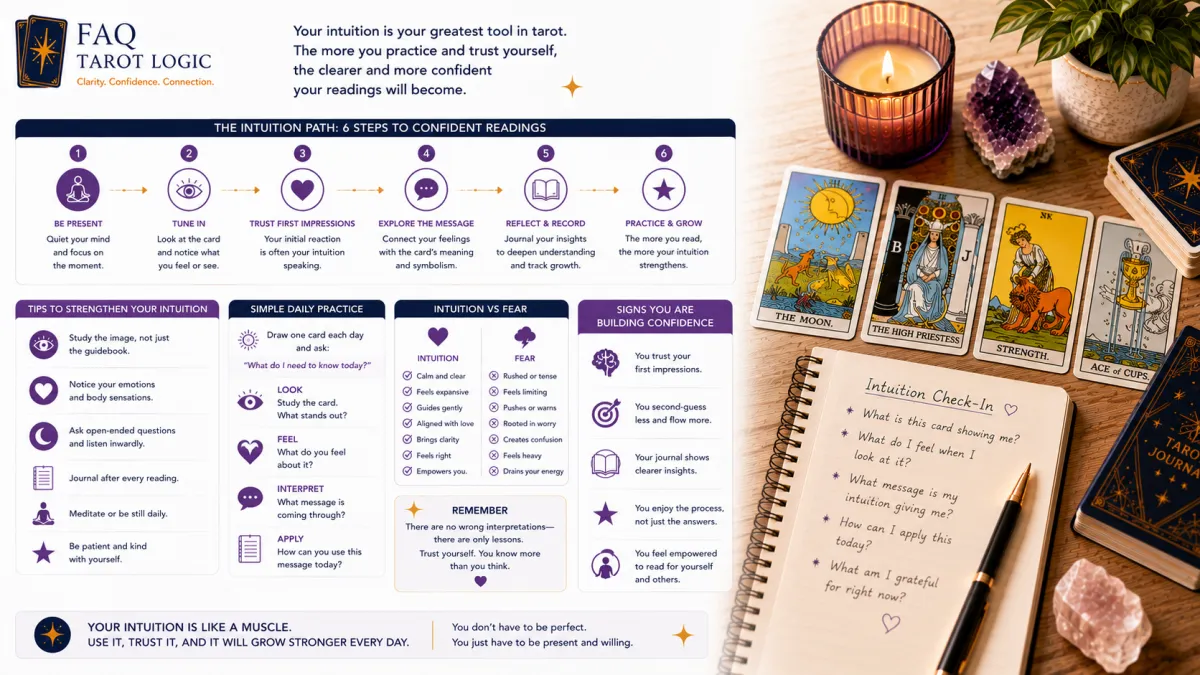
Developing Tarot Intuition: Reading with Confidence and Trust
TL;DR
Tarot intuition isn't a mysterious gift reserved for a select few. It develops through observation, practice and experience. By learning to trust your interpretations, recognising the difference between intuition and fear, and reflecting on your readings, you can build lasting confidence in your tarot practice.
IN THIS GUIDE
In this guide you'll learn:
What intuition means in tarot
Why intuition develops through practice
The difference between intuition and fear
How to trust your interpretations
Why experienced readers still continue learning
Practical ways to strengthen your intuition
How confidence grows over time
Whether you're just beginning your tarot journey or looking to trust yourself more, this guide will help you develop a balanced and confident approach to intuitive reading.
Introduction
One of the questions almost every tarot reader asks is:
"How do I know if I'm interpreting the cards correctly?"
It's a natural concern.
Many beginners assume experienced readers never doubt themselves.
The truth is quite different.
Confidence doesn't appear overnight, and intuition isn't something you're either born with or without.
Instead, intuition develops gradually as you become familiar with the cards, recognise recurring patterns and learn to trust your observations.
The more you practise, the more naturally your understanding grows.
This guide explores how intuition develops and how you can strengthen it without relying on guesswork or abandoning the traditional foundations of tarot.
What Is Tarot Intuition?
When people hear the word "intuition," they often imagine something mysterious or supernatural.
In reality, intuition is usually much more practical.
It's the ability to recognise patterns, notice details and make connections that aren't always immediately obvious.
Within tarot, intuition allows you to combine your understanding of the cards with your own observations and experience.
Rather than replacing traditional meanings, intuition works alongside them.
The strongest readings often combine knowledge, symbolism and instinct.
Why Intuition Develops Naturally
Many beginners worry because they don't immediately "feel" intuitive.
That's perfectly normal.
Confidence develops in stages.
At first you rely heavily on guidebooks.
Then you begin recognising familiar themes.
Eventually you notice yourself interpreting cards before checking their traditional meanings.
This isn't luck.
It's experience.
Every reading teaches your mind to recognise new patterns.
The more consistently you practise, the more naturally intuition develops.
Trusting Your First Impression
When turning over a card, most people notice something immediately.
Perhaps it's:
A facial expression.
A colour.
A symbol.
A particular object.
An emotional reaction.
Many beginners ignore these first impressions because they worry they're "making it up."
Instead, try exploring those observations before reaching for a guidebook.
Ask yourself:
What caught my attention?
Why did I notice that first?
How might it relate to the question?
Often your first observation becomes an important part of the interpretation.
If self-doubt is something you experience, read:
→ How Do You Stop Doubting Yourself During a Reading?
Intuition vs Fear
One of the most valuable skills any tarot reader develops is recognising the difference between intuition and anxiety.
Intuition often feels:
Calm.
Clear.
Gentle.
Observant.
Fear often feels:
Urgent.
Dramatic.
Repetitive.
Focused on worst-case scenarios.
Learning to recognise this difference prevents unnecessary worry and encourages balanced readings.
Rather than reacting emotionally, take a moment to consider whether your interpretation comes from thoughtful observation or anxious expectation.
To explore this topic further, read:
→ What Is the Difference Between Intuition and Fear?
Learning From Every Reading
Every reading offers an opportunity to learn.
Keeping a tarot journal is one of the simplest ways to strengthen your intuition.
Record:
The question.
The cards.
Your initial interpretation.
What happened afterwards.
Over time you'll notice recurring themes.
Some cards may consistently communicate certain ideas for you.
Others may reveal subtle meanings that only become obvious after repeated experience.
Reflection is one of the fastest ways to build confidence.
Why Experienced Readers Still Learn
One of the most encouraging discoveries for beginners is that experienced tarot readers never truly stop learning.
Every reading brings a new situation, a different question or another perspective to consider. As your own life experiences change, you'll often discover fresh insights within cards you've seen many times before.
That's one of tarot's greatest strengths.
Rather than reaching a point where you know everything, tarot encourages continual learning, reflection and personal growth. Even readers with years of experience continue to deepen their understanding of the cards, their symbolism and the stories they tell.
The goal isn't to memorise every possible meaning. It's to remain curious, open-minded and willing to learn from every reading.
Building Confidence One Reading at a Time
Confidence isn't built by performing perfect readings.
It's built by continuing to read despite occasional uncertainty.
Every reading improves your understanding.
Every journal entry strengthens your observations.
Every reflection helps you recognise new connections.
Instead of asking:
"Am I getting this exactly right?"
Try asking:
"What is this reading encouraging me to notice?"
That simple shift often transforms both your confidence and your interpretations.
For more practical guidance, read:
→ How Do You Build Confidence in Tarot Readings?
Developing Your Own Reading Style
As your experience grows, you'll naturally develop your own reading style.
Some readers enjoy detailed analysis.
Others focus more on symbolism.
Some combine traditional meanings with intuitive impressions.
There is no single "correct" approach.
The goal is to build a style that feels thoughtful, balanced and authentic while remaining grounded in the structure and symbolism of the cards.
Your confidence comes not from copying another reader, but from understanding how you interpret the cards best.
Coffee Cup Tip ☕
Don't judge your intuition by one reading. Confidence grows through consistency, not perfection. The more you practise, the more naturally your intuition will develop.
QUICK RECAP
Developing tarot intuition becomes easier when you:
Understand that intuition develops through practice.
Trust your first observations.
Learn the difference between intuition and fear.
Reflect on your readings.
Keep a tarot journal.
Accept that learning never ends.
Allow your confidence to grow naturally over time.
Intuition isn't about having all the answers. It's about learning to recognise and trust the insights that develop through experience.
NEXT STEP
You've now explored the five core pillars of FAQ Tarot Logic—from understanding the foundations of tarot to developing confidence in your own intuition. Continue exploring the site to deepen your knowledge, revisit topics that interest you and build your tarot skills one reading at a time.
