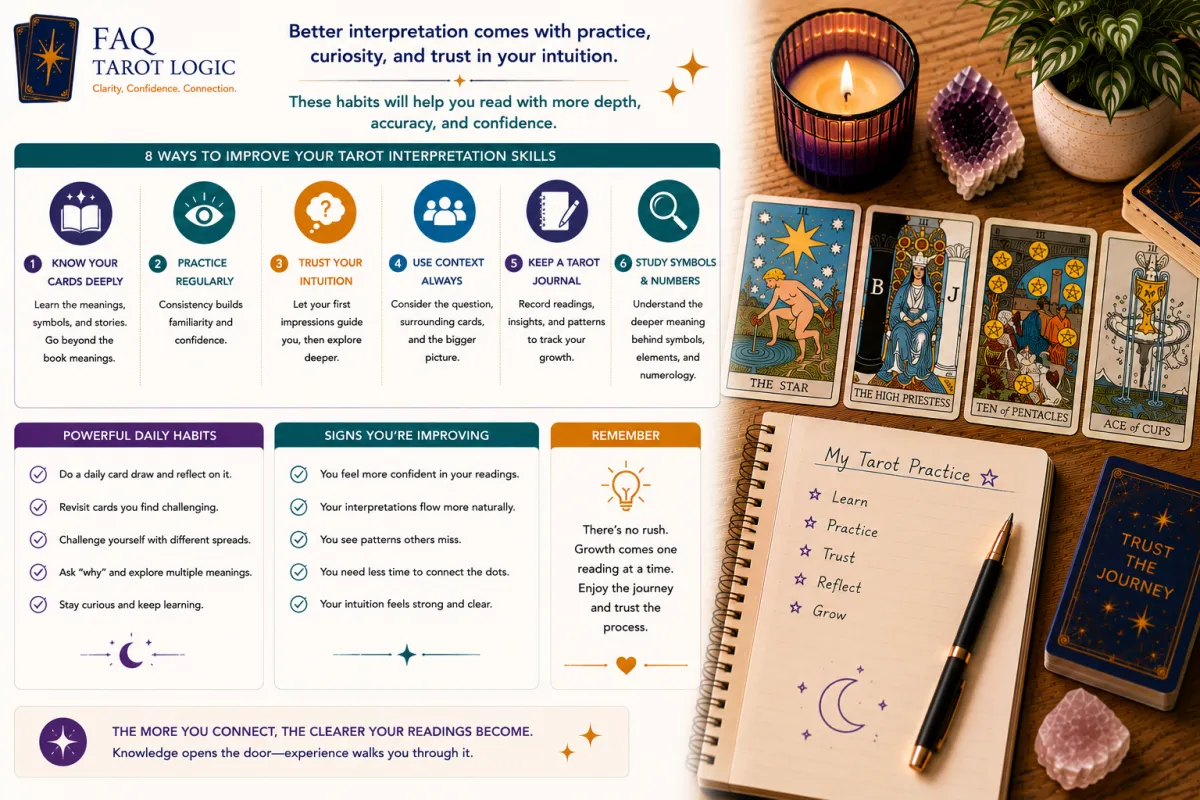
How Can You Improve Your Tarot Interpretation Skills?
TL;DR
You can improve your tarot interpretation skills by moving beyond memorised card meanings and paying more attention to the question, imagery, card position and relationships between cards. Regular practice, reflection and reviewing previous readings gradually help you develop more flexible, confident interpretations without abandoning the traditional meanings you've already learned.
IN SHORT
Learning what individual tarot cards mean is only the beginning.
The next step is learning how those meanings change depending on the reading.
The same card can communicate something slightly different depending on:
The question being asked.
Its position in the spread.
The surrounding cards.
The imagery that catches your attention.
The situation you're exploring.
Improving your interpretation skills means learning to bring all these pieces together.
Start With What You Already Know
You don't need to abandon traditional card meanings to become a better interpreter.
They're your foundation.
Suppose you draw The Hermit.
You may already associate it with:
Reflection.
Solitude.
Inner guidance.
Stepping back.
Searching for understanding.
Those meanings give you somewhere to begin.
The interpretation develops when you ask:
Which of those meanings makes the most sense in this particular reading?
That's where interpretation begins to move beyond memorisation.
If you're still finding yourself trying to remember every definition, this will help:
→ Should You Memorise Tarot Card Meanings?
Return To The Question
A card doesn't appear in isolation.
It appears in response to a question.
Imagine drawing the same card while asking:
"What should I understand about my career?"
and:
"What should I understand about this relationship?"
The traditional meaning hasn't changed, but its application probably will.
Whenever you're struggling to interpret a card, return to the original question.
Ask yourself:
What are we actually exploring?
Which aspect of this card relates to that question?
What perspective might the card be encouraging me to consider?
The question gives the card context.
Look At The Card Before Reaching For A Guidebook
One of the simplest ways to strengthen your interpretation skills is to spend a little longer looking at the card.
Before checking its meaning, notice what catches your attention.
Perhaps it's:
A person's expression.
A particular colour.
An object.
The landscape.
The direction someone is facing.
Something happening in the background.
You don't need to turn every detail into a complicated symbolic message.
Simply notice what stands out and ask how it might relate to the reading.
This encourages observation rather than automatic recall.
For a deeper look at working with the imagery in your cards:
→ How Do You Read Tarot Symbolism?
Consider The Card's Position
If you're using a spread, the position of the card helps define its role.
A card appearing as a challenge may be interpreted differently from the same card appearing as guidance.
For example, a card associated with patience might suggest:
Challenge: You're becoming frustrated because progress feels slow.
Guidance: Give the situation more time before acting.
Same card.
Same underlying meaning.
Different interpretation because the position has changed.
Read The Cards As A Group
Strong tarot interpretation isn't only about understanding individual cards.
It's also about recognising how they interact.
Look across the spread.
Ask:
Are several cards expressing similar ideas?
Do any cards appear to challenge one another?
Is one suit particularly strong?
Are several Major Arcana cards present?
Does the reading seem to move from one theme towards another?
Instead of interpreting card one, then card two, then card three separately, begin asking:
What story are these cards telling together?
This is one of the biggest steps towards deeper reading.
You can explore this skill in more detail here:
→ How Do You Interpret Multiple Tarot Cards Together?
Look For Repeated Themes
Several different cards can communicate similar ideas.
Perhaps none of the cards repeats, but three of them seem to emphasise patience.
Or several cards point towards communication.
Maybe the overall reading repeatedly returns to uncertainty, boundaries or change.
These themes often provide the central message.
Rather than becoming distracted by every possible card meaning, look for the ideas that keep appearing.
Explore More Than One Interpretation
When learning tarot, it's easy to believe every card has one correct meaning.
It doesn't.
Try considering two or three possible interpretations before deciding which fits best.
For example:
"This could suggest I need more patience."
"It could also suggest I'm hesitating unnecessarily."
Then return to the question and surrounding cards.
Which interpretation fits the wider reading?
Exploring possibilities helps you develop flexibility without simply guessing.
Explain Why You've Reached Your Interpretation
A useful exercise is to explain your interpretation as though you were describing it to someone else.
Instead of saying:
"This card means change."
try:
"I'm interpreting this as change because of the card's traditional meaning, its position in the spread and the movement also appearing in the surrounding cards."
Being able to explain why you've reached an interpretation encourages more thoughtful reading.
It also helps distinguish intuition from simply choosing a meaning you happen to prefer.
Practise With Small Spreads
You don't need large spreads to develop interpretation skills.
In fact, smaller spreads are often better for practice.
Try three cards.
Then explore:
How card one influences card two.
How card two connects with card three.
Whether the final card changes your understanding of the first.
What theme connects all three.
Three cards provide plenty of material without becoming overwhelming.
Review Readings Afterwards
Some interpretations become clearer with hindsight.
Return to an old reading and ask:
Would I interpret these cards differently now?
Did I overlook an important connection?
Was one card more significant than I realised?
Has my understanding of the situation changed?
Reviewing old readings helps you learn from real experience rather than studying meanings in isolation.
It's also a useful way to see how much your interpretation skills have developed.
Don't Chase Complicated Meanings
Deeper interpretation doesn't mean making readings more complicated.
Sometimes the simplest explanation is the most useful.
If three cards clearly point towards slowing down and reconsidering a decision, you don't need to uncover a hidden layer simply to make the reading feel more sophisticated.
Depth comes from understanding the cards in context.
It doesn't come from making every reading mysterious.
Give Yourself Time
Interpretation skills develop gradually.
At first, you may consciously work through:
Meaning → Question → Position → Surrounding Cards → Interpretation
Eventually, much of this becomes automatic.
You'll look at a spread and begin noticing connections without deliberately searching for them.
That's what practice creates.
Not perfect readings.
Familiarity.
If you find yourself questioning your interpretations as you learn, read:
→ How Do You Build Confidence in Tarot Readings?
Coffee Cup Tip ☕
After drawing a card, try completing this sentence before opening your guidebook:
"In this reading, I think this card is highlighting..."
It encourages you to interpret the card within the situation rather than simply recalling its definition.
QUICK RECAP
You can improve your tarot interpretation skills by:
Starting with traditional card meanings.
Returning to the original question.
Observing the imagery before checking a guidebook.
Considering the card's position.
Reading cards as a group.
Looking for recurring themes.
Exploring more than one possible meaning.
Explaining why you've reached an interpretation.
Practising with smaller spreads.
Reviewing previous readings.
Keeping interpretations clear rather than unnecessarily complicated.
Knowing what a tarot card means gives you the foundation.
Knowing what it means in this particular reading is interpretation.
NEXT STEP
As your interpretation skills improve, you'll begin to notice that the meaning of a card depends increasingly on what surrounds it.
Next, we'll explore why context can often tell you more than an individual card meaning on its own.
→ Why Does Context Matter More Than Individual Card Meanings?
