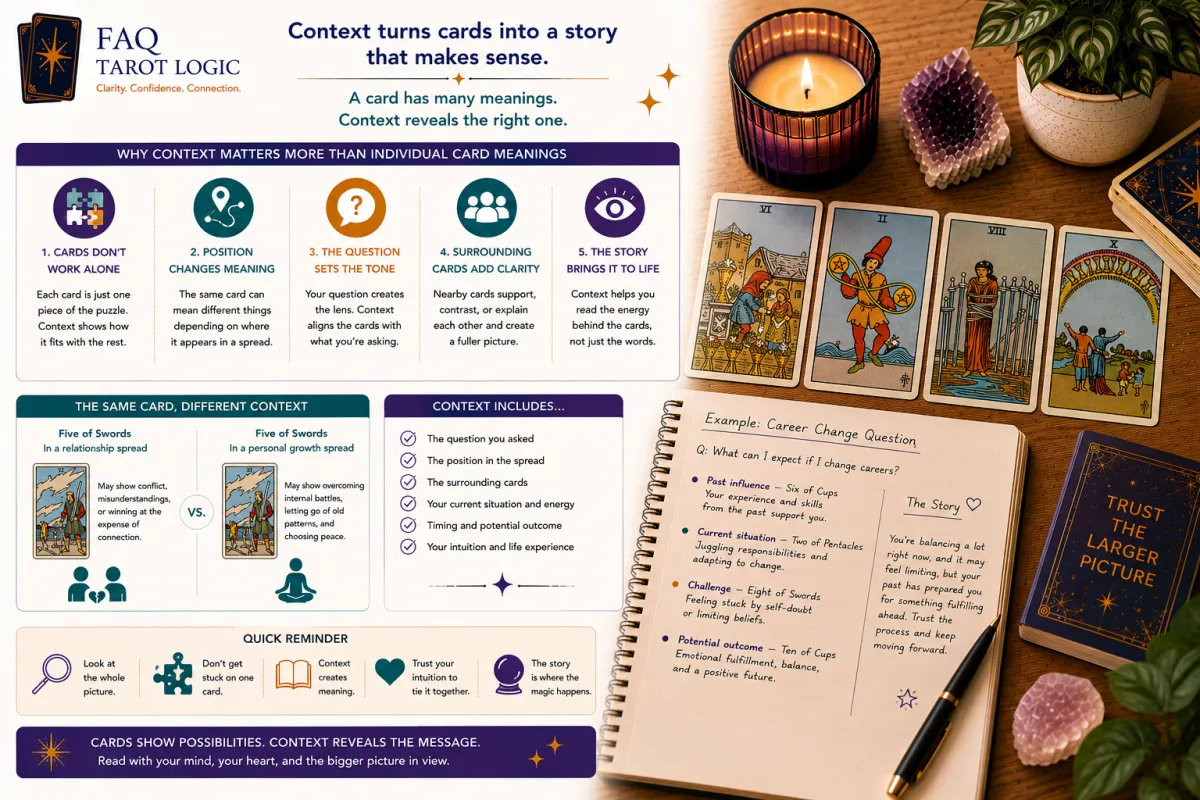
Why Does Context Matter More Than Individual Card Meanings?
TL;DR
Context matters because a tarot card doesn't have one fixed meaning that applies to every reading. The question, spread position, surrounding cards and situation all influence how a card should be interpreted. Traditional meanings provide the foundation, but learning to use context is what turns individual definitions into a meaningful reading.
IN SHORT
Learning tarot often begins with individual card meanings.
The Fool represents beginnings.
The Hermit suggests reflection.
The Tower represents disruption or sudden change.
These meanings are useful, but they're only starting points.
Once you begin performing readings, the more important question becomes:
What does this card mean here?
Understanding context helps you answer that question.
Why Card Meanings Aren't Fixed
A tarot card can contain several related ideas.
Take The Hermit.
Depending on the reading, it might suggest:
Spending time alone.
Looking inward.
Seeking guidance.
Stepping away from distractions.
Taking time before making a decision.
None of these interpretations is necessarily wrong.
The surrounding context helps you decide which aspect of the card is most relevant.
This is also why trying to memorise one rigid definition for every card can eventually limit your readings.
If you're still working through this stage of learning:
→ Should You Memorise Tarot Card Meanings?
Start With The Question
The question provides the first layer of context.
Imagine The Hermit appearing in response to:
"What should I understand about my relationship?"
It might encourage space for reflection or suggest that someone needs time to think.
Now imagine the same card appearing in response to:
"What would help me make this career decision?"
The emphasis could shift towards stepping back, considering your priorities and avoiding a rushed decision.
The card hasn't changed.
The context has.
Consider The Spread Position
The position within a spread provides another layer of meaning.
Suppose you're using:
Situation.
Challenge.
Guidance.
A card associated with independence could mean something quite different in each position.
Situation: You're currently handling something independently.
Challenge: You're trying to do too much without support.
Guidance: You may need to trust your own judgement.
The underlying theme remains similar, but the position changes how you apply it.
That's why reading the card without considering its place in the spread can produce an incomplete interpretation.
Look At The Surrounding Cards
Tarot cards influence one another.
Imagine a card associated with change appearing alongside cards suggesting excitement, opportunity and movement.
The change may feel welcome.
Put that same card alongside cards associated with hesitation, conflict and uncertainty, and the interpretation may feel very different.
This doesn't mean the original card has suddenly acquired a completely different definition.
The surrounding cards help you understand how its meaning is expressing itself within this particular reading.
If you'd like to strengthen this part of your reading:
→ How Do You Interpret Multiple Tarot Cards Together?
Look For The Overall Story
Rather than treating each card as an isolated answer, step back and look at the whole spread.
Ask yourself:
What seems to be happening?
Is there a beginning, middle and end?
Does the reading move from difficulty towards resolution?
Is one theme appearing repeatedly?
Are the cards encouraging action or patience?
Is there tension between different parts of the reading?
Sometimes one card seems confusing until you understand the overall story.
Then its role becomes much clearer.
Pay Attention To Repeating Suits
The suits can provide useful context too.
If a spread contains several Cups, emotional or relationship themes may be particularly important.
Several Pentacles may emphasise practical matters, security or resources.
A strong Swords presence might point towards thoughts, decisions, communication or conflict.
And repeated Wands can highlight energy, creativity, ambition or action.
A single card should therefore be considered alongside the wider balance of the spread.
The surrounding suits can help you recognise which aspect of its meaning deserves the most attention.
Major Arcana Can Change The Emphasis
Major Arcana cards often carry greater thematic weight within a reading.
If several appear together, the reading may be dealing with a significant period of change, development or reflection rather than a minor everyday concern.
Minor Arcana cards around them can help show how that larger theme is appearing in daily life.
Again, the cards work together.
One card provides part of the picture.
The spread provides the context that helps you understand the whole.
Symbolism Adds Another Layer
Context isn't limited to card positions and traditional meanings.
The imagery can contribute too.
Perhaps several cards contain water.
Maybe multiple figures are looking in the same direction.
Perhaps one card appears visually very different from everything surrounding it.
These details can help you recognise relationships that aren't immediately obvious from guidebook definitions.
The goal isn't to analyse every tiny detail.
It's simply to notice what appears relevant to the question and the wider spread.
For more on developing this skill:
→ How Do You Read Tarot Symbolism?
The Same Card Can Mean Different Things For Different Questions
Consider a card that strongly suggests rest.
In a career reading, it might encourage you to slow down before making a major decision.
In a relationship reading, it could suggest giving each other some space.
In a personal development reading, it might highlight exhaustion and the need to recover.
In each example, the underlying meaning remains connected to rest.
But context determines how that meaning applies.
This is what makes tarot interpretation flexible without becoming random.
Context Doesn't Mean Anything Goes
It's important to make a distinction here.
Saying that tarot meanings depend on context doesn't mean you can make a card mean whatever you want.
Traditional meanings still matter.
Symbolism still matters.
The structure of the deck still matters.
Context helps you decide which aspect of an established meaning is most relevant.
It doesn't give you permission to ignore the card completely and invent an unrelated interpretation.
The strongest readings balance knowledge with flexibility.
Contradictory Cards Can Provide Context For Each Other
Sometimes context becomes particularly useful when two cards appear to disagree.
One may encourage action while another suggests caution.
Rather than deciding that one card must be wrong, consider whether they are creating a more balanced message:
Move forward, but don't rush.
Or perhaps:
The opportunity is promising, but there are practical concerns to address first.
The apparent contradiction becomes part of the context.
If you've encountered this in your own readings:
→ What Should You Do When Tarot Cards Seem to Contradict Each Other?
Your Situation Is Part Of The Context Too
Tarot readings don't happen in a vacuum.
Your circumstances matter.
Suppose a card associated with new beginnings appears.
For someone actively considering a career change, that could have an obvious connection.
For someone who has just begun a relationship, the same card might apply very differently.
The reader's situation helps narrow the possibilities.
That's why thoughtful tarot interpretation involves listening to the question and understanding what is actually being explored.
Context Helps You Move Beyond Guidebooks
Guidebooks usually need to provide general meanings because they don't know what question you're asking.
They might describe a card using several keywords and interpretations.
Your job as the reader is to decide which of those possibilities best fits the reading in front of you.
As you gain experience, you'll naturally begin doing this more quickly.
You'll still understand the traditional meaning, but you'll stop feeling that you need to repeat it word for word.
That's an important step in developing stronger interpretation skills.
For more help with that process:
→ How Can You Improve Your Tarot Interpretation Skills?
Don't Overcomplicate It
Considering context doesn't mean analysing twenty different factors every time you draw a card.
Start with four simple questions:
What did I ask?
What does this card generally represent?
What role does it have in this spread?
How does it relate to the cards around it?
Those four questions will often give you enough information to develop a useful interpretation.
Everything else can come with experience.
Coffee Cup Tip ☕
When a familiar card appears, resist the temptation to immediately repeat its usual meaning.
Instead ask:
"Why might this particular card have appeared in this particular reading?"
That small change encourages you to interpret rather than simply remember.
QUICK RECAP
Context matters in tarot because:
Cards have several related meanings.
The question influences interpretation.
Spread positions give cards specific roles.
Surrounding cards affect emphasis.
Repeating suits can reveal dominant themes.
Major Arcana can highlight the bigger picture.
Symbolism can reveal additional connections.
Your circumstances help narrow possible meanings.
Apparently contradictory cards can clarify one another.
Context helps you move beyond guidebook definitions.
Traditional meanings give you the vocabulary of tarot.
Context helps you turn that vocabulary into a conversation.
NEXT STEP
With stronger interpretation skills and a better understanding of context, we've reached the end of Reading More Deeply.
The next stage moves beyond interpreting the cards themselves and explores how tarot can support reflection, greater self-awareness and positive action in everyday life.
Next:
