What Should You Do When Tarot Cards Seem to Contradict Each Other?
TL;DR
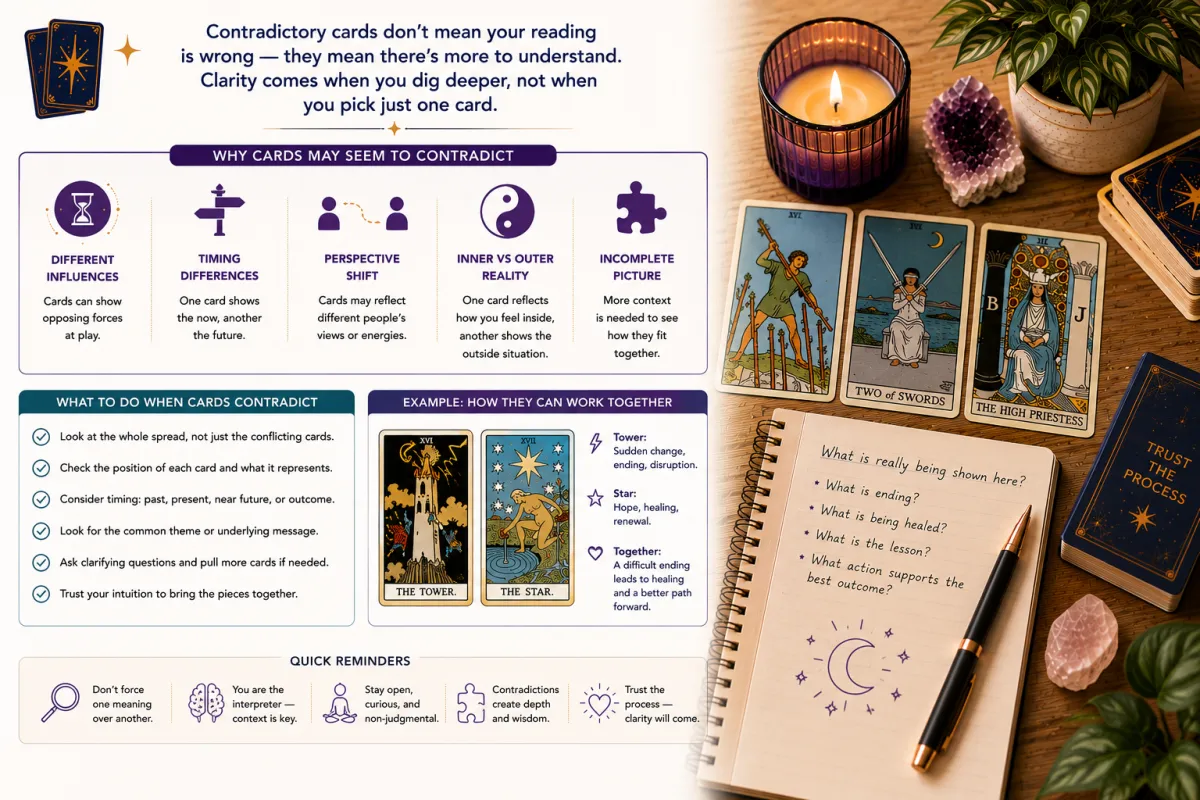
When tarot cards seem to contradict each other, don't assume you've interpreted the reading incorrectly. Contrasting cards often reveal different sides of the same situation. Look at the question, the position of each card, recurring themes and how the cards interact. What initially looks like a contradiction may actually provide a more balanced and useful message.
IN SHORT
You turn over one card and it seems positive.
The next appears to say the opposite.
Suddenly, a reading that seemed straightforward becomes confusing.
This is a normal part of reading tarot.
Cards don't always deliver one simple message. Sometimes they highlight competing feelings, different possibilities or the tension between what you want and what may be holding you back.
Learning to explore those apparent contradictions can make your readings much richer.
Don't Assume One Card Must Be Wrong
When two cards appear to conflict, a common reaction is to decide that one of them doesn't belong.
You may be tempted to redraw the card or reshuffle the deck.
Before doing that, consider whether both cards could be relevant.
Real-life situations are rarely completely positive or completely negative.
You can be excited about a new opportunity while also feeling nervous.
You can love someone while recognising difficulties within the relationship.
You can want change while being reluctant to leave something familiar behind.
Tarot can reflect those complexities.
Two apparently contradictory cards may simply be showing different parts of the same situation.
Return To The Question
When a reading becomes confusing, go back to the question you originally asked.
This gives the cards context.
Ask yourself:
What was I actually trying to understand?
Which part of the question might each card address?
Could the cards be showing different perspectives?
Am I interpreting one card too literally?
Sometimes the contradiction disappears once you reconnect the cards with the purpose of the reading.
Consider The Card Positions
If you're using a spread, each position gives the card a particular role.
Imagine a simple three-card reading with positions for:
Situation.
Challenge.
Guidance.
A positive card appearing as the situation and a difficult card appearing as the challenge aren't contradicting one another.
They're answering different parts of the question.
Similarly, a challenging card followed by an encouraging guidance card may show that the situation is difficult but manageable.
Always interpret the card within its position, rather than treating every card as though it's answering exactly the same question.
Look For The Conversation Between The Cards
Instead of asking:
"Which card is correct?"
try asking:
"What are these cards saying to each other?"
One card may represent opportunity while another encourages caution.
One may show enthusiasm while another suggests patience.
One may reflect your current feelings while another highlights what needs to change.
Thinking of the cards as a conversation can help you move beyond individual meanings and begin interpreting the spread as a whole.
Look For A Connecting Theme
Cards that appear completely different may still share an underlying theme.
For example, one card might suggest movement while another encourages reflection.
At first, those messages seem opposed.
But together they might be saying:
"Move forward, but don't rush."
Another combination might suggest confidence alongside caution.
Together, the message could be:
"Trust yourself, but make sure you have all the information first."
The connection often sits somewhere between the two extremes.
Pay Attention To The Suits
The suits can provide another clue.
For example:
Cups may highlight emotions and relationships.
Pentacles may focus on practical matters and stability.
Swords may point towards thoughts, communication or conflict.
Wands may emphasise energy, ambition and action.
Imagine a reading containing an encouraging Wands card alongside a cautious Pentacles card.
Rather than contradicting each other, they might suggest enthusiasm for an idea while reminding you to consider the practical details.
The different suits may simply be showing different dimensions of the same situation.
Major And Minor Arcana Can Play Different Roles
A Major Arcana card can sometimes represent the larger lesson or theme within a reading, while Minor Arcana cards describe the everyday circumstances surrounding it.
This can initially create what looks like a contradiction.
For example, a Major Arcana card might suggest significant change while a Minor Arcana card encourages patience.
Together, they may indicate that change is developing, but it doesn't need to happen immediately.
Looking at the hierarchy of the cards can help you understand which message represents the bigger picture.
Don't Force Everything Into Positive Or Negative
Another reason cards appear contradictory is our tendency to label them:
"Good card."
"Bad card."
Tarot is rarely that simple.
A traditionally positive card can contain a warning.
A challenging card can highlight an opportunity.
The Tower, for example, may represent disruption, but disruption can sometimes clear the way for necessary change.
The Sun is usually encouraging, but depending on the question, it could also highlight overconfidence or something becoming impossible to ignore.
Allowing cards to contain more than one possibility makes apparent contradictions much easier to understand.
Give The Reading Time
Not every reading makes sense immediately.
If you've considered the question, card positions and relationships but still feel confused, don't force an interpretation.
Make a note of the reading and return to it later.
A little distance can help you notice connections you missed initially.
Sometimes the meaning becomes clearer once you've had time to reflect on the situation itself.
Avoid Drawing More And More Cards
When a reading feels contradictory, drawing additional cards can seem like an obvious solution.
Sometimes one clarification card can help.
But repeatedly drawing cards often creates even more confusion.
Before adding anything, work with the cards already on the table.
Ask:
What does each card contribute?
Where is the tension?
What might connect the different messages?
Could both perspectives be true?
Often, the answer is already present.
It simply needs a little more interpretation.
Contradiction Can Be Valuable
One of the most useful lessons in tarot is that apparent contradictions aren't necessarily problems.
They often reflect the reality of complicated situations.
Life contains uncertainty.
People experience conflicting emotions.
Choices have advantages and disadvantages.
Tarot doesn't always simplify those complexities into one neat answer.
Sometimes its value comes from helping you see them more clearly.
Coffee Cup Tip ☕
When two cards seem to disagree, try joining their meanings with the word "but."
"There's an opportunity here, but I need to be patient."
"I want to move forward, but something still needs my attention."
That simple exercise can often reveal the connection between apparently contradictory cards.
QUICK RECAP
When tarot cards seem to contradict each other:
Don't assume one card is wrong.
Return to the original question.
Consider each card's position in the spread.
Look at how the cards communicate with one another.
Search for an underlying connecting theme.
Pay attention to suits and Major or Minor Arcana.
Avoid labelling cards simply as positive or negative.
Give confusing readings time.
Don't automatically draw more cards.
Remember that real situations often contain conflicting elements.
Contradictory cards aren't necessarily a sign that a reading has failed.
They may be inviting you to look at the situation more deeply.
NEXT STEP
Once you become comfortable exploring relationships between cards within a single spread, you can begin looking for connections that appear across several readings.
Next:
→ How Do You Recognise Patterns Across Multiple Tarot Readings?
