How Can Tarot Help You Develop Greater Self-Awareness?
TL;DR
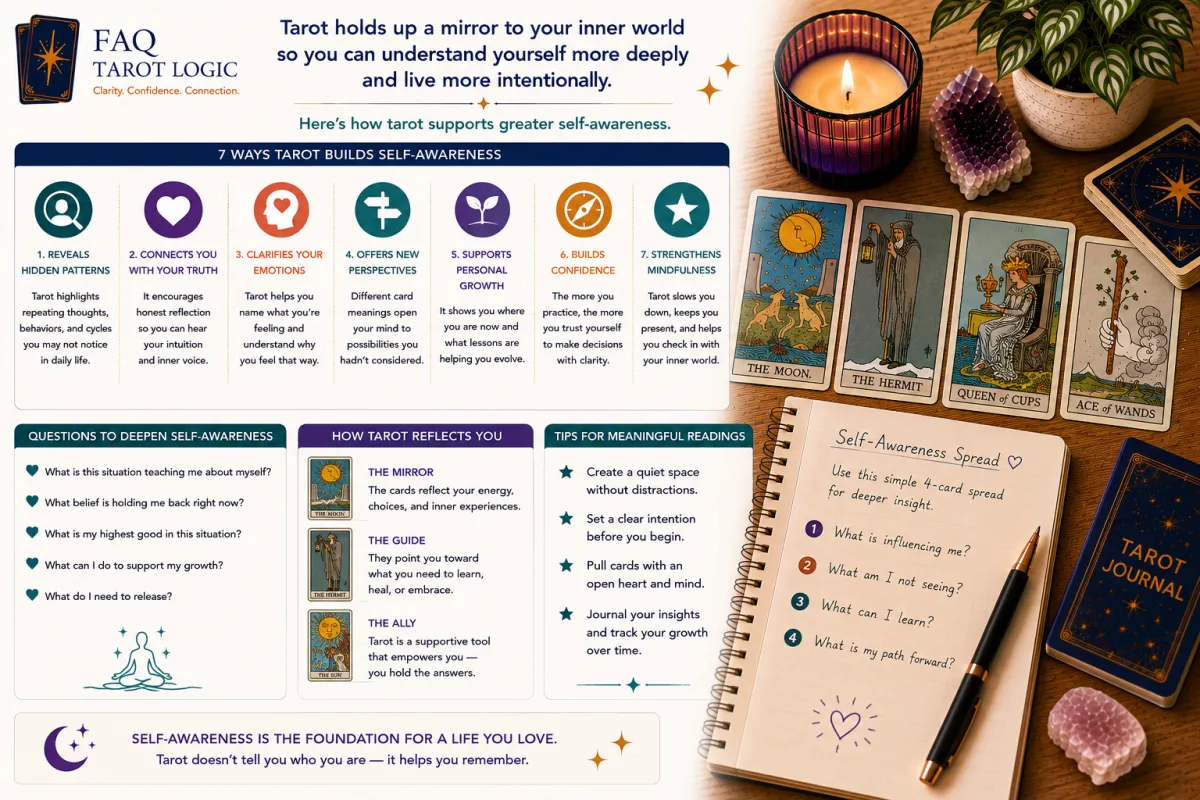
Tarot can help develop greater self-awareness by encouraging you to examine your thoughts, emotions, habits and reactions from a different perspective. Rather than telling you who you are or what you should do, the cards provide prompts for reflection. Over time, this can help you recognise patterns, question assumptions and understand what may be influencing your choices.
IN SHORT
Sometimes the hardest person to understand is yourself.
We all develop habits, assumptions and emotional reactions that become so familiar we barely notice them.
Tarot can create a useful pause.
A card, image or unexpected interpretation may encourage you to consider something you hadn't previously recognised.
That doesn't mean the cards magically know you better than you know yourself.
Their value comes from the questions and reflection they encourage.
What Does Self-Awareness Actually Mean?
Self-awareness is simply understanding yourself more clearly.
That includes recognising:
How you tend to react.
What influences your decisions.
What matters to you.
What makes you uncomfortable.
Where your strengths lie.
Which habits repeatedly cause difficulties.
What you may be avoiding.
Greater self-awareness doesn't mean analysing every thought or emotion.
It means becoming better at noticing what's happening within you before automatically reacting to it.
Tarot can provide a structured way to practise that reflection.
Tarot Gives You Something To Respond To
One reason tarot works well as a reflective tool is that you're not simply sitting down and trying to "think about yourself."
The card gives you something specific to consider.
Suppose you draw a card associated with boundaries.
You might ask:
Where are my boundaries currently being tested?
Do I find it difficult to say no?
Am I protecting myself too much?
Is there somewhere I need clearer limits?
The card hasn't diagnosed a problem.
It has prompted a conversation with yourself.
That distinction is important.
Unexpected Cards Can Be Particularly Useful
Sometimes the card you don't expect creates the most reflection.
Perhaps you believe you're completely comfortable with a decision, yet a card associated with hesitation appears.
Rather than immediately dismissing it, you could ask:
"Is there any part of this decision I'm still uncertain about?"
The answer may be no.
That's fine.
But the question encourages you to check rather than assume.
Unexpected cards can help you examine situations from perspectives you might not have considered yourself.
Tarot Can Help You Notice Emotional Reactions
Your reaction to a card can sometimes be as interesting as the card itself.
Imagine turning over a card and immediately feeling disappointed.
Why?
Were you hoping for reassurance?
Did the imagery make you uncomfortable?
Does the card raise an issue you'd rather avoid?
Your emotional reaction doesn't automatically determine the meaning of the card.
But it may tell you something about how you currently feel about the situation.
Learning to notice those reactions without immediately judging them is part of developing self-awareness.
If you'd like to explore the role tarot can play in understanding yourself more broadly:
→ Can Tarot Improve Self-Awareness?
Ask Questions That Encourage Reflection
The questions you ask make a considerable difference.
Questions such as:
"Will everything work out?"
don't necessarily encourage much self-examination.
Compare that with:
"What am I overlooking in this situation?"
or:
"What might be influencing the way I'm approaching this?"
You could also explore:
What do I need to understand about my reaction?
What assumption might I be making?
What strength could I use here?
What am I finding difficult to accept?
What could I approach differently?
These questions turn tarot into a tool for exploration rather than prediction.
Look For Recurring Themes
Self-awareness often develops through recognising patterns.
Perhaps several readings keep returning to:
Difficulty setting boundaries.
Fear of making mistakes.
Avoiding difficult conversations.
Taking on too much.
Seeking reassurance.
Hesitating before making decisions.
One reading might not seem particularly significant.
But seeing the same theme repeatedly can encourage you to look more closely.
This is where reviewing readings over time becomes especially useful.
For more on recognising these connections:
→ How Do You Recognise Patterns Across Multiple Tarot Readings?
Notice The Questions You Keep Asking
Patterns don't only appear in the cards.
They appear in your questions too.
Imagine looking through your tarot journal and discovering that you've asked five slightly different versions of the same question over the past month.
That may tell you something.
Perhaps you're struggling to accept uncertainty.
Maybe you're looking for reassurance.
Or perhaps there's a decision you've been avoiding.
Sometimes recognising why you keep asking is more revealing than drawing another card.
Tarot Can Reveal Your Assumptions
We all approach situations with assumptions.
You might think:
"If I choose this option, I'll disappoint someone."
or:
"I'm not ready to do that."
or:
"There's only one sensible choice."
Tarot can encourage you to question those assumptions.
Suppose a reading highlights independence when you've been worrying about other people's expectations.
That could prompt you to ask:
"How much of this decision is based on what I want, and how much is based on what I think others expect?"
The cards haven't made the decision for you.
They've helped you examine what's influencing it.
Reflection Can Help Separate Intuition From Fear
Greater self-awareness also helps you recognise the difference between a genuine intuitive response and an anxious reaction.
Fear often creates urgency.
It can make you imagine worst-case scenarios or repeatedly seek reassurance.
Intuition often feels quieter.
Learning to recognise your own patterns makes those differences easier to identify.
This is something we've explored in more detail here:
→ What Is the Difference Between Intuition and Fear?
Use Tarot To Explore Strengths As Well As Problems
Self-reflection doesn't have to focus entirely on difficulties.
Tarot can also help you recognise strengths you may take for granted.
You might ask:
What strength am I currently underusing?
What have I handled well recently?
What quality could help me with this situation?
What have I learned from a previous challenge?
A balanced practice explores what is working as well as what needs attention.
Self-awareness includes understanding your capabilities, not simply identifying your weaknesses.
Don't Let The Cards Define You
There is an important boundary to maintain.
A tarot card shouldn't become a label.
Drawing a card associated with conflict doesn't mean:
"I'm a difficult person."
A card associated with fear doesn't mean:
"I'm fearful."
The card may simply be encouraging you to explore how a particular theme relates to the situation you're asking about.
Use tarot to ask questions about yourself.
Don't use it to create rigid definitions of who you are.
Give Yourself Permission To Disagree
You don't have to accept every possible interpretation.
If a card suggests a theme that genuinely doesn't fit, it's okay to recognise that.
Self-awareness requires honesty, and honesty includes saying:
"I've considered this, but I don't think it applies."
The goal isn't to force your life to match the cards.
It's to use the cards as prompts for thoughtful exploration.
Write Down What You Discover
Some insights disappear surprisingly quickly once a reading ends.
Recording a few notes helps preserve them.
You might write:
What surprised me?
What did I recognise about myself?
What question do I want to think about further?
Is there something I'd like to do differently?
Did this reading change my perspective?
You don't need pages of analysis.
A few sentences can be enough.
If you're developing this habit:
→ Should You Keep a Tarot Journal?
Self-Awareness Develops Over Time
One tarot reading won't suddenly reveal everything about you.
Nor should it.
Self-awareness develops gradually through experience, reflection and a willingness to remain curious about your own thoughts and reactions.
Tarot simply gives that process some structure.
Over time, you may become quicker at recognising:
Why something bothers you.
When you're seeking reassurance.
Which situations trigger familiar reactions.
What matters most to you.
When you're avoiding something.
Where you've genuinely changed.
That knowledge can make future choices more thoughtful.
Coffee Cup Tip ☕
After a reading, ask yourself one extra question:
"What did I learn about myself rather than about the situation?"
That small change can turn an ordinary tarot reading into a much more useful exercise in self-awareness.
QUICK RECAP
Tarot can help develop greater self-awareness by encouraging you to:
Examine your thoughts and reactions.
Consider unexpected perspectives.
Notice emotional responses to cards.
Ask more reflective questions.
Recognise recurring themes.
Notice questions you repeatedly ask.
Challenge assumptions.
Distinguish intuition from fear.
Recognise strengths as well as difficulties.
Record useful insights.
Remain curious about your own development.
Tarot doesn't tell you who you are.
It can help you ask better questions about why you think, feel and respond the way you do.
And sometimes a better question is exactly what creates greater clarity.
NEXT STEP
Greater self-awareness is the beginning of applying tarot rather than simply interpreting it.
The next stage is learning how to ask better questions during a reading so the cards encourage useful reflection rather than simply seeking yes-or-no answers.
