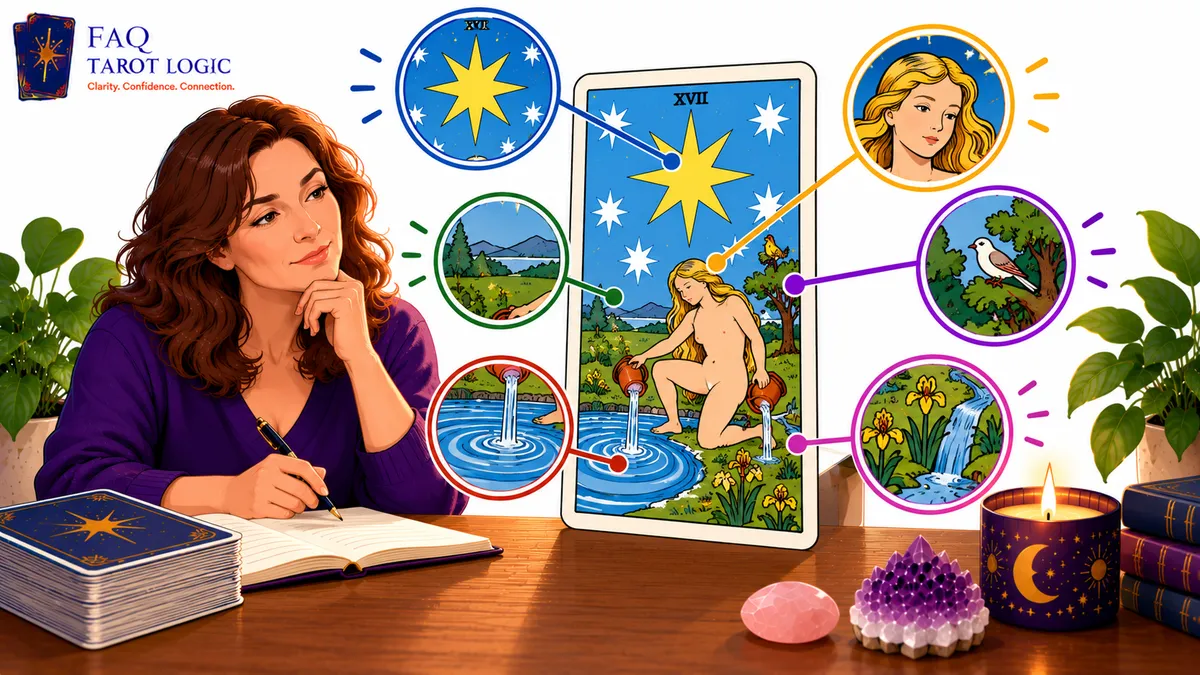
How Do You Know Which Part of a Tarot Card to Focus On?
TL;DR
Knowing which part of a tarot card to focus on begins with the question, the card's position and the surrounding cards. You don't need to interpret every symbol, colour or detail in the artwork. Instead, look for the elements that help explain the card's relevance to the reading.
Sometimes the traditional meaning provides enough information. At other times, a particular symbol, expression or visual detail may offer a useful connection. The aim is to develop a focused interpretation rather than trying to include everything you can see.
IN SHORT
Look at almost any tarot card and you'll find plenty to explore.
People.
Animals.
Colours.
Objects.
Landscapes.
Numbers.
Symbols.
And sometimes details you hadn't noticed before.
But here's the problem.
How do you know which parts actually matter?
If you try to interpret everything, even a simple three-card reading can become unnecessarily complicated.
The answer isn't to ignore the details.
It's to learn how to recognise which details are relevant to the question you're exploring.
You Don't Need To Interpret Everything
One of the easiest mistakes to make when developing your tarot skills is assuming every visible detail needs an explanation.
Suppose a card contains a figure, a mountain, several objects and a particular colour scheme.
You could spend ages examining each element.
But would that necessarily improve the reading?
Not always.
Sometimes the central meaning of the card is enough.
Other times, one small detail provides the connection you need.
A useful interpretation is about relevance, not the number of details you can identify.
Start With The Card's Main Meaning
Before exploring individual symbols, remind yourself of the card's central theme.
For example, The Hermit is commonly associated with reflection, solitude and seeking understanding.
You don't need to examine every element of the artwork before recognising those ideas.
Start with what you already know.
Then ask:
"Which aspect of this meaning is most relevant to the question?"
That gives your interpretation a foundation.
→ How Do You Learn Tarot Card Meanings?
Let The Question Guide Your Attention
The same card can draw your attention towards different details depending on what you're asking.
Imagine drawing The Hermit.
If your question concerns personal development, you might focus on reflection and inner understanding.
If you're asking about a relationship, you might consider the need for personal space.
If you're exploring a decision, you might focus on stepping away from outside opinions.
The card hasn't changed.
The question has.
That's why it's useful to establish the purpose of the reading before examining individual symbols.
Consider The Card's Position
In a structured spread, the card position provides another important clue.
Suppose a card appears in the position:
"What is helping me?"
You would naturally look for its supportive qualities.
But if the same card appears in:
"What am I overlooking?"
you might focus on something less obvious.
The position helps narrow the range of possible interpretations.
Without it, you may find yourself considering meanings that don't contribute much to the reading.
→ Why Does Context Matter More Than Individual Card Meanings?
Notice What Catches Your Attention First
When you turn over a card, something may immediately stand out.
Perhaps it's a person's expression.
Maybe it's an animal.
A particular colour.
An object being held.
Or the direction a figure is facing.
Don't dismiss that first impression.
It can provide a useful starting point.
But don't automatically assume the first thing you notice must be the most important detail.
Ask:
"How does this connect with the question?"
If there's a reasonable connection, explore it.
If not, you can return to the card's broader meaning.
Look At The People In The Card
Many tarot cards contain figures whose actions and expressions contribute to the meaning.
Consider:
What are they doing?
Where are they looking?
Are they moving or standing still?
Are they interacting with someone?
What are they holding?
What does their posture suggest?
These details can help you understand how the card expresses its central theme.
For example, a figure looking away from something might suggest withdrawal, reflection or a change in attention.
But the interpretation still needs to fit the card and the question.
Pay Attention To Movement And Direction
Movement can be particularly interesting in tarot artwork.
Some figures appear to be travelling towards something.
Others seem to be leaving.
Some cards show activity and momentum.
Others suggest stillness.
When relevant, these visual differences can help you explore whether a situation involves:
Progress.
Hesitation.
Withdrawal.
Preparation.
Resistance.
Change.
You don't need to assign a fixed meaning to every direction.
Simply notice whether movement contributes something useful to the reading.
Explore Objects And Symbols
Objects often help communicate the traditional themes of tarot cards.
A sword may suggest thought, communication or conflict.
A cup may relate to emotions or relationships.
A pentacle may draw attention towards practical matters.
A wand may suggest energy, creativity or initiative.
Other objects can add further detail.
But remember that symbolism works within the card's wider meaning.
You shouldn't isolate one symbol and allow it to override everything else without a good reason.
→ How Do You Read Tarot Symbolism?
Don't Give Every Colour A Meaning
Colours can contribute to the atmosphere of a card.
Bright colours may create a different impression from muted ones.
A dark background may feel different from an open landscape.
But it's easy to overcomplicate colour interpretation.
Not every patch of blue or red needs to represent something specific.
Instead, ask whether the colour genuinely helps communicate the card's mood or theme.
If it doesn't add anything useful, you can leave it alone.
Look For Repeated Details
Sometimes the most interesting detail isn't contained within one card.
It's repeated across several.
Perhaps multiple cards show water.
Several figures may be looking in the same direction.
You might notice repeated numbers, similar landscapes or related symbols.
These patterns can help connect cards that initially appear separate.
But again, relevance matters.
A repeated detail is worth exploring when it contributes to the question or overall interpretation.
Use Surrounding Cards To Decide What Matters
Imagine a card contains several possible themes.
On its own, you aren't sure which deserves attention.
Now look at the surrounding cards.
Perhaps they repeatedly suggest communication.
That may make one particular aspect of the original card more relevant.
Or perhaps the surrounding cards emphasise practical responsibilities.
That could direct your attention towards a different detail.
The other cards help narrow the possibilities.
→ How Do You Interpret Multiple Tarot Cards Together?
Don't Ignore The Overall Story
A spread isn't simply a collection of individual pictures.
The cards work together to explore a question.
Suppose one card suggests planning.
Another suggests action.
A third suggests reflection.
You may see a natural progression.
In that situation, details connected with preparation, movement and review may be particularly useful.
Other symbols might be interesting, but they don't necessarily improve the interpretation.
The overall story helps you decide what deserves attention.
Know When The Traditional Meaning Is Enough
Sometimes you'll look at a card and its familiar meaning fits perfectly.
You understand why it appeared.
It connects with the question.
The surrounding cards support the interpretation.
That's enough.
You don't have to search for hidden symbolism simply because you want the reading to feel more advanced.
A clear interpretation isn't less valuable because it's straightforward.
Avoid Searching For Hidden Messages Everywhere
Once you become interested in tarot symbolism, it's tempting to examine every detail as though it contains a secret message.
But that can make readings unnecessarily complicated.
You may begin creating connections that have little relationship to the question.
A useful check is:
"Would this detail still seem important if I wasn't actively searching for something unusual?"
If the answer is no, it may not deserve much attention.
Let Difficult Cards Encourage Closer Observation
Sometimes a card seems completely disconnected from the reading.
That's when examining its imagery can become particularly useful.
Instead of immediately reaching for a guidebook, look at the card again.
Perhaps a detail you normally overlook offers another way to understand it.
Maybe the imagery suggests a broader meaning than the keyword you usually associate with the card.
A closer look can sometimes reveal why an unexpected card belongs in the spread.
→ How Do You Read a Tarot Card That Seems Out of Place?
Don't Force A Symbol To Fit
There's a difference between recognising a useful connection and inventing one.
Suppose you notice an animal in the background of a card.
You begin exploring what it could represent.
But none of the possible interpretations seems relevant to the question.
That's fine.
You don't have to include it.
Not every symbol needs to contribute to every reading.
Being selective is part of developing stronger interpretation skills.
Compare Different Tarot Decks
Different decks can help you understand which elements of a card are central and which are artistic choices.
For example, two decks may portray the same card very differently.
One might emphasise a character.
Another might focus on a landscape or object.
Yet both communicate the same underlying theme.
Comparing them can help you separate the card's essential meaning from the particular way an artist has illustrated it.
Be Careful With Personal Associations
Sometimes a symbol reminds you of something from your own experience.
That association may be useful.
But ask whether it genuinely relates to the reading.
For example, a particular animal might have a strong personal meaning for you.
That doesn't necessarily mean it carries the same significance in every reading.
Personal associations can enrich interpretation, but they work best alongside context and the card's established themes.
Develop Your Own Way Of Looking At Cards
With experience, you'll probably notice that certain details naturally attract your attention.
Perhaps you focus on facial expressions.
Maybe you notice repeated symbols.
Or you may prefer to start with the traditional meaning before examining the artwork.
These preferences can become part of your personal reading style.
There's no need to copy another reader's exact method.
The important thing is being able to explain how a detail contributes to your interpretation.
Don't Mistake More Detail For Better Interpretation
A reading can become longer without becoming more useful.
You might spend several paragraphs discussing colours, symbols and imagery.
But if those details don't help answer the question, they may simply distract from the central message.
A useful interpretation should bring greater clarity.
It doesn't need to include everything you know.
Practise Focusing On One Relevant Detail
A simple exercise can help develop this skill.
Choose a familiar card.
Look at the question and spread position.
Then identify:
The card's central meaning.
One detail that seems particularly relevant.
How that detail contributes to the interpretation.
Try explaining the card using those three elements.
This encourages you to become more selective rather than automatically exploring every possible symbol.
Review Which Details Actually Helped
After completing a reading, look back at your interpretation.
Which details were genuinely useful?
Did a particular symbol help explain the card?
Did a facial expression reveal something relevant?
Or did you spend too much time examining something that didn't contribute much?
Reviewing your choices helps you recognise what works.
Over time, this can make your interpretations clearer and more focused.
→ How Can You Improve Your Tarot Interpretation Skills?
Trust Your Interpretation Without Ignoring Context
As you become more experienced, you may find yourself noticing relevant details more quickly.
That's useful.
But confidence shouldn't mean accepting every first impression without question.
A balanced approach combines:
Your knowledge of the card.
The question.
The spread position.
The surrounding cards.
Your observations.
Your developing intuition.
Together, these help you decide which details deserve attention.
Coffee Cup Tip ☕
Try the Three-Detail Exercise.
Choose one tarot card and examine it for a minute.
Then write down:
1. The main meaning: What is the card generally about?
2. The strongest detail: What catches your attention?
3. The connection: How does that detail relate to the question?
Now stop.
Don't keep searching for more symbols.
This simple exercise helps you practise choosing relevant information rather than trying to interpret everything.
QUICK RECAP
When deciding which part of a tarot card to focus on:
Start with the card's central meaning.
Let the question guide your attention.
Consider the card's spread position.
Notice what catches your eye.
Look at figures, expressions and actions.
Explore movement and direction when relevant.
Use symbolism to support interpretation.
Don't assign unnecessary meanings to every colour.
Notice repeated details across cards.
Use surrounding cards to narrow possibilities.
Consider the overall story of the spread.
Accept when the traditional meaning is enough.
Avoid searching for hidden messages everywhere.
Examine difficult cards more closely.
Don't force symbols to fit.
Compare different decks when useful.
Balance personal associations with context.
Develop your own observation style.
Remember that more detail doesn't automatically mean more clarity.
Practise selecting one relevant detail.
Review which details helped your interpretation.
Every tarot card contains more information than you need for any single reading.
The skill isn't learning to interpret every detail. It's learning to recognise which details help answer the question in front of you.
NEXT STEP
Learning to focus on the most relevant parts of a tarot card can make interpretation much clearer.
But even with that skill, you'll occasionally draw a card that leaves you completely uncertain.
Perhaps you don't recognise it.
Maybe you've forgotten its meaning.
Or the imagery simply doesn't seem to connect with the question.
Knowing how to approach those moments without immediately abandoning your own interpretation is an important part of becoming a more confident reader.
Next topic: What Should You Do When You Draw a Card You Don't Understand?
