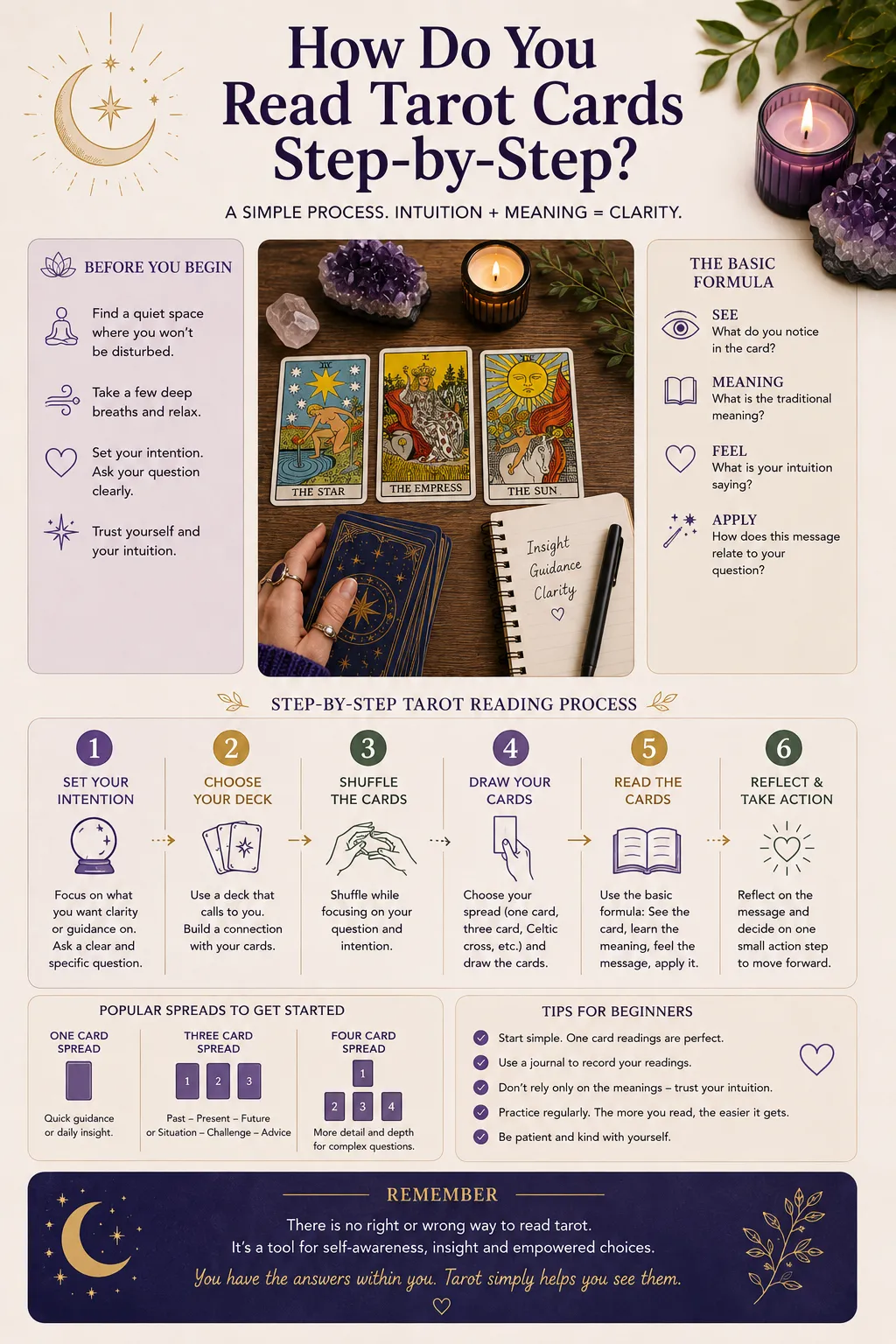
How Do You Read Tarot Cards Step-by-Step?
TL;DR
You read Tarot cards step-by-step by setting an intention, shuffling the deck, choosing a spread, interpreting the cards, and trusting both symbolism and intuition.
IN SHORT
Reading Tarot can feel intimidating at first.
Many beginners worry about:
• Doing it “wrong”
• Forgetting card meanings
• Choosing the wrong spread
• Misunderstanding the cards
But Tarot reading is not about perfection.
It is about observation, reflection, and learning to recognise patterns.
The more consistently you practice, the more natural the process becomes.
REAL TALK
A lot of new readers overcomplicate Tarot.
They think every reading must feel mystical or dramatic.
In reality, most good Tarot readings feel calm, thoughtful, and surprisingly practical.
You do not need psychic powers to begin reading Tarot.
You simply need curiosity, patience, and a willingness to learn the language of the cards.
Step 1 — Set A Clear Intention
Before touching the cards, pause for a moment.
Ask yourself:
“What do I want guidance or clarity about?”
This helps focus the reading.
Your question might relate to:
• Relationships
• Career
• Personal growth
• Emotions
• Decisions
• Spiritual guidance
Clear questions usually create clearer readings.
Step 2 — Shuffle The Cards
Shuffle the deck slowly and calmly.
There is no single “correct” method.
Some people:
• Shuffle normally
• Spread the cards across a table
• Cut the deck into sections
• Shuffle while focusing on a question
The purpose is simply to connect your attention and energy with the reading.
Step 3 — Choose A Tarot Spread
A Tarot spread is the layout used for the cards.
Beginners often start with:
• One-card readings
• Three-card spreads
• Past-present-future spreads
Simple spreads are usually easier to interpret clearly.
Step 4 — Turn The Cards Over Slowly
Reveal the cards one at a time.
Do not rush immediately to the guidebook.
First observe:
• The imagery
• Colours
• Emotions
• Symbols
• Body language
• Repeated themes
Your first impressions matter.
Tarot often communicates visually before intellectually.
Step 5 — Interpret The Meaning
Now combine:
• Traditional meanings
• Your intuition
• The position in the spread
• The surrounding cards
Ask yourself:
• What story is forming?
• Which card feels strongest?
• Are there repeated themes?
• Does the reading feel emotional, practical, or mental?
Tarot meanings become clearer when viewed together rather than separately.
Step 6 — Reflect On The Reading
After the reading, spend a few minutes reflecting.
You may wish to journal:
• The cards pulled
• Your interpretation
• Emotional reactions
• What later happened
This strengthens your understanding over time.
WHY THIS WORKS
Tarot reading works best when structure and intuition work together.
The process gives the mind space to notice patterns, emotions, and deeper perspectives that may otherwise be overlooked.
COMMON MISTAKE
Mistake:
Trying to memorise every meaning before doing readings.
Fix:
Learn through practice.
Real readings teach Tarot faster than endless studying alone.
COFFEE CUP TIP ☕
If you feel stuck during a reading, ask:
“What is the main feeling of this spread?”
That question often unlocks the overall message.
FAQ QUICK FIX
To read Tarot cards step-by-step:
Set an intention
Shuffle the cards
Choose a spread
Turn over the cards slowly
Interpret the symbols and themes
Reflect on the message
QUICK RECAP
Tarot reading becomes easier with repetition and observation.
The goal is not perfection.
It is learning to understand the stories and patterns the cards reveal.
RELATED QUESTIONS
→ What Is the Best Tarot Spread for Beginners?
→ How Many Cards Should You Pull in a Reading?
→ How Do You Learn Tarot Card Meanings?
NEXT STEP
Once you understand the reading process, the next step is choosing a Tarot spread that feels simple and beginner-friendly.
