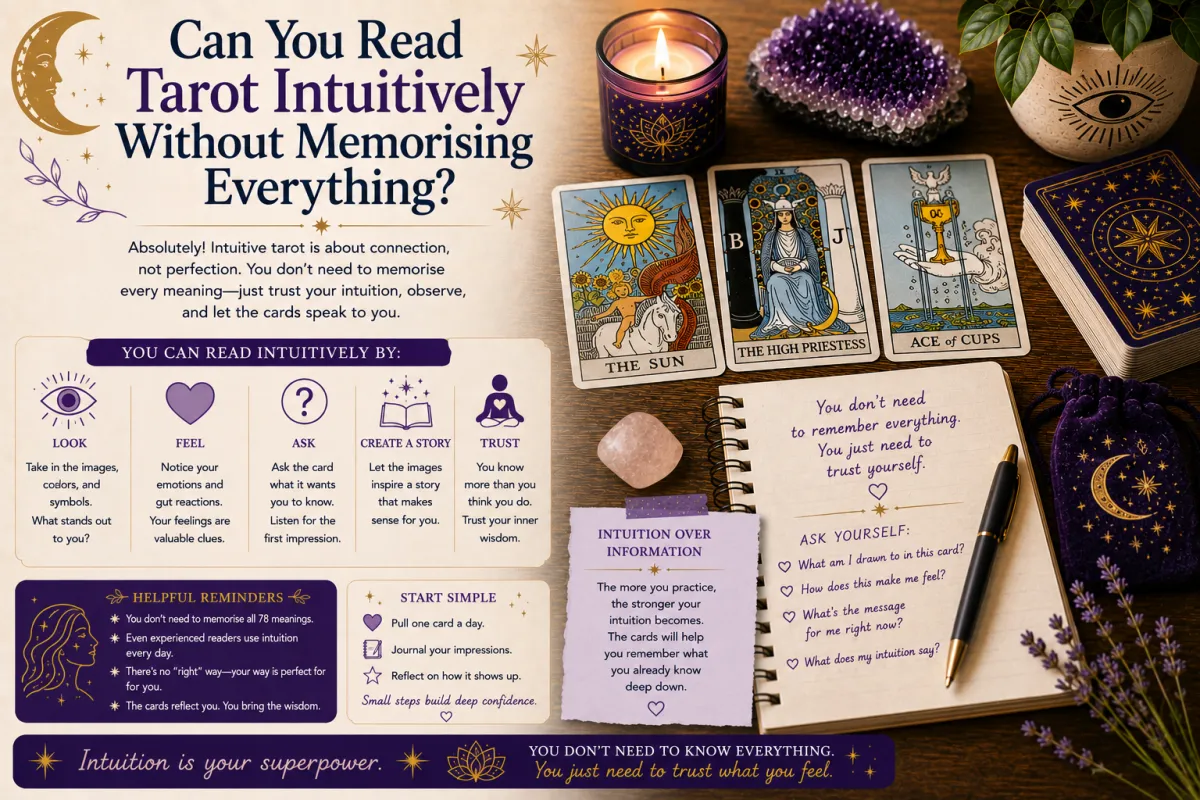
Can You Read Tarot Intuitively Without Memorising Everything?
TL;DR
Yes. You can read Tarot intuitively without memorising every card meaning. While learning traditional meanings is helpful, intuition, symbolism, and personal observation are equally important parts of Tarot reading.
IN SHORT
Many beginners believe they must memorise all 78 Tarot cards before they can perform a reading.
This often creates frustration.
The good news is that Tarot was never designed to function purely as a memory exercise.
The images themselves communicate meaning.
That's why many readers develop their skills through observation and intuition long before they have memorised every card.
REAL TALK
If you've ever looked at a Tarot card and immediately felt something before checking the guidebook, you've already experienced intuitive reading.
Most readers do this naturally.
The challenge is learning to trust those impressions rather than dismissing them.
Intuition and traditional meanings are not competing systems.
They work together.
What Is Intuitive Tarot Reading?
Intuitive Tarot reading involves paying attention to:
• First impressions
• Emotional reactions
• Symbolism
• Visual details
• Personal associations
Rather than asking:
"What does the guidebook say?"
You also ask:
"What does this card seem to be communicating right now?"
The Images Tell A Story
Tarot cards contain:
• Characters
• Colours
• Landscapes
• Symbols
• Body language
These visual elements often provide clues before you consciously remember the card's traditional meaning.
For example:
A figure standing confidently may suggest confidence.
Stormy imagery may suggest challenge or uncertainty.
A bright sunrise may suggest hope or a new beginning.
Why Memorisation Still Helps
Intuition does not replace learning.
Traditional card meanings provide structure and context.
The strongest readers usually combine:
• Knowledge
• Experience
• Observation
• Intuition
The goal is not choosing one approach over another.
The goal is allowing them to work together.
Building Intuitive Skills
One simple exercise is to study a card before looking up its meaning.
Ask yourself:
• What emotions do I notice?
• What stands out visually?
• What story seems to be unfolding?
Then compare your impressions to the traditional interpretation.
You'll often discover surprising similarities.
Practice Creates Confidence
Intuitive reading improves through repetition.
The more time you spend with the cards, the easier it becomes to recognise patterns and trust your observations.
Over time, intuition begins to feel less like guessing and more like understanding.
WHY THIS WORKS
Human beings naturally interpret stories, symbols, and images.
Tarot uses those same abilities to create insight and reflection.
Intuitive reading works because it encourages deeper engagement with the cards.
COMMON MISTAKE
Mistake:
Believing you must memorise every Tarot card before doing readings.
Fix:
Start reading now.
Allow intuition and learning to develop together.
COFFEE CUP TIP ☕
Before reaching for the guidebook, spend thirty seconds simply looking at the card.
You may notice more than you expect.
FAQ QUICK FIX
You can read Tarot intuitively by:
Observing the imagery
Trusting first impressions
Noticing emotional reactions
Learning traditional meanings gradually
Practising consistently
QUICK RECAP
Tarot is not a memory test.
While learning card meanings is valuable, intuition, symbolism, and observation are equally important parts of the reading process.
RELATED QUESTIONS
→ How Do You Trust Your Tarot Interpretation?
→ What Does It Mean to Trust Your Intuition?
→ How Do Experienced Readers Interpret the Cards?
NEXT STEP
Intuitive reading becomes easier when you understand what intuition actually is.
The next step is exploring what it means to trust your intuition.
