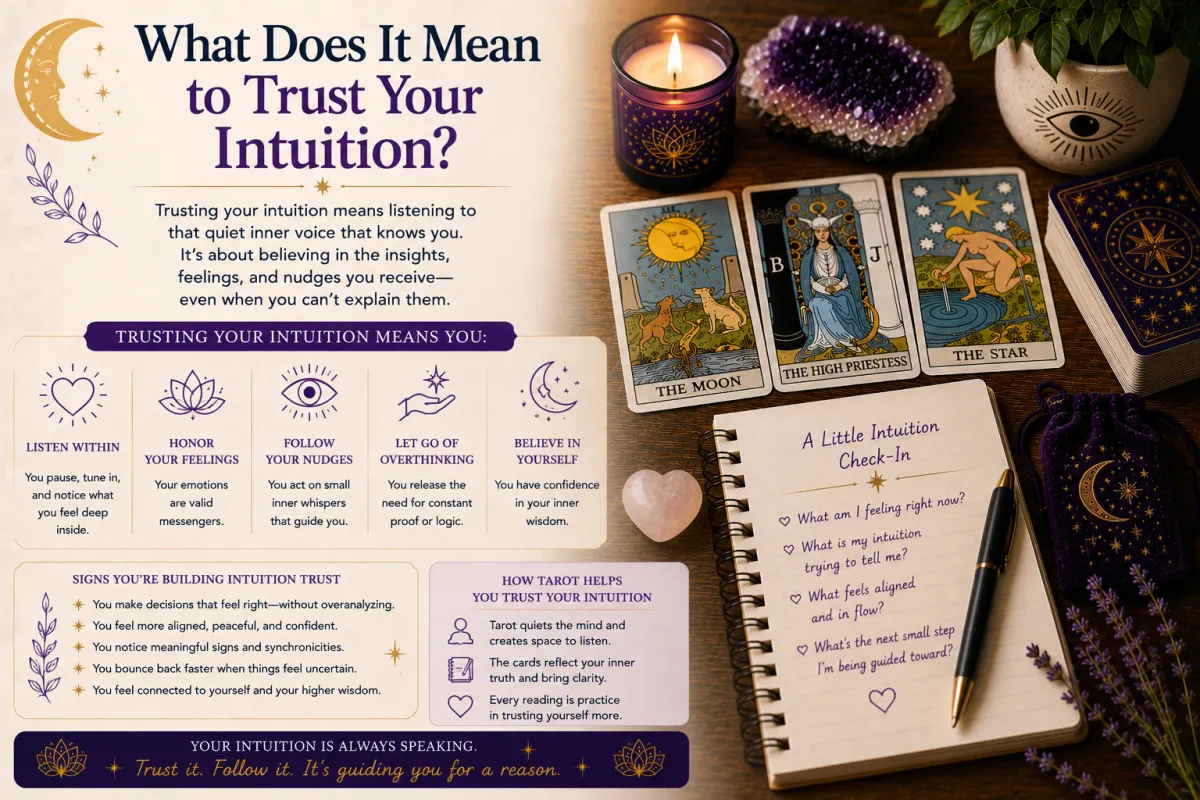
What Does It Mean to Trust Your Intuition?
TL;DR
Trusting your intuition means learning to recognise and respect your inner sense of knowing, even when you cannot immediately explain it logically. In Tarot, intuition often works alongside knowledge, experience, and reflection.
IN SHORT
Intuition is one of the most discussed parts of Tarot reading.
Yet many people struggle to define it.
Some imagine intuition as a mysterious gift that only certain people possess.
In reality, intuition is something everyone experiences.
The challenge is learning how to recognise it and trust it appropriately.
REAL TALK
Most people have experienced intuition.
Perhaps you sensed something was wrong before any evidence appeared.
Perhaps you felt strongly drawn toward a particular opportunity.
Perhaps you immediately liked or disliked a situation without knowing exactly why.
Intuition often arrives quietly.
The problem is that modern life encourages us to analyse everything.
As a result, many people learn to ignore their instincts.
What Intuition Is Not
Trusting intuition does not mean abandoning logic.
It does not mean:
• Ignoring facts
• Making reckless decisions
• Believing every feeling is meaningful
• Avoiding critical thinking
Healthy intuition works alongside reason.
The strongest decisions often use both.
What Intuition Often Feels Like
Many people describe intuition as:
• A quiet inner knowing
• A strong sense of direction
• A feeling that something fits
• A subtle emotional signal
• A repeated insight that keeps returning
Unlike fear, intuition is often calm rather than urgent.
Intuition In Tarot Readings
When reading Tarot, intuition may appear when:
• A particular symbol stands out
• A card feels unusually important
• An unexpected interpretation emerges
• A pattern suddenly becomes clear
• A message feels especially relevant
These moments often provide valuable insight.
Learning To Recognise The Difference
One challenge is separating intuition from anxiety.
Fear often sounds like:
"What if everything goes wrong?"
Intuition often sounds like:
"Pay attention to this."
Fear tends to create panic.
Intuition tends to create awareness.
Learning the difference takes practice.
Why Intuition Develops Over Time
Like any skill, intuition strengthens through use.
The more you observe:
• Your reactions
• Your impressions
• Your experiences
The easier it becomes to recognise genuine intuitive signals.
This is why many readers become more confident with experience.
WHY THIS WORKS
Human beings constantly process information below conscious awareness.
Intuition often draws from patterns, observations, and experiences that the conscious mind has not fully recognised yet.
COMMON MISTAKE
Mistake:
Assuming intuition should always feel dramatic or mystical.
Fix:
Remember that intuition is often subtle, quiet, and surprisingly ordinary.
COFFEE CUP TIP ☕
When a card catches your attention, ask:
"Why am I noticing this?"
The answer often reveals an intuitive insight worth exploring.
FAQ QUICK FIX
Trusting your intuition means:
Listening to inner impressions
Combining intuition with logic
Paying attention to patterns
Recognising subtle signals
Developing confidence through practice
QUICK RECAP
Intuition is not about magic.
It is about recognising inner signals, observations, and insights that can help deepen understanding during a Tarot reading.
RELATED QUESTIONS
→ Can You Read Tarot Intuitively Without Memorising Everything?
→ How Do You Trust Your Tarot Interpretation?
→ How Do Experienced Readers Interpret the Cards?
NEXT STEP
Once you understand intuition, it becomes easier to see how experienced Tarot readers combine intuition, symbolism, and knowledge during a reading.
