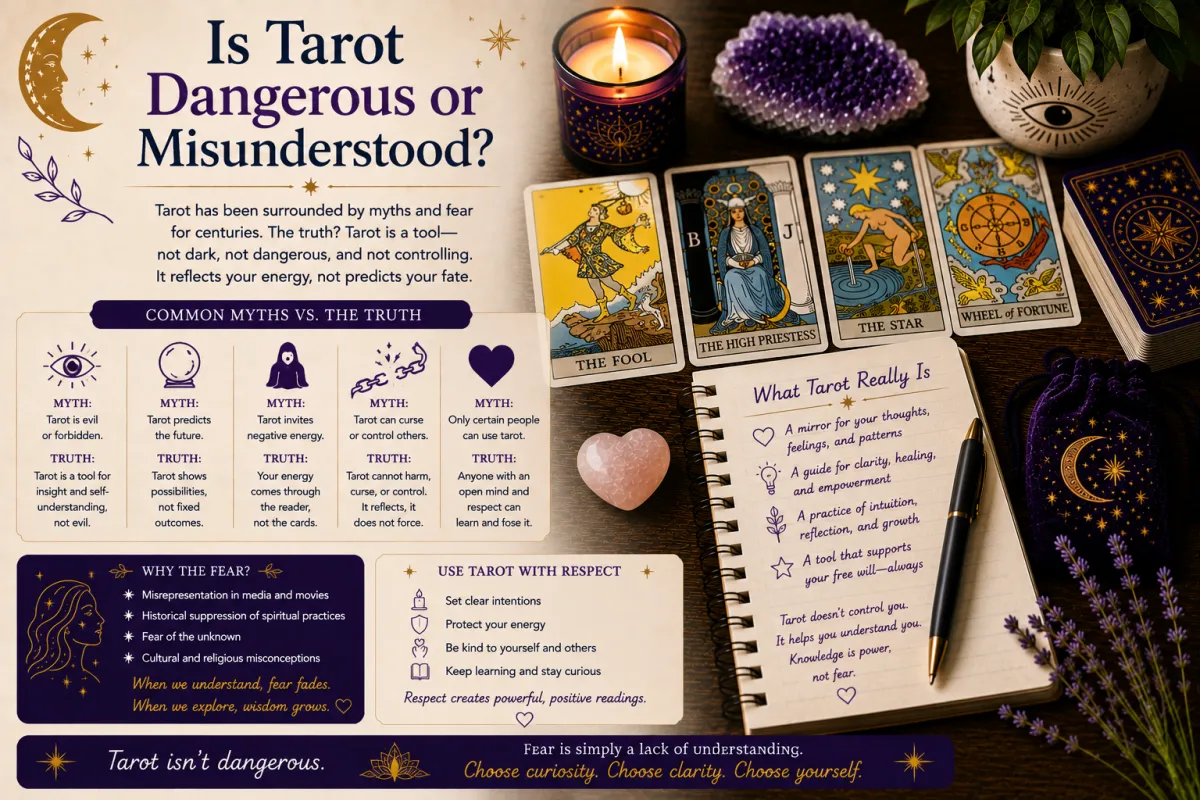
Is Tarot Dangerous or Misunderstood?
TL;DR
Tarot is often misunderstood rather than dangerous. Most people use Tarot as a tool for reflection, self-awareness, and personal insight rather than something harmful or negative.
IN SHORT
Tarot has attracted myths and misunderstandings for generations.
Some people view it as:
• Dangerous
• Supernatural
• Negative
• Something to fear
Others see it as:
• A reflective tool
• A creative practice
• A method of self-exploration
• A way to gain perspective
Much of the confusion comes from misunderstanding what Tarot actually is.
REAL TALK
Many fears surrounding Tarot come from movies, television, and popular culture.
Tarot is often portrayed as mysterious, dramatic, or frightening.
In reality, most Tarot readings involve someone sitting quietly, asking thoughtful questions, and reflecting on the cards.
There is usually far less drama and far more self-reflection than people expect.
Where The Misconceptions Come From
Tarot has existed for centuries.
Over time, different cultures and belief systems have interpreted Tarot in different ways.
As a result, many myths have developed.
Common misconceptions include:
• Tarot predicts a fixed future
• Tarot controls events
• Tarot attracts bad luck
• Tarot should never be questioned
• Tarot is only for gifted people
None of these ideas reflect how most modern readers use Tarot.
Tarot Is A Tool
A useful way to think about Tarot is as a tool.
Just as a journal helps organise thoughts, Tarot helps explore ideas, emotions, and situations from different perspectives.
The cards themselves do not make decisions.
They encourage reflection.
Why Some People Feel Uncomfortable
Tarot often encourages honesty.
The cards may highlight:
• Fears
• Uncertainty
• Avoidance
• Personal patterns
• Difficult emotions
Sometimes that discomfort can be mistaken for danger.
In reality, it is often simply self-awareness.
Different People Use Tarot Differently
People approach Tarot for many reasons.
Some use it for:
• Personal growth
• Reflection
• Creativity
• Spiritual exploration
• Decision-making
There is no single correct approach.
The value usually comes from the insight and reflection it encourages.
Focus On Healthy Use
Like any reflective practice, Tarot works best when approached with balance.
Healthy Tarot use involves:
• Critical thinking
• Personal responsibility
• Curiosity
• Reflection
The cards should support your judgement, not replace it.
WHY THIS WORKS
Many fears disappear once people understand what Tarot actually involves.
Knowledge often replaces uncertainty, allowing people to approach the cards with greater confidence and perspective.
COMMON MISTAKE
Mistake:
Assuming Tarot controls outcomes or predicts a fixed future.
Fix:
View Tarot as a tool for reflection and insight rather than certainty.
COFFEE CUP TIP ☕
If you're unsure about Tarot, focus on what the cards encourage you to think about rather than what they supposedly predict.
That simple shift often changes the entire experience.
FAQ QUICK FIX
Tarot is generally misunderstood more often than it is dangerous.
Most readers use Tarot to:
Reflect on situations
Explore perspectives
Understand emotions
Encourage self-awareness
Support decision-making
QUICK RECAP
Tarot has collected many myths over the years.
For most people, it is simply a reflective tool that encourages insight, perspective, and personal understanding.
RELATED QUESTIONS
→ Why Does Tarot Feel So Overwhelming at First?
→ What Should Beginners Learn First in Tarot?
→ How Long Does It Take to Learn Tarot?
NEXT STEP
Many beginners discover that Tarot feels far less intimidating once they understand the basics.
The next step is exploring why Tarot can feel overwhelming when you're first getting started.
