Should You Change Tarot Decks as You Gain Experience?
TL;DR
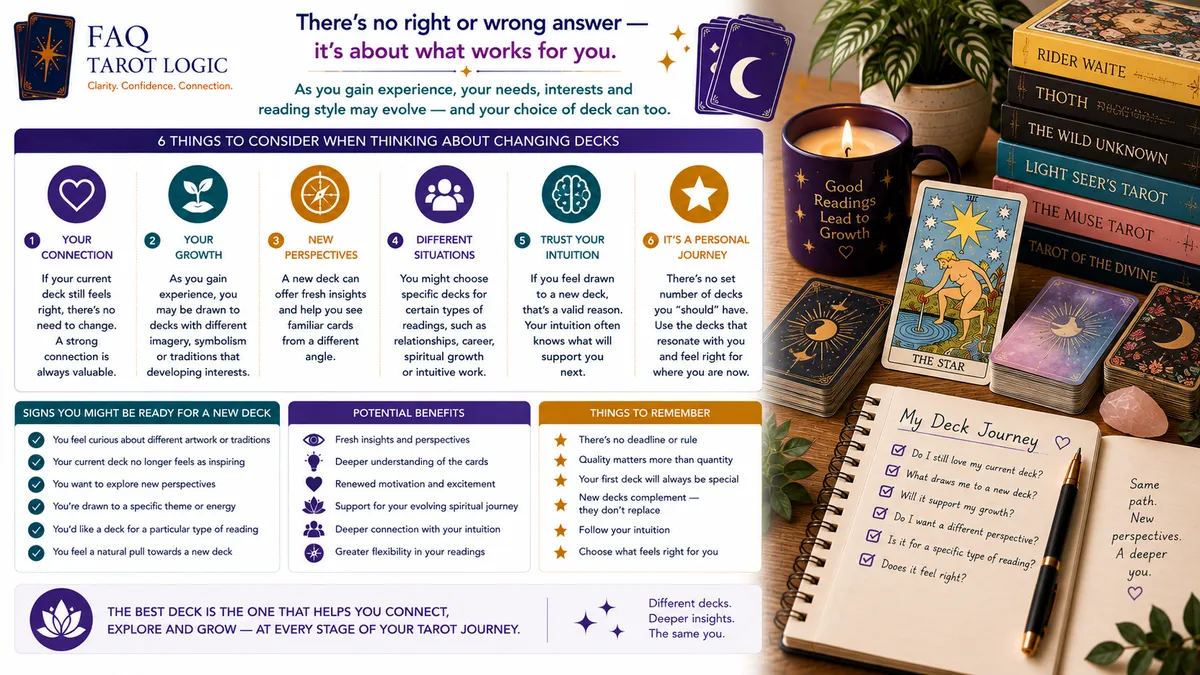
You don't need to change tarot decks simply because you've become a more experienced reader. If your current deck still feels clear, comfortable and useful, there's no reason to replace it. However, experience may change what you want from a deck, and exploring different artwork, symbolism or styles can sometimes help you develop your interpretation skills. The best deck isn't necessarily the most advanced one. It's the one that supports the way you read.
IN SHORT
Your first tarot deck doesn't have an expiry date.
You don't graduate from a beginner deck and automatically need an "advanced" one.
Some readers use the same deck for years.
Others gradually build a collection and choose different decks for different kinds of readings.
Both approaches are perfectly reasonable.
The question isn't:
"Am I experienced enough for a different deck?"
A better question is:
"Does my current deck still work well for the way I read tarot?"
There Is No Such Thing As Graduating From A Beginner Deck
When you're learning tarot, you're often advised to choose a deck with clear imagery and familiar symbolism.
That makes sense.
But a beginner-friendly deck doesn't suddenly become less useful once you've gained experience.
In fact, familiarity can make it more valuable.
You've spent time learning:
Its imagery.
Its symbols.
Its colours.
Its characters.
Its small visual details.
How particular cards tend to speak to you.
That familiarity can create depth.
You don't need to abandon it simply because you've become a better reader.
If you're still interested in what makes a good first deck, you can revisit:
→ How Do You Choose Your First Tarot Deck?
Experience May Change What You Notice
Although you don't need a new deck, your relationship with tarot imagery may change.
When you first started, you may have concentrated mainly on remembering card meanings.
Now you might notice:
Symbolism.
Body language.
Background details.
Relationships between figures.
Repeated colours.
Visual connections between cards.
As your interpretation skills develop, you may become interested in decks that provide more visual material to explore.
That's not because your original deck has become too basic.
Your interests have simply developed.
Ask Why You Want Another Deck
Before buying or switching decks, ask yourself what you're hoping will change.
Perhaps you want:
Different artwork.
Richer symbolism.
A deck that feels easier to interpret visually.
A different interpretation of traditional imagery.
A deck suited to a particular kind of reflective reading.
A fresh perspective on familiar cards.
Those are useful reasons to explore.
But if the answer is:
"I think experienced tarot readers are supposed to use something different,"
there's no need.
Experience isn't measured by the deck sitting on your table.
A New Deck Can Refresh Familiar Meanings
One benefit of trying another deck is seeing familiar cards represented differently.
Suppose you've interpreted The Hermit hundreds of times in one deck.
Another artist may portray the same archetype in a way that emphasises something you hadn't previously considered.
Perhaps solitude becomes more prominent.
Or searching.
Wisdom.
Distance.
Reflection.
The underlying card hasn't changed, but the artwork can encourage you to explore another aspect of its meaning.
That can be particularly useful once you're comfortable with the traditional foundations.
→ Why Do Tarot Cards Have Different Meanings?
Different Artwork Can Strengthen Your Symbolism Skills
A new deck can encourage you to look more closely at imagery rather than relying entirely on familiar keywords.
You may encounter:
Different objects.
New colour choices.
Alternative landscapes.
Changed character positions.
Different cultural or artistic influences.
Symbols that aren't present in your usual deck.
Instead of immediately deciding whether the new imagery is "right" or "wrong," ask:
"What does this version encourage me to notice?"
Comparing decks can become an interesting way to strengthen visual interpretation.
→ How Do You Read Tarot Symbolism?
But Familiarity Has Advantages Too
New isn't automatically better.
A deck you've used for a long time has an important advantage:
you know it.
You may recognise small details immediately.
Certain cards may remind you of previous readings.
You understand how the artwork communicates particular themes.
That familiarity reduces the amount of effort required to understand the imagery.
It allows you to concentrate on the question, context and relationships between cards.
So don't underestimate the value of staying with a deck you already understand well.
You Don't Need A Different Deck For Every Situation
It's easy to start thinking that every type of reading requires a specialised deck.
One for relationships.
Another for career questions.
Another for personal reflection.
Another for decision-making.
You certainly can use different decks if you enjoy doing so.
But you don't need to.
A versatile tarot deck can explore many different situations because the context comes largely from the question and the way the cards interact.
The deck doesn't have to be specifically designed for every subject you explore.
Multiple Decks Can Be Useful
Although they're not necessary, owning more than one deck can have advantages.
You might have:
A familiar everyday deck.
A deck with particularly detailed symbolism.
A deck you enjoy using for reflective readings.
A deck you're currently studying.
A deck whose artwork gives you a very different perspective.
Different decks can encourage different ways of looking at the same themes.
The important thing is that each deck adds something useful rather than simply becoming another deck you feel you ought to own.
Don't Mistake Collecting For Learning
Tarot decks can be beautiful, and there's nothing wrong with collecting them if that's something you enjoy.
But buying more decks doesn't automatically improve your reading skills.
If your goal is to become a stronger reader, you'll usually learn more by spending time interpreting cards than continually changing decks.
One deck used regularly can teach you more than twenty decks that rarely leave their boxes.
Practice creates experience.
The number of decks you own doesn't.
Give A New Deck Time
A new deck may feel unfamiliar at first.
That doesn't necessarily mean you've chosen the wrong one.
You've lost the familiarity you had with your usual cards.
Spend some time with it.
You could:
Look through the entire deck.
Compare familiar cards with your usual version.
Use it for simple one-card readings.
Try a few three-card spreads.
Record what stands out.
Notice which cards feel particularly different.
Allow yourself time to learn the deck before deciding whether it suits you.
Compare The Same Card Across Two Decks
A useful exercise is to choose one card and place the versions from two decks beside each other.
Ask:
What's similar?
What's different?
Which symbols appear in both?
What has the second artist emphasised?
Does one image suggest an interpretation you hadn't considered?
Which aspects of the traditional meaning remain consistent?
This can help separate the core meaning of the card from the particular artwork you're used to seeing.
It also strengthens your ability to interpret rather than simply recognise familiar images.
Don't Assume More Abstract Means More Advanced
Some decks use artwork that departs considerably from traditional tarot imagery.
That can be fascinating.
It can also be harder to interpret.
But difficulty doesn't automatically make a deck more advanced or more valuable.
A clear deck isn't somehow less sophisticated because the symbolism is easy to recognise.
The purpose of the deck is to support your reading.
If highly abstract artwork makes every spread harder to understand, there's no prize for struggling with it.
Choose clarity over complexity when clarity serves you better.
Your Reading Style Can Influence Your Deck Choice
As your personal reading style develops, you may discover that certain decks suit it particularly well.
If you rely heavily on visual symbolism, detailed artwork may be valuable.
If you prefer traditional meanings and structured spreads, a deck that closely follows familiar imagery may suit you better.
If you tend to read cards as a story, you might prefer artwork where the scenes interact naturally.
Your deck choice can gradually become an extension of your reading style.
→ How Do You Develop Your Own Tarot Reading Style?
A New Deck Can Challenge Your Habits
Familiarity is useful, but sometimes it can make interpretation automatic.
You see a familiar card and immediately think:
"I know what this means."
A different deck can interrupt that habit.
Because the image has changed, you may stop and look properly.
That can encourage you to reconsider:
The question.
The symbolism.
The card's position.
The surrounding cards.
Your usual interpretation.
Used occasionally, a different deck can therefore become a useful learning exercise.
You Can Return To Your Original Deck
Trying another deck isn't a permanent commitment.
You may use a new deck for several weeks and decide you prefer your original one.
That's not going backwards.
You've simply learned something about your preferences.
You might also discover that you enjoy both decks for different reasons.
There doesn't need to be a single deck that replaces everything else.
Know When A Deck No Longer Works For You
Occasionally, your relationship with a deck genuinely changes.
Perhaps:
The imagery no longer appeals to you.
You find the symbolism difficult to connect with.
Another deck suits your reading style much better.
Your interests have changed.
You simply no longer enjoy using it.
You don't need to force yourself to continue with a deck because it was your first one.
Equally, you don't need to stop using it because you've gained experience.
Let usefulness rather than experience determine the decision.
Experience Is In The Reader, Not The Deck
An experienced reader can create a thoughtful reading with a simple, familiar deck.
A complicated deck doesn't create an experienced reader.
Your development comes from:
Practice.
Reflection.
Learning card meanings.
Understanding symbolism.
Reading cards together.
Recognising context.
Asking better questions.
Reviewing your interpretations.
Becoming comfortable with uncertainty.
The deck provides the images.
Your experience determines how you work with them.
Coffee Cup Tip ☕
If you're considering a new deck, don't ask:
"Is this deck more advanced?"
Ask:
"What could this deck add to the way I already read?"
If you have a clear answer, exploring it may be worthwhile.
If you don't, there's nothing wrong with continuing to use the deck you already enjoy.
QUICK RECAP
You don't need to change tarot decks as you gain experience because:
Beginner-friendly decks remain useful at every level.
Familiarity can deepen interpretation.
Experience may change what you want from the imagery.
New decks can provide fresh perspectives.
Different artwork can strengthen symbolism skills.
Multiple decks can be useful but aren't necessary.
Buying decks doesn't replace practising.
New decks need time to become familiar.
Abstract artwork isn't automatically more advanced.
Your developing reading style may influence your preferences.
A different deck can challenge automatic interpretations.
You can always return to an old favourite.
There is no deck you have to graduate to.
The best tarot deck is the one that helps you read clearly, thoughtfully and confidently.
NEXT STEP
Changing decks is only one of the choices you may encounter as your tarot practice develops.
The more useful question is often not whether you need different tools, but how your own skills, habits and approach continue to grow through experience.
