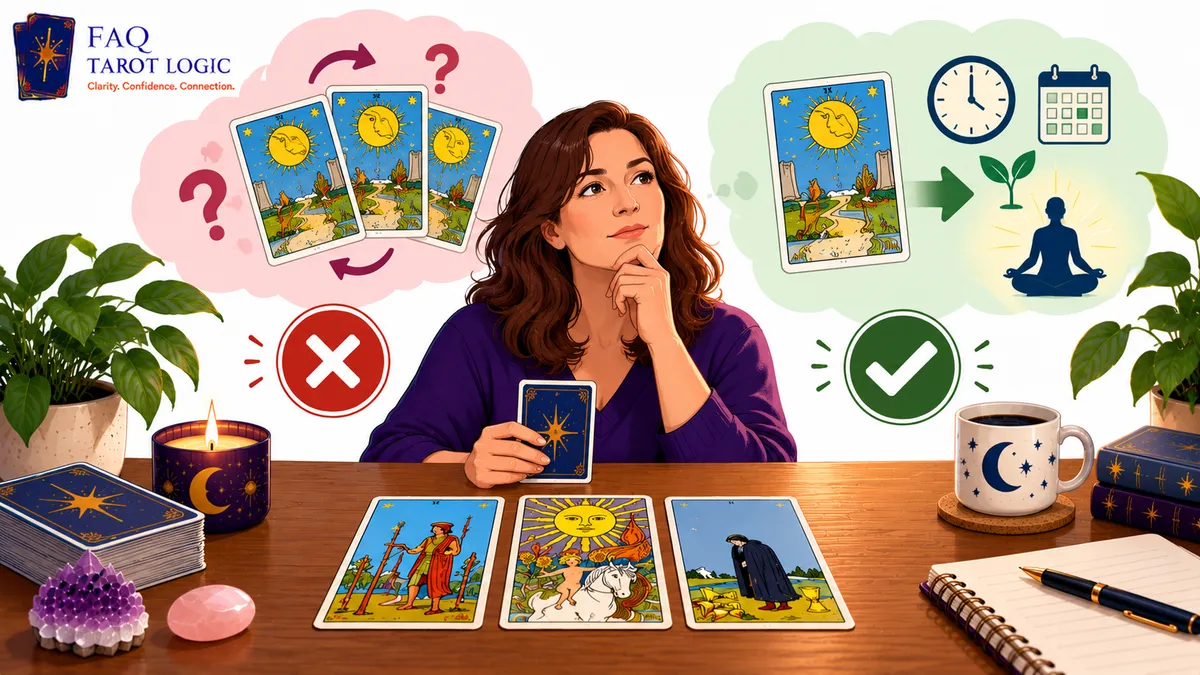
Should You Read Tarot About the Same Situation More Than Once?
TL;DR
You can read tarot about the same situation more than once, but the reason for returning to the question matters. A new reading can be useful when circumstances have changed, new information has emerged or you want to explore a genuinely different aspect of the situation.
However, repeatedly asking because you dislike an earlier interpretation can create confusion and encourage reassurance-seeking. The key is knowing whether another reading will provide a fresh perspective or simply repeat what you've already explored.
IN SHORT
You've completed a tarot reading.
The cards seem reasonably clear.
But a few hours later, you're thinking about the situation again.
Perhaps you're wondering whether you interpreted something correctly.
Maybe you're hoping for a different outcome.
Or perhaps you simply want more information.
So you reach for the cards again.
Is it okay to read tarot about the same situation more than once?
Yes.
But there's an important difference between returning to a situation because something has changed and repeating a reading because you're uncomfortable with the first one.
Understanding that difference can make your tarot practice more thoughtful and useful.
There's No Rule Against Reading About The Same Situation
Tarot doesn't have a fixed rule saying you can only explore a particular situation once.
Some situations develop over days, weeks or months.
A career decision may involve several stages.
A relationship may change as new conversations take place.
A personal challenge may become clearer as you gain experience.
Returning to these situations can be useful.
The important question isn't how many times you've read about something.
It's what you hope to learn from another reading.
Understand Why You Want Another Reading
Before shuffling, ask yourself:
"Why am I returning to this situation?"
Perhaps:
Something has changed.
You've received new information.
You've taken action since the previous reading.
You want to explore a different perspective.
You're reviewing how the situation has developed.
Those can be reasonable reasons to read again.
But perhaps you're returning because the original interpretation made you uncomfortable.
That's worth recognising before drawing more cards.
Repeating A Question Isn't The Same As Exploring It Further
Imagine asking:
"Should I accept this opportunity?"
You complete a reading and consider the cards.
An hour later, you ask exactly the same question.
Then you ask it again the following morning.
Nothing about the opportunity has changed.
You haven't received new information or made a decision.
You're simply hoping another spread will provide greater certainty.
That can become an unhelpful cycle.
→ What Happens When You Ask Tarot the Same Question Repeatedly?
Ask What's Changed Since The Previous Reading
One of the simplest ways to decide whether another reading is worthwhile is to identify what's different.
For example, perhaps you previously explored whether to begin a new project.
Since then:
You've discovered the actual costs.
Someone has offered to help.
Your available time has changed.
You've identified a potential problem.
You've made an initial commitment.
You now have additional information.
A new reading could help you reflect on the situation as it currently stands.
That's different from repeating the original question without anything changing.
Give The First Reading Time
Not every tarot reading becomes completely clear straight away.
Sometimes you need time to consider the cards.
A particular interpretation may seem uncertain.
One card may not fit your initial understanding.
Or you may simply need some distance from the question.
Before starting again, return to the original spread.
Ask:
"Have I properly considered what these cards might be saying?"
You may discover that another reading isn't necessary.
→ What Should You Do If a Tarot Reading Doesn't Make Sense Straight Away?
Don't Keep Reading Until You Get The Answer You Want
This is one of the easiest habits to develop without noticing.
You ask a question.
The interpretation isn't particularly reassuring.
So you try again.
The next reading feels more positive.
Now you're happier.
But what actually changed?
If you only accept interpretations that support what you already want, tarot becomes less useful as a reflective tool.
A more balanced approach means being willing to consider uncomfortable possibilities without treating them as inevitable outcomes.
Recognise When You're Seeking Reassurance
Sometimes the desire for another reading comes from anxiety rather than curiosity.
You may find yourself thinking:
"I just need to check one more time."
But after checking, you still feel uncertain.
So you repeat the process.
The difficulty is that another reading may provide temporary reassurance without addressing the underlying uncertainty.
If you notice this pattern, consider stepping away from the cards.
You may need time, practical information or a conversation rather than another spread.
→ How Do You Avoid Fear-Based Tarot Reading?
Explore A Different Aspect Of The Situation
Returning to the same situation doesn't necessarily mean asking the same question.
Suppose your first reading explored:
"What should I consider before making this decision?"
A later reading might ask:
"What practical challenges should I prepare for?"
Or:
"What assumptions might be influencing my thinking?"
Or:
"What could help me approach the next stage more effectively?"
These questions explore different aspects of the same situation.
You're not trying to replace the first reading.
You're building on it.
Make Sure The New Question Has A Purpose
Changing the wording isn't enough on its own.
For example:
"Will this work?"
"Is this going to succeed?"
"Will everything turn out well?"
These are essentially variations of the same question.
If you want a genuinely different reading, identify what new perspective you're trying to explore.
Better questions give the cards a clearer purpose.
→ How Can You Ask Better Questions During a Tarot Reading?
Review Your Original Reading First
Before returning to a situation, look at your previous reading.
What did you ask?
Which cards appeared?
What did you conclude?
Was there something you intended to do afterwards?
Have your circumstances changed?
Reviewing these details can help you decide whether another reading is necessary.
It also prevents you from treating every reading as though you're starting from nothing.
Keep A Record Of Related Readings
If you regularly explore a situation over time, keeping a simple record can be particularly useful.
You might note:
The date.
The question.
The cards.
Your interpretation.
What has changed since the previous reading.
Any action you've taken.
This creates a record of how both the situation and your understanding have developed.
You may begin noticing patterns that aren't obvious when looking at individual readings.
→ Should You Keep a Tarot Journal?
Avoid Comparing Readings As Predictions
Suppose your first reading feels encouraging.
Your second reading seems more cautious.
Does that mean one of them was wrong?
Not necessarily.
They may be highlighting different aspects of the situation.
Your questions may have been different.
Your circumstances may have changed.
Or you may have interpreted the cards differently.
Instead of asking which reading is correct, consider what each one helped you explore.
Tarot doesn't need to produce identical interpretations to be useful.
Don't Assume Different Cards Mean Something Has Changed
If you ask the same question twice, you'll probably draw different cards.
That alone doesn't prove the situation has changed.
A different spread can offer another perspective without representing a new development.
Be careful not to treat every new card combination as evidence that something significant has happened.
Look for actual changes in the situation before drawing conclusions.
Consider Whether You've Acted On The First Reading
Sometimes we return to tarot because thinking feels easier than doing.
Perhaps your first reading helped you recognise that you needed more information.
But you haven't gathered it.
Or you realised a conversation was necessary.
But you've avoided having it.
Before drawing again, ask:
"Have I done anything with what I learned last time?"
If not, the next useful step may involve action rather than another reading.
Use Tarot To Support Decisions, Not Delay Them
Important decisions can feel uncomfortable.
There's often no way to remove every uncertainty.
Repeated tarot readings may create the impression that one more spread will finally provide the perfect answer.
But that certainty may never arrive.
Tarot can help you examine possibilities, priorities and concerns.
It shouldn't become a substitute for making decisions using the information available to you.
→ Can Tarot Help With Decision-Making?
Allow Enough Time Between Readings
There's no universal waiting period.
You don't have to wait seven days, a month or any other fixed amount of time.
What matters is whether another reading has a useful purpose.
If something important changes tomorrow, another reading may be reasonable.
If nothing has changed for several weeks, repeating the question may still add little.
Let the situation guide the timing rather than following an arbitrary rule.
Notice Your Emotional State
If you're particularly anxious, excited or disappointed, you may feel a stronger urge to consult the cards repeatedly.
That doesn't mean you shouldn't read.
But it does mean your emotional state deserves attention.
Ask yourself whether you're able to consider interpretations you may not like.
If the answer is no, waiting may help.
→ Should You Read Tarot When You're Feeling Emotional?
Try Using Fewer Cards
If you decide another reading would be useful, you don't necessarily need a large spread.
A focused three-card layout might explore:
What has changed?
What deserves attention now?
What could help me move forward?
This keeps the reading connected to the present situation.
It also reduces the temptation to keep adding cards in search of certainty.
Don't Turn Every Development Into Another Reading
When a situation matters to you, even small changes can feel significant.
A message arrives.
Someone makes a comment.
A meeting is postponed.
You start wondering what it all means.
But not every development needs a tarot reading.
Sometimes the most useful response is simply to wait for more information.
Learning when not to read can be part of becoming a more confident reader.
Know When To Stop
If repeated readings leave you feeling increasingly confused, anxious or dependent on the cards, it's worth taking a break.
You don't have to solve every uncertainty through tarot.
Put the cards away.
Return to the practical situation.
Consider what you know and what remains outside your control.
A pause can give you more perspective than another spread.
Learn From Readings Over Time
Repeated readings can be useful when they form part of thoughtful reflection rather than reassurance-seeking.
For example, you might explore a personal goal at the beginning of a month.
At the end of the month, you could review:
What changed.
What you learned.
What actions you took.
Which challenges remain.
What deserves attention next.
You're not asking tarot to repeat its earlier answer.
You're using the practice to reflect on progress.
Coffee Cup Tip ☕
Before reading about a familiar situation, ask yourself three questions:
1. What has changed since my last reading?
2. What new perspective am I hoping to explore?
3. Am I looking for understanding or reassurance?
If you can't identify anything new and you're mainly hoping for a more comforting answer, consider returning to your previous reading instead.
Sometimes the most useful next step is to work with the cards you've already drawn.
QUICK RECAP
Reading tarot about the same situation more than once can be useful when you:
Have new information to consider.
Recognise that circumstances have changed.
Want to explore a genuinely different aspect.
Have taken action since the previous reading.
Need to reflect on how a situation has developed.
Review your earlier interpretations.
Keep records of related readings.
Allow enough time for reflection.
Ask focused questions.
Avoid using tarot simply to seek reassurance.
Recognise when emotions are influencing your approach.
Know when another reading isn't necessary.
You don't need a strict rule limiting how often you can revisit a situation.
But you do need a reason for doing so.
A useful second reading should help you explore something new, not simply give you another chance to hear the answer you wanted the first time.
NEXT STEP
Returning to a familiar situation can be helpful when you have a clear reason for doing so.
But whether you're exploring a new question or revisiting an old one, the quality of your interpretation still depends on how carefully you examine the cards.
Sometimes one particular detail in a card catches your attention while everything else seems less relevant.
Learning how to recognise which parts of a card deserve your attention can help you develop more focused interpretations.
Next topic: How Do You Know Which Part of a Tarot Card to Focus On?
