Using Tarot for Clarity, Self-Reflection and Better Decision-Making
TL;DR
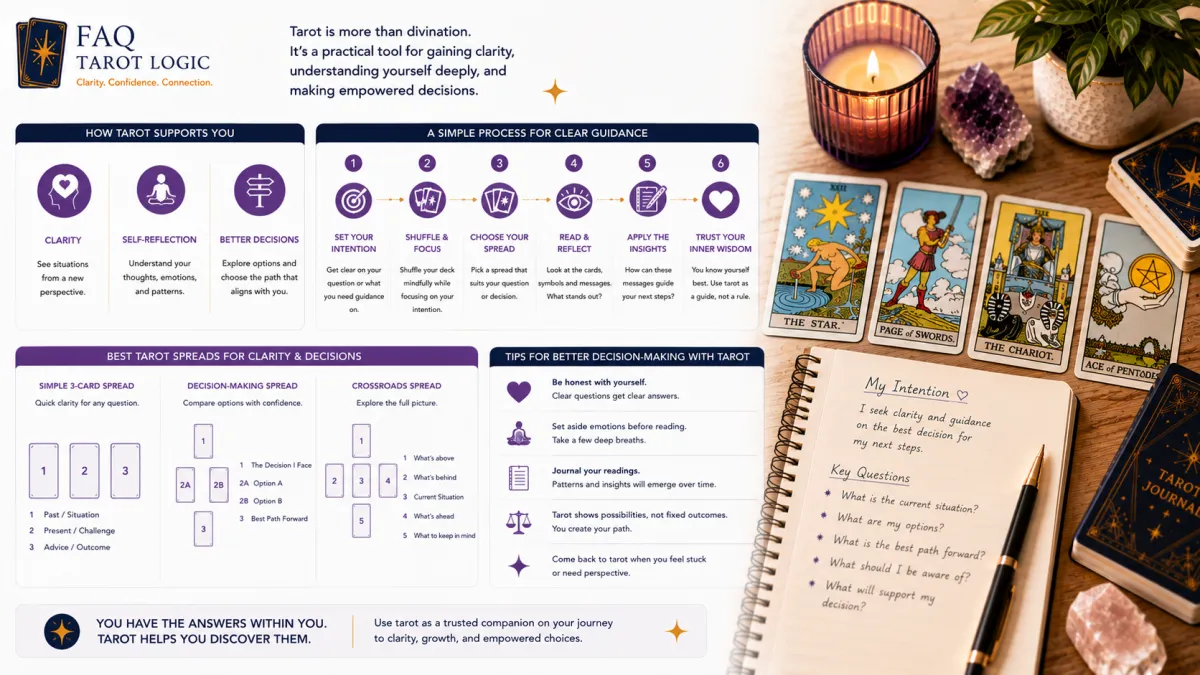
Tarot is a powerful tool for gaining clarity, understanding your thoughts and emotions, and exploring different perspectives before making decisions. Rather than telling you what will happen, tarot encourages thoughtful reflection so you can make choices with greater confidence and awareness.
IN THIS GUIDE
In this guide you'll learn:
How tarot supports better decision-making
Why self-reflection is central to every reading
Using tarot during periods of uncertainty
Avoiding fear-based interpretations
Why asking the same question repeatedly can create confusion
How tarot can help reduce overthinking
Building confidence in your own judgement
Whether you're facing a major life decision or simply seeking a fresh perspective, tarot can help you explore your options with greater clarity.
Introduction
Life is full of decisions.
Some are small and everyday, while others have the potential to change the direction of our lives.
Whether you're considering a career move, navigating a relationship, facing a period of uncertainty or simply trying to understand yourself better, it's natural to want greater clarity before deciding what to do next.
Many people turn to tarot hoping the cards will provide definitive answers.
In reality, tarot offers something far more valuable.
Rather than making decisions for you, tarot helps you explore possibilities, recognise patterns and reflect on situations from different perspectives.
The cards don't remove uncertainty.
Instead, they help you understand it.
This guide explores how tarot can become a practical tool for thoughtful decision-making and personal growth.
Tarot Is a Tool for Reflection, Not Prediction
One of the biggest misunderstandings about tarot is the belief that it predicts an unchangeable future.
Most experienced readers approach tarot very differently.
Instead of asking:
"What will happen?"
They ask:
What am I overlooking?
What should I understand about this situation?
What options are available?
What lesson can I learn here?
These questions encourage reflection rather than passive prediction.
Tarot doesn't replace your judgement.
It helps you strengthen it.
Making Better Decisions with Tarot
Every decision involves uncertainty.
Sometimes we're missing information.
Sometimes our emotions influence how we see a situation.
Sometimes fear prevents us from moving forward.
Tarot encourages you to pause before reacting.
By exploring different perspectives, you often notice opportunities, concerns or patterns that weren't immediately obvious.
Instead of rushing towards an answer, tarot encourages thoughtful consideration.
It doesn't tell you what choice to make. Instead, it helps you understand the situation more clearly, weigh your options and recognise the factors that deserve your attention.
Used in this way, tarot becomes less about finding certainty and more about making thoughtful, informed decisions with greater confidence.
Understanding Yourself More Clearly
Many people discover that tarot becomes less about predicting events and more about understanding themselves.
The cards can encourage questions such as:
Why am I reacting this way?
What belief is influencing this decision?
What am I avoiding?
What matters most to me?
These questions develop self-awareness.
As your understanding of yourself grows, decision-making often becomes much easier.
Tarot doesn't change who you are.
It simply helps you see yourself more clearly.
For more on this topic, see:
→ Can Tarot Improve Self-Awareness?
Using Tarot During Times of Change
Periods of change often create uncertainty.
Changing careers.
Moving home.
Starting or ending relationships.
Beginning new opportunities.
During these moments it's easy to feel overwhelmed by possibilities.
Tarot helps slow the process down.
Rather than trying to predict every outcome, the cards encourage you to consider your priorities, your concerns and the practical steps available to you.
Sometimes the greatest insight isn't discovering the "right" answer.
It's recognising which direction feels most aligned with your values.
To learn more, read:
→ Can Tarot Help During Difficult Life Changes?
Avoiding Fear-Based Readings
Fear can easily influence the way we interpret tarot.
When we're anxious, it's tempting to focus only on cards that appear negative while ignoring the wider context of the reading.
Experienced readers understand that every card contains opportunities for learning.
Even traditionally challenging cards often encourage:
Growth
Awareness
Preparation
Honest reflection
Rather than asking:
"What terrible thing is going to happen?"
Try asking:
"What can I learn from this situation?"
That simple shift often changes the entire reading.
If this is something you've experienced, read:
→ How Do You Avoid Fear-Based Tarot Reading?
Why Repeating the Same Question Rarely Helps
One of the most common beginner habits is asking the same question repeatedly.
If the first reading feels unclear, it's tempting to shuffle again and hope for a different answer.
Unfortunately, this usually creates more confusion.
Each new reading introduces additional information, making it harder to recognise the original message.
Instead of repeatedly asking the same question, spend time reflecting on your first reading.
Allow yourself to consider its themes before returning to the cards.
If you'd like to explore this in greater depth, read:
→ What Happens When You Ask Tarot the Same Question Repeatedly?
Reducing Overthinking
Overthinking often happens when we search endlessly for certainty.
Tarot reminds us that certainty isn't always possible.
Instead, it encourages thoughtful reflection followed by action.
Sometimes a reading doesn't eliminate every doubt.
Instead, it helps identify the next sensible step.
Small, confident actions usually create more progress than waiting for perfect certainty.
If overthinking is something you struggle with, read:
→ Can Tarot Help Reduce Overthinking?
Trusting Yourself
Perhaps the greatest gift tarot offers isn't prediction.
It's confidence.
Not confidence that every decision will be perfect.
But confidence that you have the ability to think carefully, reflect honestly and make choices aligned with your values.
Over time, many readers discover that tarot becomes less about seeking external answers and more about strengthening their own judgement.
That's where lasting confidence comes from.
Coffee Cup Tip ☕
Before asking the cards what you should do, ask yourself what you already know. Tarot often confirms insights that are already waiting beneath the surface.
QUICK RECAP
Using tarot for decision-making works best when you:
Use the cards to explore possibilities rather than predict outcomes.
Reflect honestly on your thoughts and emotions.
View uncertainty as an opportunity for learning.
Avoid fear-based interpretations.
Resist repeating the same question.
Take practical action after each reading.
Trust your own judgement alongside the insights the cards provide.
The goal isn't to remove uncertainty—it's to approach it with greater clarity and confidence.
NEXT STEP
Once you've learned how tarot can support better decisions and deeper self-reflection, the final step is developing confidence in your own intuition. Discover how to trust your interpretations while recognising the difference between intuition and fear in Developing Tarot Intuition: Reading with Confidence and Trust.
