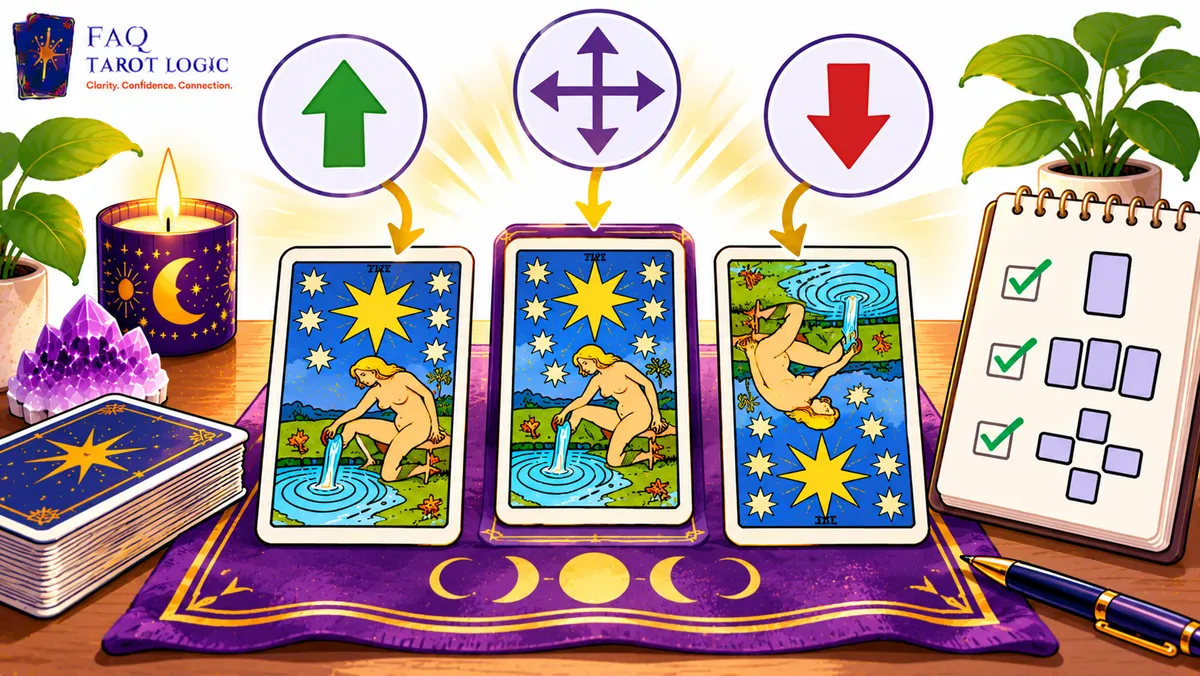
How Do Tarot Card Positions Change Their Meanings?
A tarot card can have different meanings depending on its position in a spread because each position gives the card a particular role in answering your question. The same card might describe a past influence, highlight a present challenge or suggest something worth considering as you move forward.
Understanding the relationship between card meanings and spread positions helps you develop interpretations that are more relevant, balanced and useful.
IN SHORT
You've shuffled your tarot deck, laid out your cards and started interpreting the spread. One card immediately catches your attention because you recognise its traditional meaning.
But then you notice something interesting.
The card has appeared in a position labelled Challenge, even though you usually associate it with something positive.
Does that mean its meaning has changed?
Or should you interpret it exactly as you would if it appeared in the Advice position?
How do you interpret a tarot card differently depending on its position in a spread?
This is an important question because tarot interpretation involves more than knowing what individual cards represent. You also need to understand how their meanings relate to the question you're asking and the positions they occupy.
A card doesn't necessarily change its fundamental symbolism when it appears in a different position. Instead, the position helps you decide which aspects of its meaning are most relevant.
Learning to make that distinction can help you move beyond memorised definitions and develop a more flexible approach to reading tarot.
Why Does a Card's Position Matter in a Tarot Spread?
A tarot spread provides a structure for exploring a question. Each position represents a particular aspect of the situation, helping you organise the interpretation rather than treating every card as an isolated message.
For example, a simple three-card spread might use the positions Past, Present and Future. Another might use Situation, Challenge and Advice.
Although both spreads contain three cards, they encourage different kinds of interpretation.
In the first spread, you're considering how circumstances may have developed and what possibilities deserve attention. In the second, you're examining the current situation, identifying difficulties and exploring possible responses.
The cards themselves haven't changed, but the questions you're asking of them have.
This is why spread positions are so useful. They provide a framework that helps you connect traditional card meanings with the purpose of the reading.
Without that framework, it's easy to become distracted by every possible interpretation of a card.
With it, you can concentrate on the meanings that are most relevant to the question.
How the Same Tarot Card Can Have Different Meanings
Consider the Strength card, which is commonly associated with patience, courage, self-control and inner resilience.
Imagine drawing Strength in three different positions within separate readings.
Strength in the Past Position
If Strength appears in a position representing the past, you might consider how patience or resilience has influenced your present circumstances.
Perhaps you've already worked through a difficult experience or developed greater confidence through previous challenges.
The card could encourage you to recognise qualities you've demonstrated before.
Strength in the Challenge Position
Now imagine Strength appearing in a position representing a current difficulty.
Its traditional associations remain relevant, but the interpretation changes.
You might consider whether you're struggling to remain patient, finding it difficult to manage frustration or overlooking your ability to approach a situation calmly.
The card isn't necessarily suggesting that you lack strength. It may simply highlight an area where those qualities deserve attention.
Strength in the Advice Position
If Strength appears as advice, the emphasis could shift towards how you respond to your circumstances.
Rather than concentrating on past experiences or current difficulties, you might consider whether patience, confidence or emotional balance could help you move forward.
The same card has provided three different interpretations without losing its traditional meaning.
The position doesn't replace the card's symbolism. It helps you decide how to apply that symbolism.
What Happens When a Positive Card Appears in a Challenge Position?
One of the most confusing experiences for newer tarot readers is drawing a traditionally positive card in a position associated with difficulties.
For example, suppose the Sun appears in the Challenge position.
The Sun is commonly associated with clarity, optimism, confidence and positive energy. At first glance, those meanings might seem inconsistent with the position.
However, a challenge doesn't always have to represent something negative.
In this context, the Sun could encourage you to consider whether you're struggling to recognise positive possibilities, finding it difficult to maintain confidence or overlooking information that could make a situation clearer.
Alternatively, it might highlight the challenge of balancing optimism with realistic expectations.
The appropriate interpretation depends on your original question and the surrounding cards.
This is an important reminder that positive and negative labels can sometimes limit your understanding.
A card associated with encouraging qualities may still highlight an area where those qualities are difficult to express.
Similarly, a traditionally challenging card can offer constructive advice.
The aim isn't to reverse the card's meaning automatically, but to understand how its themes relate to the position.
Can a Challenging Tarot Card Offer Positive Advice?
Yes. Cards with uncomfortable imagery or difficult traditional meanings can still provide useful perspectives when they appear in an advice position.
Consider the Five of Cups.
This card is often associated with disappointment, regret or concentrating on what has been lost.
If it appears in a position representing advice, you wouldn't necessarily interpret it as a warning that disappointment is approaching.
Instead, you might consider whether acknowledging difficult feelings could help you move forward.
The card could also encourage you to recognise what remains available rather than concentrating entirely on what hasn't worked out.
Now consider the Eight of Cups.
In a position describing the current situation, it might represent dissatisfaction or the feeling that something no longer meets your needs.
In an advice position, it could encourage reflection on whether continuing along the same path remains worthwhile.
Neither interpretation requires you to treat the card as a definite instruction to leave a situation.
Instead, the symbolism provides a perspective worth considering alongside your practical circumstances.
A challenging card can offer constructive insight without becoming a prediction of an unpleasant outcome.
How Do Past, Present and Future Positions Change Interpretation?
Past, present and future spreads are popular because they provide a straightforward structure for exploring how a situation may be developing.
However, it's important to understand that the positions don't necessarily represent fixed events.
The past position can highlight previous experiences, established patterns or influences that may still be relevant.
The present position usually encourages you to consider your current circumstances, attitudes or concerns.
The future position can be approached as an opportunity to explore possible developments, emerging themes or considerations that may become important.
For example, imagine drawing the Two of Wands in each of these positions.
In the past, it might suggest that earlier planning or decisions have influenced your present circumstances.
In the present, it could highlight a current opportunity to consider different directions.
In the future, it might encourage you to think about how your plans could develop if you continue along your present course.
The card's associations with planning and possibilities remain consistent, but the position changes the perspective.
This approach also avoids treating the future position as a guaranteed prediction.
Tarot can support reflection on possibilities, but it doesn't remove uncertainty or determine what must happen.
Why the Original Question Still Matters
Even when you understand a card's position, you need to consider the question that prompted the reading.
A card appearing in the Advice position of a career reading may deserve a different interpretation from the same card appearing in the Advice position of a relationship reading.
Consider the Queen of Pentacles.
In a career reading, this card might encourage practical organisation, careful management of resources or creating a stable working environment.
In a reading about personal wellbeing, it could suggest paying attention to everyday needs, comfort and maintaining a manageable routine.
In a reading about relationships, you might consider themes of reliability, generosity and practical support.
The position tells you which aspect of the question you're exploring, while the card provides the symbolism you use to develop an interpretation.
Both elements are necessary.
This is why understanding context is often more useful than trying to memorise a single definition for every card.
→ Why Does Context Matter More Than Individual Card Meanings?
How Surrounding Cards Influence the Meaning of a Position
Although spread positions provide an important framework, tarot cards shouldn't always be interpreted independently.
The surrounding cards can help you understand how different parts of the reading relate to one another.
Imagine using a three-card spread with the positions Situation, Challenge and Advice.
You draw the Two of Pentacles, Seven of Cups and Eight of Pentacles.
The Two of Pentacles in the situation position might highlight competing responsibilities or the need to balance several priorities.
The Seven of Cups in the challenge position could suggest that too many possibilities are making it difficult to concentrate on one direction.
The Eight of Pentacles in the advice position might encourage consistent effort and developing a practical approach.
Together, these cards could suggest that simplifying your choices and concentrating on steady progress may be more useful than trying to pursue everything at once.
Each card has its own meaning, but the overall interpretation becomes clearer when you examine their relationship.
The spread positions help you organise those connections into a coherent explanation.
Without them, you might recognise three individual themes without understanding how they contribute to the original question.
What If a Card Seems Completely Out of Place?
Sometimes a card appears in a position where none of its familiar meanings seem relevant.
This can be frustrating, particularly when the other cards fit the spread quite naturally.
Suppose you draw the Four of Swords in a position representing action.
You may associate this card with rest, recovery and stepping away from activity. Those meanings might seem inconsistent with a position that appears to require doing something.
However, the interpretation may be simpler than you expect.
Perhaps the most useful action is to pause before making a decision, allow yourself time to reflect or avoid rushing into a response.
The card hasn't lost its traditional meaning. You've simply considered how that meaning could apply to the position.
Of course, not every card will produce an immediately satisfying interpretation.
Sometimes it's better to acknowledge uncertainty than force a connection that doesn't feel reasonable.
You can record the card, position and possible meanings in your tarot journal and revisit them later.
As your experience develops, you may find it easier to recognise connections that weren't obvious during the original reading.
Should You Follow Spread Positions Exactly?
Spread positions are helpful guides, but they don't need to become rigid rules that prevent thoughtful interpretation.
If you're using a recognised spread, it's generally useful to understand the intended purpose of each position before beginning.
This gives the reading a consistent structure and helps you avoid changing meanings simply because you prefer a different interpretation.
However, you can still consider how the cards relate to one another and whether a particular position deserves a broader explanation.
For example, a position labelled Obstacle might represent an external difficulty, an internal concern or something that requires further understanding.
You don't need to assume it must describe an unavoidable problem.
Similarly, a position labelled Outcome doesn't have to be interpreted as a fixed prediction. You can explore it as a possible direction or consequence worth considering.
The important thing is to establish what each position represents before drawing the cards.
Changing the purpose of a position after seeing an uncomfortable card can make the interpretation less consistent.
If you regularly find that a particular spread doesn't suit your questions, consider choosing a different layout rather than repeatedly changing its structure.
→ How Do You Know Which Tarot Spread to Use?
How to Practise Interpreting Cards in Different Positions
One of the best ways to become more comfortable with spread positions is to practise interpreting the same card in several different roles.
You don't need to conduct a complete reading every time.
Instead, choose a card you're already familiar with and consider how its traditional meanings might apply to different positions.
For example, select the Magician.
In a Situation position, you might consider whether the question involves making use of existing skills or resources.
In a Challenge position, you could explore whether confidence, preparation or recognising available opportunities is proving difficult.
In an Advice position, you might consider how taking initiative or using your abilities more effectively could help.
This exercise encourages you to explore several aspects of a card's symbolism without relying entirely on guidebook definitions.
You can repeat the process with other cards, including those you find more difficult to interpret.
Over time, you'll begin to recognise that tarot meanings are flexible without being arbitrary.
The position provides direction, but the interpretation still needs to remain connected to the card's established symbolism and the question being explored.
Avoid Making Every Position Mean the Same Thing
As you become more familiar with tarot, it's worth paying attention to whether you're genuinely using the spread positions.
Sometimes readers become so focused on traditional card meanings that they overlook the purpose of the layout.
For example, imagine drawing the Chariot in the Past, Present and Advice positions across three different readings.
If you interpret it as determination and progress every time without considering the position, you may miss useful distinctions.
In the past, it might encourage reflection on earlier determination or decisions that helped shape your circumstances.
In the present, it could highlight the importance of maintaining direction while managing competing demands.
As advice, it might suggest considering how greater focus or commitment could support your next steps.
The interpretations share familiar themes, but they aren't identical.
This is where spread positions become particularly valuable.
They help you move beyond simply identifying what a card represents and begin exploring why that meaning might matter in a particular part of the reading.
Coffee Cup Tip ☕
Try the One Card, Three Positions Exercise to practise developing more flexible tarot interpretations.
Choose a card from your deck and write down three positions:
1. Situation: What might this card suggest about the circumstances being explored?
2. Challenge: Which aspects of the card's meaning could highlight something difficult or uncertain?
3. Advice: How might the card's symbolism encourage a useful response or change in perspective?
Write two or three sentences for each position.
For example, if you choose the Temperance card, you might explore balance in the situation position, difficulty finding moderation in the challenge position and the value of patience in the advice position.
Once you've finished, compare your interpretations.
Notice how the central symbolism remains recognisable while the emphasis changes.
This simple exercise can help you become more confident with spread positions without needing to memorise a separate definition for every possible placement.
QUICK RECAP
A tarot card's position helps determine which aspects of its meaning are most relevant to the question being explored.
The card's traditional symbolism remains important, but its interpretation changes according to the role it plays within the spread.
Remember that:
Spread positions provide structure and direction for interpretation.
The same card can represent different themes in different positions.
Positive cards can highlight challenges, while difficult cards can offer constructive advice.
Past, present and future positions encourage different perspectives rather than guaranteeing outcomes.
The original question and surrounding cards remain important.
Spread positions should guide interpretation without becoming unnecessarily restrictive.
Practising with the same card in several positions can improve your flexibility and confidence.
The aim isn't to invent a completely different meaning every time a card appears.
Instead, you're learning how to apply familiar symbolism to different circumstances.
When you understand how card meanings and spread positions work together, your readings become more coherent, relevant and useful.
NEXT STEP
Understanding how spread positions influence tarot meanings is an important part of developing your interpretation skills.
However, you don't need to practise with complicated spreads every day to become a more confident reader.
Some people enjoy drawing cards as part of a regular routine, while others prefer to read only when they have a particular question or situation to explore.
Both approaches can support learning, but they offer different advantages.
Next topic: Should You Read Tarot Every Day or Only When You Have a Question?
