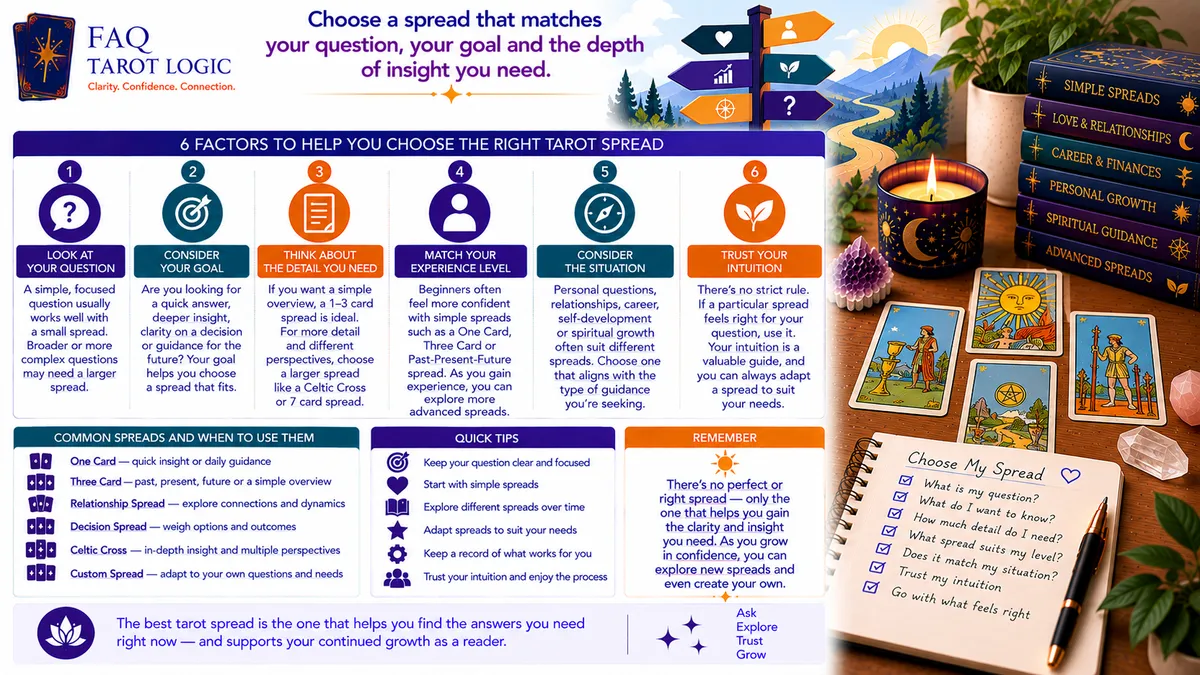
How Do You Know Which Tarot Spread to Use?
TL;DR
Choose a tarot spread based on what you want the reading to explore, not on how impressive or detailed the spread looks. A one-card or three-card spread may be enough for a focused question, while a larger spread can help when you need to examine several aspects of a more complicated situation.
The best spread is the one where every card position has a clear purpose and helps answer the question without adding unnecessary complexity.
IN SHORT
There are hundreds of tarot spreads available.
One card.
Three cards.
Five cards.
Relationship spreads.
Decision spreads.
Career spreads.
The Celtic Cross.
And countless layouts created for very specific situations.
So how do you know which one to use?
Start with the question.
Choose the spread to fit what you're trying to understand rather than choosing a spread first and trying to make the question fit it.
Start With What You're Actually Asking
Before deciding how many cards to draw, make sure you understand the question.
Suppose you're asking:
"What should I focus on today?"
You probably don't need ten cards.
One may be enough.
But if you're asking:
"What should I consider before deciding whether to change careers?"
you may want several positions exploring different aspects of the situation.
The complexity of the question should help determine the complexity of the spread.
One Card Can Be Enough
A one-card reading is sometimes dismissed as being too simple.
It isn't.
One card can work particularly well when you want:
A point of focus.
Something to reflect on.
A different perspective.
One factor to consider.
A theme for the day.
The advantage is focus.
You have one card to explore deeply rather than several cards competing for your attention.
For a straightforward question, that may be exactly what you need.
Three Cards Give You More Context
Three-card spreads are popular for good reason.
They're simple enough to interpret without becoming overwhelming, but they provide enough information to create relationships between cards.
You might use:
Situation → Challenge → Advice
or:
What I know → What I'm overlooking → What to consider
or:
Option → Influence → Possible direction
The positions can change according to what you're exploring.
You don't have to use Past → Present → Future simply because it's a familiar three-card spread.
→ What Is the Best Tarot Spread for Beginners?
Let Every Position Have A Job
A useful spread should tell you why each card is there.
If you draw five cards without deciding what they represent, you may end up trying to create meaning afterwards.
Instead, define the positions first.
For example:
What is happening?
What is influencing the situation?
What am I overlooking?
What can I influence?
What should I consider next?
Now each card answers a particular part of the wider question.
That structure can make interpretation considerably easier.
Match The Spread To The Question
Different questions need different structures.
For a decision, you might explore:
Option A → What it offers → What to consider
Option B → What it offers → What to consider
For a personal challenge:
Current situation → Main obstacle → Available strength → Helpful action
For a relationship:
My perspective → Their perspective → Shared dynamic → What deserves attention
The spread isn't predicting what must happen.
It's organising the reading so you can examine the situation from several useful angles.
Don't Use More Cards Than You Need
More cards don't automatically produce more insight.
They produce more information.
And more information means more relationships and possibilities to interpret.
If three cards answer the question clearly, drawing another seven may make the reading less useful.
Before choosing a large spread, ask:
"What will these additional positions help me understand?"
If you don't have a clear answer, you may not need them.
Choose A Spread You Can Actually Interpret
A twelve-card spread may look impressive.
But if you're spending most of the reading trying to remember what every position represents, it may not be helping.
Choose something you can comfortably work with.
That allows you to concentrate on:
The cards.
Their relationships.
The question.
The wider context.
You can always experiment with larger spreads as your confidence develops.
Use The Question To Create Your Own Spread
You don't always need to find an existing spread.
Sometimes the question itself tells you what positions you need.
Suppose you're wondering whether to begin a new project.
You could create:
What attracts me to this project?
What challenge should I consider?
What resources do I already have?
What might I be overlooking?
What would be a useful first step?
You've created a spread specifically for the situation.
This can be much more useful than searching for the perfect pre-designed layout.
Better Questions Create Better Spreads
If you're struggling to choose a spread, the real problem may be the question.
A vague question such as:
"Tell me about my career."
could go in dozens of directions.
But:
"What should I consider before looking for a different job?"
immediately suggests useful positions.
Clear questions make it easier to decide what information the spread actually needs to explore.
→ How Can You Ask Better Questions During a Tarot Reading?
Consider What You Already Know
Not every part of a situation needs a card.
Suppose you already know why you're considering changing jobs.
You may not need a position asking:
"Why do I want to leave?"
Instead, use that space to explore something you don't already understand.
A good spread shouldn't simply repeat information you already have.
It should help direct your attention towards what still needs consideration.
Avoid Positions That Ask The Same Thing
Sometimes a spread contains several positions that are really variations of the same question.
For example:
What should I know?
What should I understand?
What should I consider?
Those may produce unnecessary overlap.
Make each position distinct.
The clearer the difference between positions, the easier it becomes to understand what each card contributes.
Think About The Order Of The Cards
A spread can guide you through a logical process.
For example:
Situation → Influence → Challenge → Resource → Next step
That order makes sense because each position builds on the previous one.
When creating your own spread, imagine explaining the positions to someone else.
Does the sequence feel natural?
If it does, the resulting reading will often be easier to follow.
Small Spreads Can Produce Deep Readings
Don't confuse depth with size.
Three cards can produce a detailed reading when you explore:
Individual meanings.
Card combinations.
Symbolism.
Repeated themes.
Contrasts.
Context.
Your reaction to the imagery.
A large spread can sometimes encourage you to rush through individual cards because there's so much information to cover.
Depth comes from how you interpret the cards, not simply how many you draw.
→ How Do You Interpret Multiple Tarot Cards Together?
Use Familiar Spreads When You're Learning Something New
If you're trying a new deck or exploring an unfamiliar type of question, a familiar spread can help.
You already understand the structure.
That means you can concentrate on what's new.
Changing the deck, question, reading style and spread all at once can make it difficult to know which part is causing confusion.
Familiarity isn't boring.
Sometimes it provides the structure that lets you explore something else more confidently.
Experiment When A Familiar Spread Stops Helping
The opposite can also happen.
You may use the same three-card spread for everything simply because you're comfortable with it.
Eventually, you may realise that certain questions need something different.
That's a good reason to experiment.
Not because you've outgrown simple spreads, but because another structure may fit the question better.
Your choice of spread can evolve alongside your reading style.
Don't Force A Question Into A Popular Spread
The Celtic Cross is one of the best-known tarot spreads.
That doesn't mean it's automatically the right choice.
The same applies to any popular layout.
A spread can be excellent and still be wrong for the question you're asking.
Rather than thinking:
"This is an advanced spread, so it must give me a better reading,"
ask:
"Do these positions help me explore what I actually want to understand?"
That's the more useful test.
Change A Spread When Necessary
You don't have to follow somebody else's spread exactly.
If a five-card layout contains one position that doesn't suit your question, change it.
If two positions seem repetitive, combine them.
If the spread is missing something important, add a position before you begin.
A tarot spread is a structure for organising a reading.
It doesn't need to become a rigid rule.
Don't Change Positions Halfway Through
Flexibility is useful before you draw the cards.
Once the reading has started, try to keep the positions you've chosen.
If you change a position because you don't like the card that appeared there, you risk adjusting the reading to fit what you hoped to see.
Define the spread.
Draw the cards.
Then work with what appears.
Notice Which Spreads Work Best For You
Over time, you'll probably develop preferences.
You may discover that:
Three cards handle most everyday questions well.
Five cards work better for decisions.
Larger spreads help when reviewing complicated situations.
One-card readings are useful for reflection.
Creating your own positions feels more natural than using fixed spreads.
There isn't one correct combination.
Experience teaches you which structures help you think most clearly.
→ How Do You Refine Your Tarot Reading Style Through Experience?
What If The Spread Doesn't Work?
Sometimes you'll choose a spread and realise it wasn't particularly useful.
That's okay.
Don't immediately assume you need to repeat the entire reading.
Ask what went wrong.
Were the positions unclear?
Did several positions overlap?
Was the question too broad?
Were there simply too many cards?
Learning why a spread didn't work can help you choose more effectively next time.
Coffee Cup Tip ☕
Before drawing any cards, try completing this sentence:
"By the end of this reading, I'd like to understand..."
Then look at your planned spread.
Does every position help you explore that?
If a card position doesn't contribute anything useful, remove it.
That's one of the simplest ways to create clearer tarot readings.
QUICK RECAP
When choosing a tarot spread:
Start with the question.
Use one card when one clear focus is enough.
Use three cards when you need more context.
Give every card position a clear purpose.
Match the spread to the situation.
Don't use more cards than necessary.
Choose a layout you can comfortably interpret.
Create your own spread when useful.
Improve vague questions before adding cards.
Don't ask the cards what you already know.
Avoid repetitive positions.
Arrange positions in a logical order.
Remember that small spreads can still be deep.
Use familiar spreads when they provide useful structure.
Experiment when your usual spread doesn't fit.
Don't assume popular or complicated spreads are automatically better.
Adapt spreads before the reading when necessary.
Keep positions consistent once you've drawn the cards.
Notice which spreads consistently work well for you.
The best tarot spread isn't necessarily the biggest or most sophisticated.
It's the one that gives each card a clear reason for being there and helps you explore the question without creating unnecessary confusion.
NEXT STEP
Choosing the right spread gives your reading a useful structure, but the cards are only part of the process.
Your own emotional state can also influence what you notice, how you interpret difficult cards and whether you're looking for insight or reassurance.
Learning when to read — and when it might be better to wait — can therefore be just as important as deciding which spread to use.
→ Should You Read Tarot When You're Feeling Emotional?
