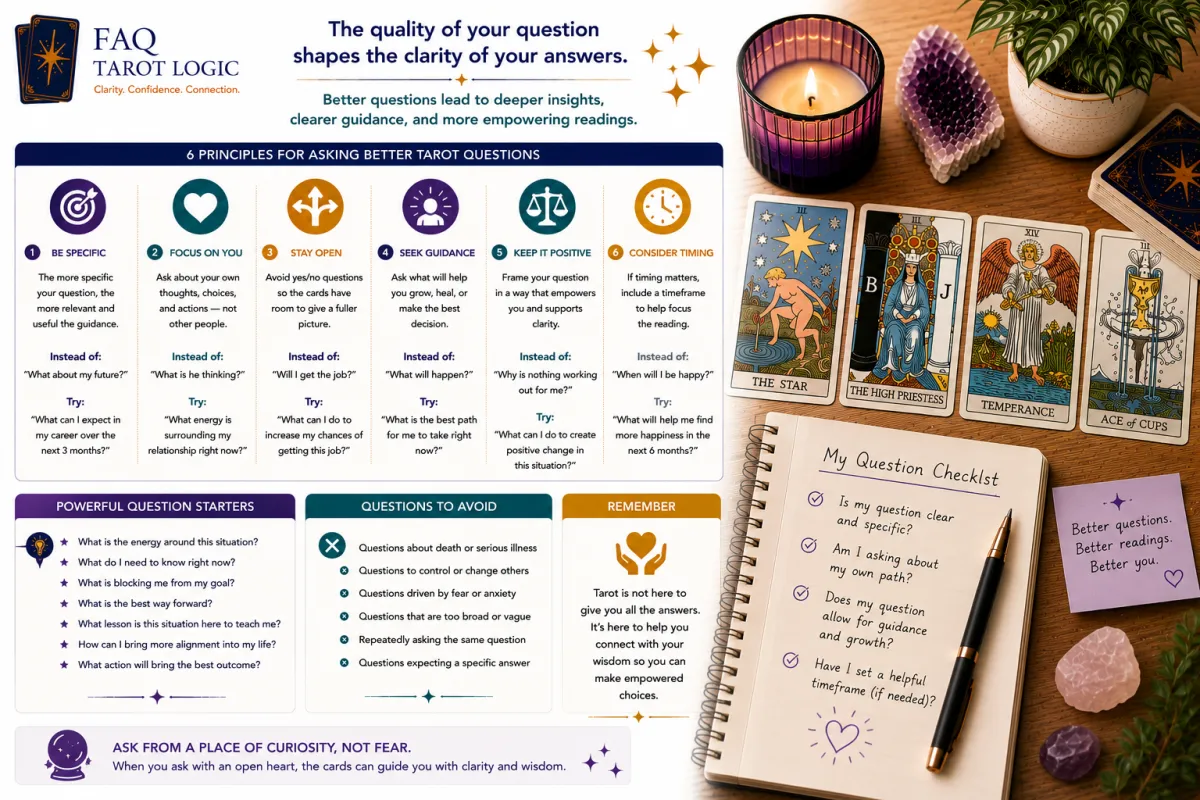
How Can You Ask Better Questions During a Tarot Reading?
TL;DR
Better tarot questions are open enough to encourage reflection but focused enough to produce a useful reading. Instead of asking the cards to predict exactly what will happen, ask questions that help you explore your situation, understand your choices and recognise what you can influence. Changing the way you phrase a question can often make the entire reading clearer and more useful.
IN SHORT
The quality of a tarot reading often begins before you draw the first card.
It begins with the question.
Compare:
"Will I get the job?"
with:
"What can I do to give myself the best chance of getting this job?"
The first question asks the cards to predict an outcome.
The second gives you something you can explore and potentially act upon.
Learning to ask better questions is one of the simplest ways to improve the usefulness of your tarot readings.
Why Does The Question Matter So Much?
Your question gives the reading direction.
Without a clear question, you may draw several perfectly understandable cards but struggle to work out how they relate to one another.
A useful question creates a framework.
It tells you:
What you're exploring.
Which aspects of the cards deserve your attention.
How different cards relate to the situation.
What kind of insight you're looking for.
This is one reason context matters so much when interpreting tarot.
A card doesn't simply have a meaning. It has a meaning within a particular question and reading.
→ Why Does Context Matter More Than Individual Card Meanings?
Start With What You Actually Want To Understand
Sometimes the first question that comes to mind isn't the question you really want answered.
You might ask:
"Will my relationship work?"
But perhaps what you're actually worried about is:
"Why do I feel uncertain about this relationship?"
Or:
"What needs more attention in this relationship?"
Before beginning a reading, ask yourself:
"What am I really trying to understand?"
That small pause can dramatically improve the question.
Ask Open Questions
Questions beginning with what, how or where often create more room for exploration.
For example:
Instead of:
"Will my business idea succeed?"
try:
"What should I consider before developing this business idea further?"
Instead of:
"Will this relationship improve?"
try:
"What could help improve communication within this relationship?"
Instead of:
"Should I change jobs?"
try:
"What should I consider when deciding whether to change jobs?"
Open questions encourage the cards to explore a situation rather than reduce everything to yes or no.
Focus On What You Can Influence
Questions become particularly useful when they focus on something within your control.
You can't control how another person behaves.
You can explore how you respond.
You can't guarantee that an opportunity will succeed.
You can examine how prepared you are for it.
You can't know exactly what will happen six months from now.
You can consider what might help you move in the direction you want.
This shifts tarot away from trying to predict events and towards helping you think more clearly about your choices.
That's also why tarot can be useful when you're facing a decision.
→ Can Tarot Help With Decision-Making?
Avoid Asking The Cards To Read Someone Else's Mind
It's tempting to ask questions such as:
"What does this person really think about me?"
or:
"Why hasn't this person contacted me?"
The problem is that you're asking tarot to tell you what is happening inside someone else's mind.
A more useful approach is to bring the question back to yourself.
For example:
"What should I understand about my relationship with this person?"
or:
"How can I approach this situation more clearly?"
You're still exploring the relationship, but you're focusing on something you can genuinely reflect upon.
Make The Question Specific Enough
Open questions shouldn't be so broad that the reading loses direction.
Consider:
"What should I know about my life?"
That's an enormous subject.
A more focused question might be:
"What should I understand about the way I'm currently approaching my career?"
or:
"What could help me create more balance in my daily life?"
You don't need an extremely narrow question.
You simply need enough focus to give the cards somewhere useful to go.
Don't Build The Answer Into The Question
Sometimes our questions already contain assumptions.
For example:
"Why am I going to fail at this?"
already assumes failure.
"Why doesn't anyone appreciate me?"
assumes nobody does.
"Why is this relationship going wrong?"
assumes the relationship is going wrong.
Try removing the assumption.
You could ask:
"What should I understand about the challenges I'm experiencing?"
or:
"What might I be overlooking in this situation?"
A more neutral question leaves room for perspectives you hadn't already considered.
Ask Questions That Create Clarity
If you're confused about a situation, you don't necessarily need tarot to provide a final answer.
You may simply need help seeing the situation differently.
Useful clarity questions include:
What am I overlooking?
What deserves more attention?
What is influencing my thinking?
What should I consider before deciding?
What might help me see this situation differently?
What part of this situation can I influence?
These questions can reveal factors that become lost when you're emotionally involved in a situation.
For more on using tarot this way:
→ How Do You Use Tarot for Clarity?
Explore More Than One Option
Tarot can also help when you're choosing between alternatives.
Suppose you're considering two possible paths.
Instead of asking:
"Which one should I choose?"
you could explore each separately:
"What should I consider if I choose option A?"
Then:
"What should I consider if I choose option B?"
This allows you to compare the opportunities, difficulties and implications surrounding each option.
The cards aren't making the choice.
They're helping you think about the choice from different angles.
Ask Questions About Yourself
Some of the most useful tarot questions don't concern external events at all.
They concern you.
For example:
What am I learning from this situation?
What assumption might I be making?
What strength could help me here?
What am I finding difficult to accept?
What reaction should I examine more closely?
What could I approach differently?
Questions like these can turn an ordinary reading into an exercise in self-reflection.
We've recently explored this more deeply here:
→ How Can Tarot Help You Develop Greater Self-Awareness?
Be Careful With Repeated Questions
If you don't like or understand an answer, it's easy to shuffle the deck and ask the same question again.
Then again.
And perhaps once more with slightly different wording.
Usually, this creates more confusion rather than more clarity.
If you've already explored a question thoroughly, give yourself time to reflect on the reading before asking it again.
If circumstances genuinely change, returning to the question later may be useful.
Repeatedly asking because you're hoping for a different answer is something else.
→ What Happens When You Ask Tarot the Same Question Repeatedly?
Try Reframing Questions That Feel Stuck
If a reading isn't helping, the problem may not be the cards.
Try changing the question.
Instead of:
"Why can't I make a decision?"
try:
"What is making this decision difficult for me?"
Instead of:
"When will things get better?"
try:
"What could help me improve this situation?"
Instead of:
"Will I make the right choice?"
try:
"What matters most when making this choice?"
Reframing the question often opens a completely different path for reflection.
One Good Question Can Be Enough
You don't need a long list of questions for every tarot reading.
Sometimes one thoughtful question and three cards will give you more to consider than ten vague questions and a large spread.
A focused reading is often easier to interpret because every card relates to the same central issue.
If something important emerges, you can always explore it with a carefully chosen follow-up question.
The goal isn't to ask as much as possible.
It's to ask something worth exploring.
Coffee Cup Tip ☕
Before shuffling your cards, complete this sentence:
"By the end of this reading, I'd like to understand..."
Then turn your answer into a question.
If you write:
"I'd like to understand why I'm hesitating over this decision,"
your question might become:
"What is contributing to my hesitation about this decision?"
It's a simple way to get beneath the first question that comes into your head.
QUICK RECAP
Better tarot questions tend to:
Focus on what you genuinely want to understand.
Encourage exploration rather than prediction.
Begin with what, how or where.
Focus on things you can influence.
Avoid trying to read another person's mind.
Be specific without becoming restrictive.
Avoid assumptions built into the wording.
Encourage clarity and self-reflection.
Explore different options without asking the cards to choose.
Avoid repeatedly asking the same thing.
Give every card in the reading a clear context.
You don't need complicated questions to create useful tarot readings.
You need thoughtful questions that give you something meaningful to explore.
NEXT STEP
Better questions can help you look beneath the surface of a situation, and sometimes what you discover is less about the situation itself and more about how you're feeling about it.
Next, we'll explore:
