How Can Tarot Help You Understand Your Emotions?
TL;DR
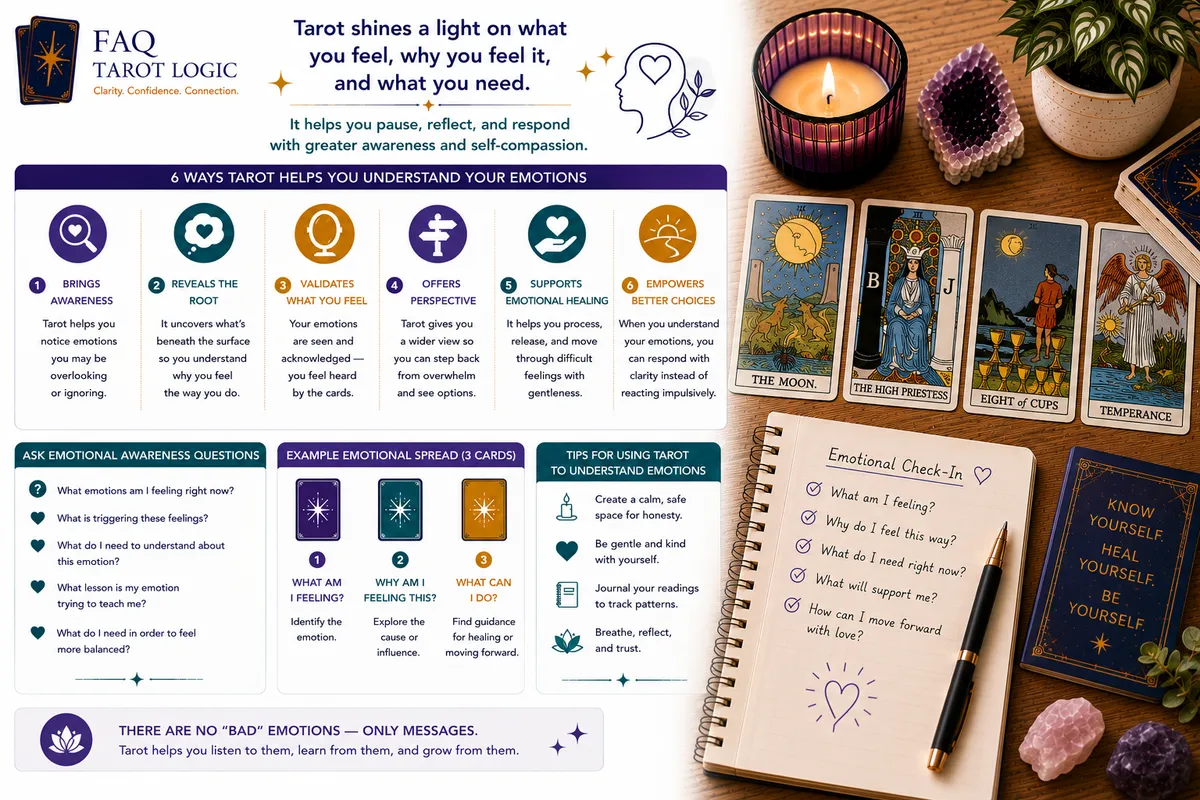
Tarot can help you understand your emotions by giving you a structured way to pause, reflect and explore what you're feeling. The cards don't diagnose emotions or tell you how you should feel. Instead, their imagery, symbolism and themes can prompt useful questions that help you recognise feelings, identify possible triggers and understand how emotions may be influencing your thoughts and decisions.
IN SHORT
We don't always understand what we're feeling straight away.
You might know you're uncomfortable about a situation without knowing why.
You may feel frustrated when you're actually disappointed.
Or you might think you're uncertain about a decision when fear of making a mistake is really driving the hesitation.
Tarot can help you slow things down.
Instead of immediately trying to solve the situation, a reading can encourage you to ask:
"What am I actually feeling here?"
That can be a surprisingly useful place to begin.
Tarot Creates Space For Reflection
Strong emotions can make it difficult to see a situation clearly.
When you're worried, frustrated or disappointed, your attention naturally becomes focused on whatever is causing those feelings.
A tarot reading creates a small amount of distance.
You stop.
Shuffle the cards.
Ask a question.
Look at what appears.
That process doesn't make the emotion disappear, but it can give you an opportunity to examine it rather than simply react to it.
This is one reason tarot can be useful for developing greater self-awareness.
→ How Can Tarot Help You Develop Greater Self-Awareness?
Start By Naming What You're Feeling
Sometimes simply identifying an emotion helps make it easier to understand.
You might ask:
"What am I feeling about this situation?"
Then notice your immediate response to the cards.
Perhaps a card makes you think of:
Frustration.
Excitement.
Disappointment.
Uncertainty.
Resentment.
Relief.
Fear.
Hope.
You don't have to assume the card has magically identified your emotion.
Instead, use your response to the card as a starting point.
Ask:
"Why did that particular feeling come to mind?"
The answer may tell you more than the card itself.
Look Beneath The First Emotion
The emotion you notice first isn't always the whole story.
Anger may be hiding disappointment.
Frustration may come from feeling ignored.
Indecision may be connected to fear.
Sadness may include relief.
Excitement may exist alongside nervousness.
Tarot can encourage you to look one layer deeper.
For example, if a card makes you think of disappointment, you could ask:
"What was I hoping would happen instead?"
That question begins exploring the reason behind the emotion rather than simply naming it.
Your Reaction To A Card Can Be Useful
Imagine turning over a card and immediately thinking:
"I didn't want to see that."
That's worth noticing.
Why didn't you want to see it?
Perhaps the card represents something you've been trying not to think about.
Maybe you associate it with an outcome you're worried about.
Or perhaps its imagery simply makes you uncomfortable.
Your reaction doesn't prove that your interpretation is correct.
But it gives you something useful to explore.
Sometimes your response to a card reveals an assumption or concern you hadn't consciously recognised.
Ask Questions About The Emotion
Once you've identified what you may be feeling, you can explore it further.
Useful questions include:
What might be contributing to this feeling?
What am I finding difficult about this situation?
What am I afraid might happen?
What expectation may be influencing my reaction?
What do I need to acknowledge?
What part of this situation can I control?
What could help me respond more thoughtfully?
These questions keep the focus on understanding rather than predicting.
As we explored in the previous article, the way you phrase the question can dramatically change the usefulness of the reading.
→ How Can You Ask Better Questions During a Tarot Reading?
Notice When Fear Is Influencing The Reading
Fear can have a powerful effect on interpretation.
If you're already worried about a situation, it's easy to see every challenging-looking card as confirmation that something bad will happen.
A card showing conflict becomes:
"Everything is going wrong."
A card suggesting change becomes:
"I'm going to lose something."
A card associated with uncertainty becomes:
"My worst fear must be true."
But that's not necessarily what the cards are saying.
Your emotional state may be affecting how you're interpreting them.
Recognising this is an important part of reading tarot thoughtfully.
→ How Do You Avoid Fear-Based Tarot Reading?
Emotions Can Influence Decisions
Feelings aren't separate from decision-making.
They often influence it.
You might avoid an opportunity because you're nervous.
Stay with a familiar option because change feels uncomfortable.
Rush into something because you're excited.
Or delay making a choice because you're afraid of regretting it.
Tarot can help you notice those influences.
Instead of asking:
"Which option should I choose?"
you might ask:
"What emotions are influencing the way I'm looking at these options?"
That doesn't remove emotion from the decision.
Nor should it.
It simply helps you recognise the role emotion is playing.
For more on exploring choices with tarot:
→ Can Tarot Help With Decision-Making?
Tarot Can Help You Recognise Emotional Patterns
One reading may reveal how you're feeling today.
Several readings over time can reveal patterns.
Perhaps you regularly become anxious when faced with uncertainty.
Maybe you become defensive when you feel criticised.
Perhaps you repeatedly seek reassurance before making decisions.
Or you may notice that certain situations trigger the same emotional response.
Recognising these patterns can be valuable because it gives you the opportunity to respond differently.
A tarot journal can make these patterns easier to spot.
→ Should You Keep a Tarot Journal?
Don't Label Cards As Emotions Too Quickly
It's tempting to create fixed associations.
For example:
"This card means sadness."
"That card means anger."
But emotional context is more complicated than that.
The same card might represent frustration in one reading and determination in another.
A card associated with solitude might feel peaceful to one person and lonely to another.
Return to:
The question.
The surrounding cards.
The situation.
Your reaction to the imagery.
Context helps you decide which emotional interpretation makes the most sense.
Difficult-Looking Cards Aren't Automatically Negative
Some tarot imagery can look dramatic.
That doesn't mean you should assume something terrible is happening.
A difficult-looking card may encourage you to acknowledge:
An uncomfortable truth.
A fear.
A disappointment.
Something that needs to change.
An emotional reaction you've been avoiding.
Acknowledging difficult emotions isn't the same as predicting negative events.
Sometimes simply recognising what you're feeling can reduce the confusion surrounding a situation.
Positive-Looking Cards Don't Mean Ignoring Difficult Feelings
The reverse is also true.
Drawing an apparently positive card doesn't mean you should dismiss genuine sadness, worry or frustration.
Suppose you're disappointed about something and draw a card associated with opportunity.
That doesn't necessarily mean:
"You shouldn't be disappointed because something better is coming."
A more thoughtful interpretation might be:
"I can acknowledge this disappointment while also considering what possibilities remain open to me."
Different emotions can exist at the same time.
A useful tarot reading leaves room for that complexity.
Don't Keep Drawing Cards Until You Feel Better
When a reading touches an uncomfortable emotion, it can be tempting to keep drawing cards.
One more for clarification.
Then another.
Then another because the previous one wasn't reassuring enough.
Eventually, the reading becomes harder to understand.
If you notice yourself doing this, stop and ask:
"Am I looking for understanding, or am I looking for reassurance?"
If it's reassurance, drawing more cards may not help.
Sometimes the most useful thing you can do is put the deck down and give yourself time to reflect.
Record What You Notice
You don't need to write a detailed emotional diary after every reading.
A few simple notes can be enough.
Try recording:
Situation: What was happening?
Feeling: What emotion did I notice?
Trigger: What seemed to contribute to it?
Insight: What did the reading encourage me to consider?
Over time, these short observations can help you recognise recurring emotional patterns.
They also give you something concrete to revisit later when your perspective may have changed.
Tarot Is A Reflection Tool, Not A Replacement For Support
Tarot can be useful for everyday reflection, but there are limits to what a deck of cards should be expected to do.
If emotions are persistent, overwhelming or seriously affecting everyday life, tarot shouldn't replace appropriate professional support.
You can still use the cards as a personal reflective practice if you find that helpful.
The important distinction is recognising what tarot can reasonably provide:
questions, perspectives and opportunities for reflection.
It isn't a diagnosis or treatment.
Coffee Cup Tip ☕
When a card creates a strong emotional reaction, don't immediately ask what the card means.
First ask:
"What about this card am I reacting to?"
You may discover that the image, traditional meaning or situation it reminds you of has touched something you hadn't consciously recognised.
QUICK RECAP
Tarot can help you understand your emotions by encouraging you to:
Pause before reacting.
Identify what you're feeling.
Look beneath the first emotion.
Notice your reactions to particular cards.
Explore what may be contributing to a feeling.
Recognise when fear affects interpretation.
Understand how emotions influence decisions.
Identify recurring emotional patterns.
Avoid labelling cards too rigidly.
Accept that several emotions can exist together.
Reflect rather than repeatedly drawing cards for reassurance.
The cards don't decide what you're feeling.
They can provide a framework that helps you notice, explore and understand your feelings more clearly.
NEXT STEP
As you become more comfortable asking thoughtful questions, interpreting cards in context and reflecting on your own reactions, something else gradually begins to change:
the way you read tarot itself.
Next:
