How Does Experience Change the Way You Read Tarot?
TL;DR
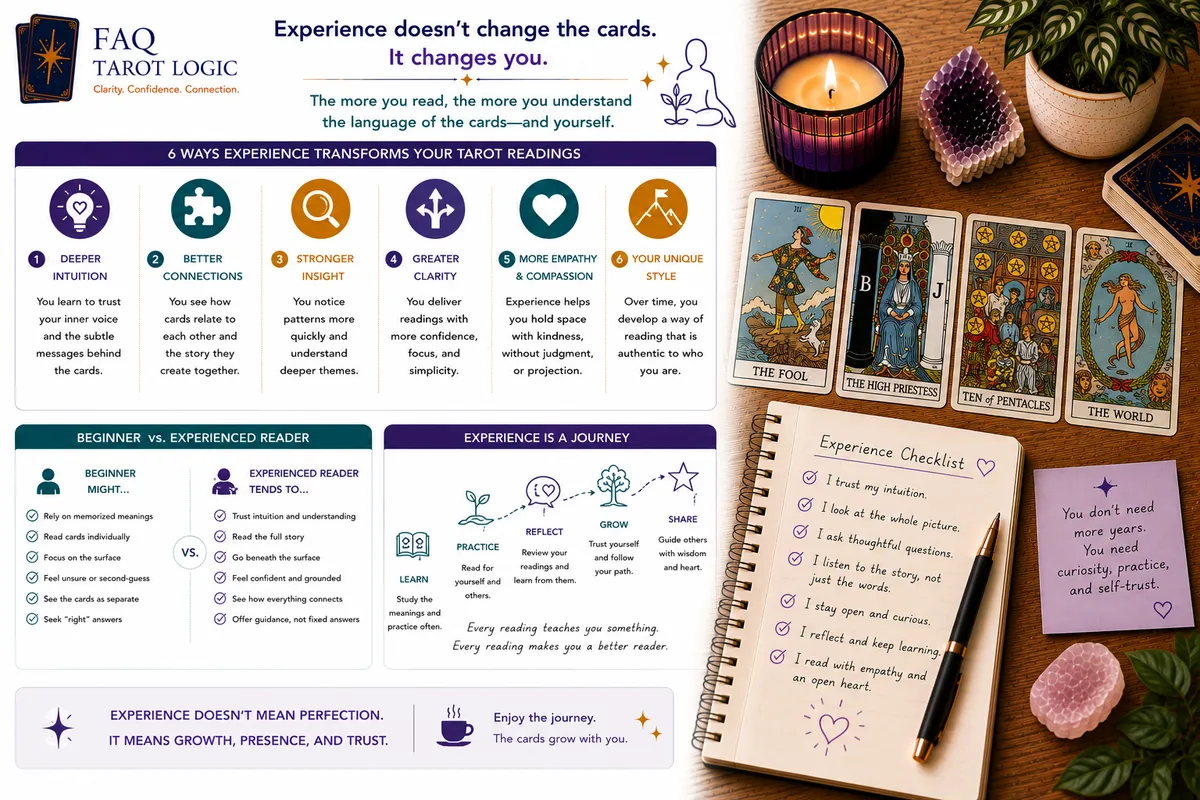
Experience changes the way you read tarot by making interpretation more natural, flexible and contextual. Instead of concentrating mainly on remembering individual card meanings, experienced readers tend to notice relationships between cards, recurring themes, symbolism and the overall story of a spread. Experience doesn't mean knowing everything. It means becoming more comfortable combining knowledge, intuition and context while accepting that some readings still require thought.
IN SHORT
When you first learn tarot, much of your attention goes towards remembering what the cards mean.
You draw a card.
You try to remember its keywords.
You check the guidebook.
You move to the next card.
With experience, that process begins to change.
You still know the individual meanings, but they become the starting point rather than the entire reading.
Instead of thinking:
"What does this card mean?"
you increasingly ask:
"What does this card mean here?"
That's one of the biggest changes experience brings.
Card Meanings Become More Flexible
Beginners often want clear definitions.
That's understandable.
Having a dependable meaning for each card gives you something solid to work with.
But experience gradually shows you that cards can express their underlying themes in different ways.
A card associated with solitude might suggest:
Taking time to think.
Creating some personal space.
Working independently.
Withdrawing too much.
Looking inward before deciding.
You haven't forgotten the traditional meaning.
You've learned to apply it more flexibly.
This is why experienced readers rarely treat tarot meanings as rigid definitions.
→ Why Do Tarot Cards Have Different Meanings?
You Spend Less Time Trying To Remember
One of the most noticeable changes is that you gradually stop mentally searching for keywords every time you turn over a card.
You've seen the card before.
You've interpreted it in different situations.
You've watched how it interacts with other cards.
That familiarity frees your attention.
Instead of spending most of your energy remembering definitions, you can concentrate on understanding the reading.
This doesn't happen overnight.
It develops through repeated exposure to the cards.
You Begin Seeing The Spread Before The Individual Cards
A beginner might look at a three-card spread like this:
Card one → meaning.
Card two → meaning.
Card three → meaning.
An experienced reader is more likely to notice the spread as a whole.
Perhaps all three cards suggest movement.
Maybe two cards reinforce one another while the third introduces caution.
Perhaps the reading seems to move from uncertainty towards clarity.
The individual meanings still matter, but the relationships between them become increasingly important.
→ How Do You Interpret Multiple Tarot Cards Together?
Context Becomes Automatic
When you're learning, you may consciously remind yourself to consider:
The question.
The card's position.
Surrounding cards.
The imagery.
The wider situation.
With practice, you begin doing much of this automatically.
You see a familiar card but immediately recognise that its usual interpretation doesn't quite fit the question.
So you consider another aspect of its meaning.
That isn't ignoring what you've learned.
It's applying what you've learned more naturally.
→ Why Does Context Matter More Than Individual Card Meanings?
You Notice Patterns More Quickly
Experience makes recurring patterns easier to spot.
You may notice:
Several cards from one suit.
Repeated numbers.
Multiple Major Arcana cards.
Similar symbols.
Figures looking towards or away from one another.
Repeated themes such as communication, patience or change.
A beginner may recognise these patterns after studying the spread for a while.
An experienced reader may notice them almost immediately.
That's not necessarily because they have stronger intuition.
Often, they've simply encountered similar patterns many times before.
Your Relationship With Symbolism Changes
At first, tarot symbolism can feel like another collection of things to memorise.
Colours mean this.
Objects mean that.
Animals represent something else.
Over time, symbolism becomes less mechanical.
You may notice an image because it connects naturally with the question rather than because you're deliberately searching for its traditional symbolic meaning.
The picture begins contributing to the reading instead of feeling like another test of your memory.
→ How Do You Read Tarot Symbolism?
You Become More Comfortable With Uncertainty
Beginners often worry that every card must have one correct interpretation.
Experience teaches you that sometimes several interpretations are possible.
You might think:
"This could be suggesting patience, but it could also be highlighting hesitation."
Rather than panicking because you haven't immediately found the "right" answer, you can examine the surrounding cards and question.
Sometimes the answer becomes obvious.
Sometimes it doesn't.
Experienced readers can usually tolerate that uncertainty more comfortably.
You Stop Expecting Every Reading To Be Immediately Clear
Some spreads make sense almost instantly.
Others don't.
Experience doesn't eliminate confusing readings.
It changes how you respond to them.
Instead of immediately thinking:
"I've read the cards incorrectly,"
you may think:
"I haven't understood the connection yet."
You might sit with the spread for longer.
Return to the original question.
Look for repeated themes.
Or write the reading down and revisit it later.
Experience teaches you that clarity doesn't always arrive the moment the cards are drawn.
You Become Less Dependent On Guidebooks
Guidebooks are valuable learning tools.
There's nothing wrong with using them, even when you've been reading tarot for years.
The difference is that experience makes them less necessary for every card.
You may use a guidebook when:
A card feels particularly difficult.
You want another perspective.
You're using an unfamiliar deck.
You want to explore symbolism more deeply.
But you no longer need to check every card before trusting your interpretation.
That independence develops naturally through practice.
You Learn Which Details Matter
A tarot card can contain a huge amount of visual information.
Trying to interpret every colour, object, number and symbol can make a reading unnecessarily complicated.
Experience helps you become more selective.
You begin recognising which details appear relevant to the question and which can remain in the background.
Sometimes one small feature becomes important.
At other times, the broad traditional meaning is all you need.
Knowing when not to analyse something is also a reading skill.
You Become Better At Explaining Your Interpretation
Experience doesn't only change what you notice.
It can change how clearly you communicate it.
Instead of saying:
"This card means change,"
you might explain:
"I'm reading this as a period of change because of the card's traditional meaning, but the surrounding cards suggest that the change is likely to require patience rather than immediate action."
You're connecting the interpretation to the evidence within the spread.
That makes the reading clearer and more grounded.
For more on how experienced readers approach interpretation:
→ How Do Experienced Readers Interpret the Cards?
You Develop Your Own Reading Style
With enough practice, you'll discover that some approaches feel more natural than others.
You may prefer:
Small spreads.
Larger structured spreads.
Traditional meanings.
Strong visual interpretation.
Reading cards as a story.
Journalling after readings.
Spending time with one card before moving on.
Your reading style doesn't need to look exactly like someone else's.
Experience helps you discover which methods allow you to understand the cards most clearly.
→ How Do You Develop Your Own Tarot Reading Style?
Intuition Feels Less Mysterious
When you're beginning, intuitive reading can sound like something you either possess or don't.
Experience often makes it feel much more ordinary.
You see a card and something immediately stands out.
A connection between two cards seems obvious.
A particular interpretation comes to mind before you've consciously worked through every keyword.
Part of that may feel intuitive.
But part of it also comes from experience.
Your brain has seen similar cards, symbols and combinations before.
Knowledge and intuition begin working together rather than feeling like separate skills.
You Trust Yourself More Without Assuming You're Always Right
Confidence is another change that comes with experience.
But useful confidence isn't:
"I always know exactly what the cards mean."
It's closer to:
"I can work through this reading even if I don't understand everything immediately."
That's a much stronger form of confidence.
You trust your ability to explore the cards while remaining open to reconsidering an interpretation.
Experience makes you less frightened of being uncertain without making you believe you're infallible.
You Draw Fewer Unnecessary Clarifying Cards
When you're unsure of a reading as a beginner, the natural reaction is often to draw another card.
Then another.
And perhaps another.
With experience, you're more likely to spend additional time with the cards already on the table.
You may realise that the information you need is already there.
This doesn't mean experienced readers never use clarifying cards.
They simply become better at recognising when another card will genuinely help and when it will only create more confusion.
You Learn From Readings That Didn't Work
Experience isn't built only from readings that felt clear and accurate.
Confusing readings teach you too.
When you review an old reading, you might notice:
A connection you originally missed.
An interpretation you made too quickly.
A question that was too vague.
A card you interpreted too rigidly.
An assumption that influenced your reading.
Those moments are part of becoming a better reader.
A reading doesn't have to be perfect to teach you something.
Experience Doesn't Mean Knowing Everything
There isn't a point where you've officially finished learning tarot.
Even experienced readers encounter unfamiliar combinations.
Different decks emphasise different symbolism.
Life presents new situations.
And your understanding of familiar cards can continue changing.
Experience isn't about reaching a stage where you never need to think.
It's about having more ways to approach a reading when you do need to think.
Coffee Cup Tip ☕
Take a reading you recorded several months ago and interpret the cards again without looking at what you originally wrote.
Then compare the two versions.
Don't ask which interpretation is "better."
Instead ask:
"What am I noticing now that I didn't notice then?"
That's one of the simplest ways to see how your reading skills are changing.
QUICK RECAP
Experience changes the way you read tarot because you gradually:
Apply card meanings more flexibly.
Spend less time remembering keywords.
See the spread as a whole.
Consider context automatically.
Recognise patterns more quickly.
Use symbolism more naturally.
Become comfortable with uncertainty.
Depend less heavily on guidebooks.
Recognise which details matter.
Explain interpretations more clearly.
Develop your own reading style.
Combine knowledge and intuition more naturally.
Trust yourself without assuming you're always right.
Use clarifying cards more selectively.
Learn from readings that didn't initially make sense.
Experience doesn't replace what you learned as a beginner.
It changes how naturally you can use it.
NEXT STEP
The more experience you gain, the less tarot becomes about remembering the "correct" meaning of every card and the more it becomes about recognising connections, context and patterns.
And that development doesn't stop once you've learned the basics.
As your confidence grows, the next stage is learning how to develop your own approach while continuing to strengthen the skills that make your readings clearer and more meaningful.
