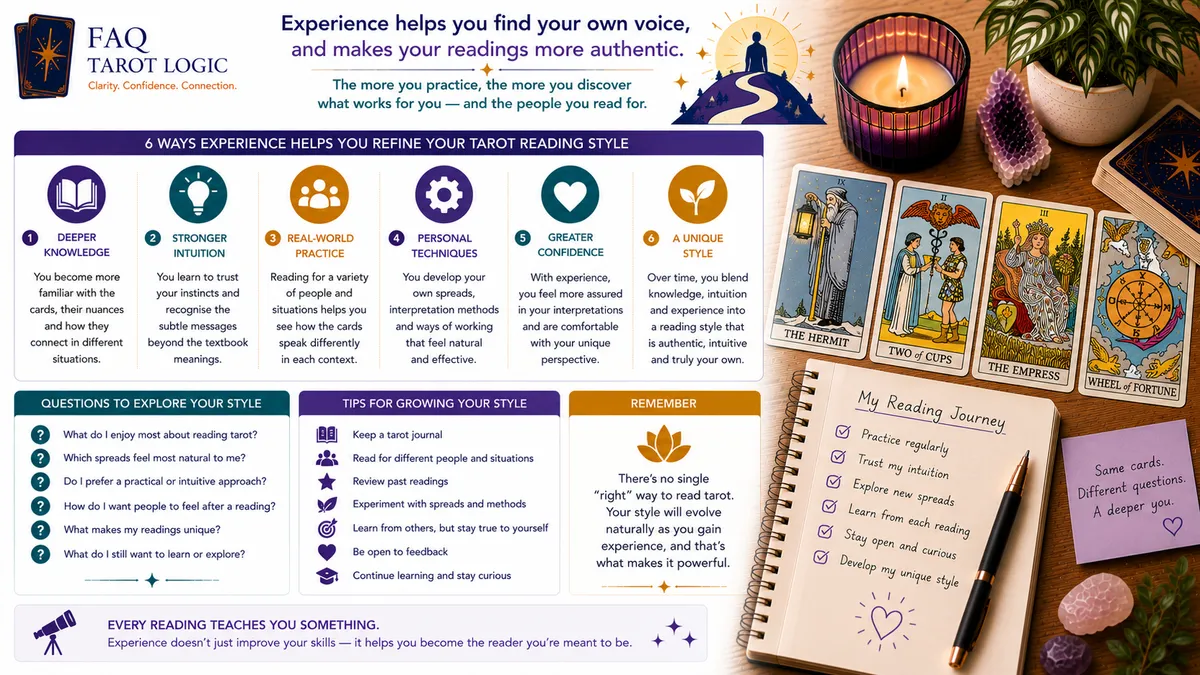
How Do You Refine Your Tarot Reading Style Through Experience?
TL;DR
You refine your tarot reading style through experience by noticing which methods help you understand the cards most clearly. As you practise, you naturally discover which spreads, decks, interpretation techniques and reading habits work best for you. Developing your own style doesn't mean ignoring traditional meanings or rules. It means building on what you've learned and gradually creating an approach that feels natural, consistent and useful.
IN SHORT
When you first learn tarot, it's natural to follow other people's methods.
You use recommended spreads.
Learn established card meanings.
Follow guidebooks.
Try the techniques experienced readers suggest.
That's exactly how most skills begin.
But as you gain experience, something changes.
You start discovering which parts of those methods work particularly well for you and which don't.
Gradually, you stop simply learning how to read tarot and begin developing the way you read tarot.
Your Reading Style Develops Naturally
You don't need to sit down one day and decide:
"This is going to be my tarot reading style."
It usually develops gradually.
Perhaps you discover that three-card spreads consistently give you clearer readings than larger layouts.
Maybe you naturally pay close attention to symbolism.
You might prefer starting with traditional meanings and then looking at how the cards interact.
Or perhaps the overall story of the spread stands out to you before individual meanings do.
These preferences become clearer through repeated practice.
Start With A Strong Foundation
Developing your own style doesn't mean abandoning what you've already learned.
Traditional card meanings, suits, symbolism and spread structures provide a foundation.
Your personal approach develops on top of that knowledge.
Think of learning tarot like learning a language.
First, you learn the vocabulary and basic structure.
Eventually, you become comfortable enough to express yourself naturally.
You haven't abandoned the language.
You've learned how to use it.
This is why experience changes the way you approach interpretation.
→ How Does Experience Change the Way You Read Tarot?
Notice What You Naturally Pay Attention To
Different readers notice different things first.
When you turn over a card, perhaps you immediately notice:
The traditional meaning.
A particular symbol.
The expression on a figure's face.
The colours.
How the card relates to the question.
Its relationship with another card.
The overall mood of the spread.
There's no need to force yourself to focus on everything equally.
Notice which elements consistently help you make sense of the reading.
Those tendencies can become part of your personal style.
Experiment Before You Decide What Works
It's difficult to develop a reading style if you only ever use one method.
Experiment occasionally.
Try:
One-card readings.
Three-card spreads.
Larger structured spreads.
Reading without predetermined positions.
Looking at the imagery before recalling keywords.
Writing interpretations before checking a guidebook.
Reading cards as a continuous story.
You don't need to keep every technique you try.
The purpose of experimenting is discovering what genuinely helps.
Keep What Helps And Leave What Doesn't
Not every tarot technique will suit you.
You may try a popular spread and find it unnecessarily complicated.
Perhaps reading reversed cards makes your interpretations clearer.
Or perhaps it makes them harder to follow.
Maybe elaborate rituals help you concentrate.
Maybe you'd rather shuffle, ask the question and begin.
You don't have to adopt a practice simply because another reader recommends it.
Ask instead:
"Does this help me produce a clearer, more thoughtful reading?"
If it does, keep it.
If it doesn't, you can leave it behind.
Your Style Isn't The Same As Your Rules
There's a useful distinction between preferences and rigid rules.
You might prefer three-card spreads.
That doesn't mean you can never use five cards.
You might usually read with one particular deck.
That doesn't mean another deck won't work for you.
You might normally begin with traditional meanings.
That doesn't mean symbolism can never take the lead.
A reading style should make tarot easier to work with.
It shouldn't become another set of restrictions.
Learn From The Readings That Feel Clear
When a reading works particularly well, don't simply enjoy it and move on.
Ask why.
Was the question especially clear?
Did the spread suit the situation?
Were you relaxed rather than rushing?
Did you spend more time looking at the imagery?
Did you interpret the cards together rather than separately?
Identifying what helped can show you which practices are worth repeating.
Learn From Confusing Readings Too
The readings that don't work are equally useful.
Perhaps you used too many cards.
Maybe the question was vague.
You might have relied too heavily on guidebook definitions.
Perhaps you drew so many clarifying cards that the original message disappeared.
Instead of treating a confusing reading as a failure, ask:
"What would I do differently next time?"
That's how experience gradually refines your method.
If unclear readings tend to make you doubt yourself, this may also help:
→ Why Do Tarot Readings Sometimes Feel Confusing?
Notice Which Spreads Suit You
Some readers enjoy detailed spreads with clearly defined positions.
Others prefer smaller layouts with more room for interpretation.
Neither is automatically better.
Experiment with different spreads and notice:
Which are easiest to interpret.
Which produce useful insights.
Which feel unnecessarily complicated.
Which suit different kinds of questions.
You may eventually develop a small collection of favourite spreads rather than searching for a new layout every time you read.
Let Your Questions Shape Your Method
Your reading style isn't only about cards and spreads.
It also includes the questions you ask.
As you gain experience, you may find yourself moving away from questions such as:
"What will happen?"
towards:
"What should I understand?"
"What am I overlooking?"
"What could help me approach this differently?"
Better questions often produce better readings, regardless of which spread you use.
→ How Can You Ask Better Questions During a Tarot Reading?
Find Your Balance Between Knowledge And Intuition
Some readers naturally lean towards traditional meanings.
Others are strongly drawn to imagery and intuitive impressions.
Most eventually develop a mixture of both.
You might begin with what you know about the card and then ask what stands out in this particular reading.
Or an image might immediately suggest something, after which you check whether that impression makes sense alongside the traditional meaning and surrounding cards.
There's no need to choose between knowledge and intuition.
Experience can teach you how to let them support each other.
Become Comfortable Trusting Your Interpretation
Developing a personal style requires some confidence.
If you constantly assume someone else's interpretation must be better than yours, it's difficult to discover how you understand the cards.
That doesn't mean refusing to learn from other readers.
It means being willing to say:
"This is how I'm interpreting the card in this context, and here's why."
Being able to explain your reasoning gives your interpretation a stronger foundation.
→ How Do You Trust Your Tarot Interpretation?
Use Guidebooks As Resources Rather Than Instructions
Guidebooks remain useful at every level of experience.
But your relationship with them may change.
At first, the guidebook may provide the answer.
Later, it becomes another perspective.
You might interpret the card yourself, then check the book to see whether it highlights something you missed.
Or you may only reach for it when a card feels particularly difficult.
The goal isn't to prove that you no longer need a guidebook.
It's to become comfortable thinking before automatically reaching for one.
Your Deck Preferences May Change
As your reading style develops, you may also notice that your preferences in tarot decks change.
A deck that was perfect when you started may eventually feel less suited to the way you now interpret cards.
Perhaps you want richer symbolism.
Clearer imagery.
A different artistic approach.
Or maybe the first deck you bought continues to work perfectly.
There's no requirement to change.
Your deck is simply another part of your reading practice, and we'll explore that in the next article.
Review Your Progress Occasionally
Every few months, look back at some older readings.
Notice:
How you interpreted cards then.
How much you relied on guidebooks.
Which spreads you used.
How you phrased questions.
Whether you noticed relationships between cards.
How confident you were explaining your interpretation.
You may discover that your reading style has already changed without you consciously trying to change it.
A tarot journal makes this particularly easy to see.
→ How Can You Track Your Progress as a Tarot Reader?
Don't Copy Someone Else's Style Too Closely
Learning from experienced readers is valuable.
Copying every detail of their approach isn't necessary.
A method may work brilliantly for someone else because it suits:
Their experience.
Their personality.
Their preferred decks.
The kinds of readings they perform.
The way they process information.
Take ideas from other readers.
Experiment with them.
Then decide whether they improve your readings.
Your goal isn't to read exactly like your favourite tarot reader.
It's to learn from them while becoming comfortable with your own approach.
Your Style Can Continue Changing
Developing a reading style doesn't mean eventually arriving at a finished method that never changes.
You may discover a new deck.
Learn another spread.
Become interested in symbolism.
Start journalling.
Stop using a technique that no longer helps.
Return to something you previously dismissed.
Experience changes preferences.
That's healthy.
Your reading style should be able to develop as your understanding develops.
Coffee Cup Tip ☕
After your next few readings, write down one sentence:
"This reading was easier to understand because..."
After five or ten readings, look at your answers.
You may begin noticing the techniques, habits and conditions that consistently help you read more clearly.
Those patterns are clues to your natural reading style.
QUICK RECAP
You refine your tarot reading style through experience by:
Building on strong foundations.
Noticing what naturally catches your attention.
Experimenting with different approaches.
Keeping techniques that genuinely help.
Avoiding unnecessary rigid rules.
Learning from clear readings.
Learning from confusing readings.
Discovering which spreads suit you.
Improving the questions you ask.
Balancing knowledge with intuition.
Trusting interpretations you can explain.
Using guidebooks as resources rather than instructions.
Reviewing how your readings change over time.
Learning from other readers without copying them.
Allowing your style to continue evolving.
Your tarot reading style doesn't need to be invented.
It emerges from the way you learn, practise and interpret the cards over time.
NEXT STEP
As your reading style develops, you may begin wondering whether the deck you started with still suits the way you now work with tarot.
Do experienced readers need more advanced decks, or is there no reason to change something that's already working?
Next:
