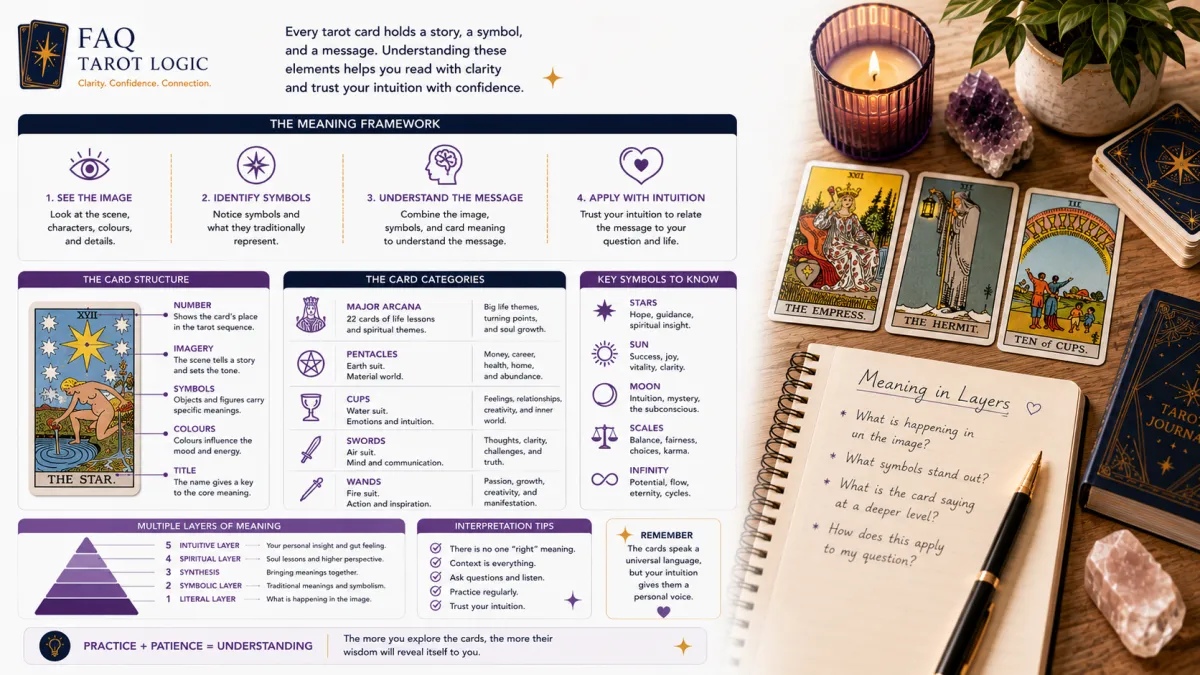
Understanding Tarot Cards: A Beginner's Guide to Meanings, Symbolism and Interpretation
TL;DR
Every tarot card tells part of a bigger story. By understanding the Major Arcana, Minor Arcana, suits, Court Cards and symbolism, you can move beyond memorising keywords and begin interpreting cards with confidence and intuition.
IN THIS GUIDE
In this guide you'll learn:
How a tarot deck is organised
The difference between the Major and Minor Arcana
What each tarot suit represents
How to understand Court Cards
Why symbolism matters more than memorisation
How to develop your own card interpretations
Practical ways to learn the cards without becoming overwhelmed
Whether you're holding your first deck or looking to deepen your understanding, this guide will help you build a strong foundation for reading tarot confidently.
Introduction
For many beginners, learning tarot feels like trying to memorise seventy-eight separate pieces of information.
It's easy to believe every card has a fixed definition that must be remembered perfectly before you can perform a reading.
Fortunately, that's not how tarot works.
Each card carries themes, symbols and ideas rather than rigid meanings. As you become familiar with the structure of the deck and the symbolism within each card, you'll find that reading tarot becomes far more natural than simply recalling keywords from memory.
This guide explores the building blocks of every tarot deck, helping you understand not only what the cards mean individually, but how they work together to tell a story.
Understanding the Tarot Deck
Every traditional tarot deck contains 78 cards divided into two main sections:
Major Arcana
Minor Arcana
Although they work together during a reading, each serves a different purpose.
Understanding this structure is one of the biggest steps towards reading confidently.
If you're completely new to tarot, you may also wish to revisit:
→ Tarot Foundations: Everything Beginners Need to Start Reading with Confidence
The Major Arcana
The Major Arcana contains 22 cards that represent life's significant lessons, personal growth and transformative experiences.
These are often the cards that attract the most attention because they explore major themes such as:
New beginnings
Personal development
Challenges
Change
Wisdom
Fulfilment
Cards like The Fool, The Magician, The Hermit and The World don't simply describe events—they reflect stages of life's journey.
When several Major Arcana cards appear in a reading, they often suggest that something meaningful or long-lasting is developing.
For a deeper explanation, read:
→ What Is the Difference Between Major and Minor Arcana?
The Minor Arcana
While the Major Arcana focuses on life's bigger picture, the Minor Arcana reflects everyday experiences.
These 56 cards explore the situations we encounter regularly:
Relationships
Communication
Work
Family
Finances
Creativity
Personal challenges
Rather than dramatic life-changing events, they often describe how we respond to daily circumstances.
Learning the Minor Arcana becomes much easier once you understand the four suits.
Understanding the Four Tarot Suits
Each suit represents a different area of life.
Instead of treating every card as completely unique, recognising the themes of each suit provides valuable context during a reading.
Cups
The Suit of Cups relates to:
Emotions
Relationships
Compassion
Intuition
Creativity
Whenever Cups appear, they often encourage you to consider your emotional world.
Pentacles
Pentacles focus on practical matters including:
Career
Money
Health
Home
Long-term stability
These cards tend to deal with the physical aspects of life.
Swords
Swords represent the mind.
They commonly explore:
Thoughts
Decisions
Conflict
Communication
Truth
Although sometimes seen as challenging, Sword cards often encourage clarity and honest reflection.
Wands
Wands symbolise energy and inspiration.
They frequently relate to:
Passion
Ambition
Creativity
Personal growth
New opportunities
These cards often inspire action and forward movement.
To explore the suits in greater depth, read:
→ What Do the Tarot Suits Represent?
Understanding Court Cards
Court Cards often feel like the biggest hurdle for beginners.
Unlike numbered cards, they don't always represent events or situations.
Instead, they may symbolise:
A person
A personality trait
A role you are taking
An attitude or approach
A stage of personal development
Each suit contains four Court Cards:
Page
Knight
Queen
King
Rather than trying to memorise dozens of separate meanings, begin by understanding the qualities each role naturally represents.
As your experience grows, interpreting Court Cards becomes much more intuitive.
Learn more here:
→ What Are Court Cards in Tarot?
Why Symbolism Matters
One of tarot's greatest strengths is its rich visual symbolism.
Every illustration contains details that contribute to interpretation.
You might notice:
Colours
Expressions
Landscapes
Animals
Objects
Weather
Direction of movement
These elements provide context that often goes beyond traditional guidebook meanings.
For example, two cards may both represent change, yet the imagery reveals whether that change feels welcome, uncertain or challenging.
Learning to observe these details gradually strengthens your confidence as a reader. Rather than relying solely on memorised definitions, you'll begin recognising the story each card is telling through its imagery and how it connects with the surrounding cards.
Memorisation vs Understanding
Many beginners begin by making flashcards or memorising keyword lists.
While this can be helpful initially, relying on memory alone has limitations.
Instead of asking:
"What is the official meaning of this card?"
Try asking:
What stands out visually?
What emotion does this card create?
How does it connect with the question?
How does it interact with the surrounding cards?
These questions encourage genuine interpretation rather than simple recall.
Over time, you'll find yourself recognising themes naturally instead of searching for the "correct" answer.
Related reading:
→ Should You Memorise Tarot Card Meanings?
Reading Cards Together
Tarot cards rarely exist in isolation.
A reading becomes meaningful because each card influences the others around it.
Imagine reading a sentence.
Individual words matter, but their meaning depends upon the words surrounding them.
Tarot works in much the same way.
A card that usually feels positive may take on a different nuance when surrounded by challenging cards, while a traditionally difficult card may suggest valuable growth when viewed in context.
Understanding relationships between cards is one of the biggest steps from beginner to confident reader.
To explore this skill further:
→ Why Do Tarot Cards Have Different Meanings?
Developing Your Own Interpretation Style
Every experienced tarot reader eventually develops their own voice.
This doesn't mean ignoring traditional meanings.
Instead, it means combining established symbolism with personal observation and experience.
As you practise, you'll notice certain cards consistently communicate similar themes for you.
Keeping a tarot journal can help identify these patterns over time.
The goal isn't to replace traditional knowledge but to build upon it.
That's where confidence begins.
Coffee Cup Tip ☕
Don't rush to memorise every card. Learn the structure of the deck first, then let repeated practice and observation build your understanding naturally.
QUICK RECAP
Understanding tarot cards becomes much easier when you:
Learn the overall structure of the deck.
Recognise the roles of the Major and Minor Arcana.
Understand the themes of the four suits.
View Court Cards as personalities and approaches rather than fixed definitions.
Pay attention to symbolism.
Focus on interpretation instead of memorisation.
Read cards together as part of a larger story.
The more familiar you become with these foundations, the more naturally each reading will flow.
NEXT STEP
Now that you understand how tarot cards are structured and interpreted, the next step is learning how to put them into practice. Discover how to prepare for readings, ask better questions and interpret cards together in How to Read Tarot Cards: A Complete Beginner's Reading Guide.
