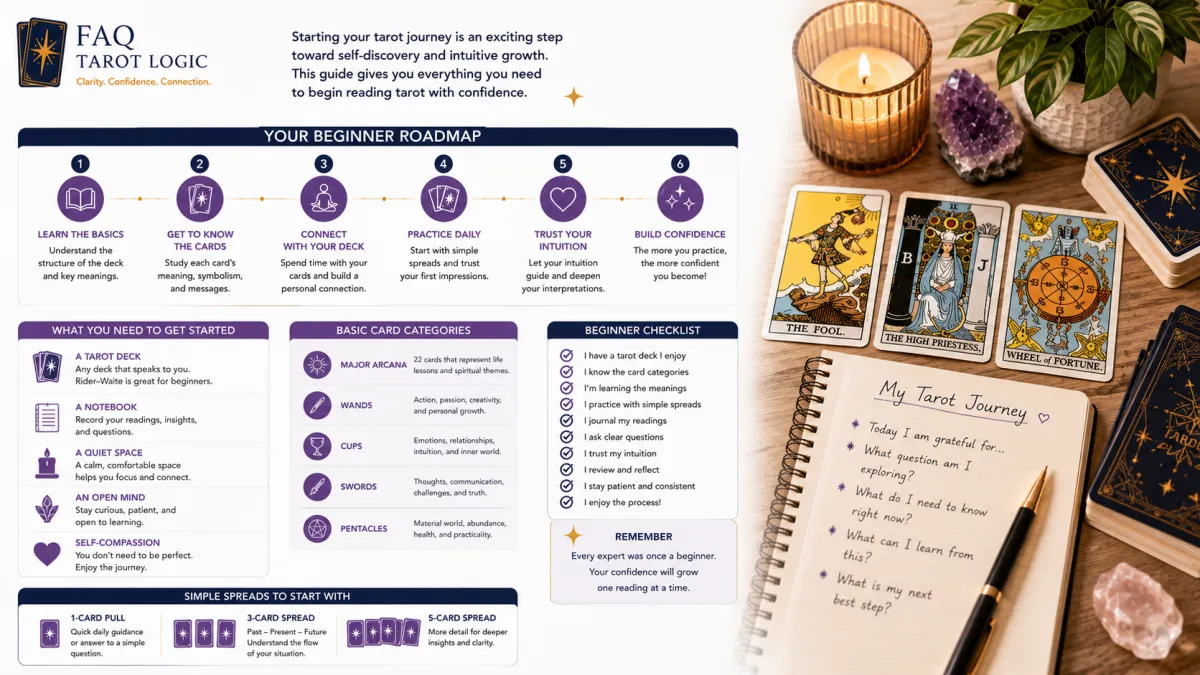
Tarot Foundations: Everything Beginners Need to Start Reading with Confidence
TL;DR
Tarot is a tool for self-reflection, personal insight and thoughtful decision-making—not fortune telling. By understanding how a tarot deck is structured, choosing a deck that suits you, learning the cards step by step and practising consistently, anyone can develop the confidence to read tarot for themselves and others.
IN THIS GUIDE
In this guide you'll learn:
What tarot is and how it works
Why so many myths surround tarot
How to choose your first tarot deck
How a tarot deck is organised
The easiest way to start learning the cards
Why tarot spreads matter
Simple steps for building confidence as a beginner
Whether you've just bought your first deck or you're curious about learning tarot, this guide will help you build a solid foundation without feeling overwhelmed.
Introduction
Starting tarot can feel exciting, but it can also be confusing.
A quick search online reveals thousands of videos, books, courses and opinions. Some people describe tarot as a mystical practice, while others see it as a psychological tool for reflection and self-discovery. With so much information available, it's easy to wonder where to begin.
The good news is that learning tarot doesn't have to be complicated.
You don't need years of experience, psychic abilities or an exceptional memory to start reading the cards. Like any new skill, tarot becomes easier when you begin with the fundamentals and build your knowledge one step at a time.
This guide brings together the essential concepts every beginner should understand before diving deeper into individual cards and reading techniques. By the end, you'll have a clear roadmap for developing your tarot practice with confidence.
What Is Tarot?
At its core, tarot is a system of 78 illustrated cards used to encourage reflection, explore situations and uncover new perspectives.
Rather than predicting an unchangeable future, tarot invites you to pause, examine your circumstances and consider possibilities that may not have been obvious before.
Each card represents themes, experiences and patterns that many people encounter throughout life. When combined within a reading, those themes create a story that can help you better understand your thoughts, emotions or decisions.
For a more detailed introduction, read:
→ What Is Tarot and How Does It Work?
Can Anyone Learn Tarot?
One of the biggest misconceptions is that tarot is reserved for people with special gifts.
In reality, tarot is a skill that develops through study, observation and practice.
Just as someone learns to play an instrument or speak another language, reading tarot becomes easier with repetition. Every reading helps strengthen your understanding of the cards and your ability to recognise patterns.
Many experienced readers began with little or no prior knowledge. Their confidence came from practising consistently rather than waiting to feel "ready."
If you've ever wondered whether tarot is for you, the answer is simple: anyone willing to learn can develop the skill.
Related reading:
→ Do You Need to Be Psychic to Read Tarot?
Understanding Common Tarot Myths
Few subjects attract as many myths as tarot.
Popular culture has often portrayed tarot as mysterious, frightening or capable of predicting unavoidable events. These misconceptions discourage many beginners before they even shuffle their first deck.
In truth, tarot is far less dramatic than these portrayals suggest.
Many readers use tarot as a structured way to organise their thoughts, explore emotions or gain clarity when making decisions. Rather than removing personal responsibility, tarot encourages greater awareness and thoughtful reflection.
Approaching tarot with curiosity instead of fear allows you to experience its real value.
If you'd like to explore these misconceptions further, see:
→ Is Tarot Dangerous or Misunderstood?
Choosing Your First Tarot Deck
Buying your first deck is often one of the most enjoyable parts of learning tarot.
Some people are drawn to traditional artwork such as the Rider–Waite–Smith deck, while others prefer modern interpretations with different artistic styles.
Although countless designs exist, beginners often benefit from selecting a deck with clear symbolism and widely available learning resources.
More importantly, choose a deck that encourages you to practise.
A beautifully illustrated deck that stays on the shelf teaches far less than a simpler deck you enjoy using every day.
For more guidance, read:
→ How Do You Choose Your First Tarot Deck?
Understanding the Structure of a Tarot Deck
Before trying to memorise individual cards, it helps to understand how the deck is organised.
The 78 cards are divided into two main groups.
The Major Arcana
The Major Arcana contains 22 cards that represent significant life lessons, personal growth and major turning points.
Cards such as The Fool, The Hermit and The World often point towards important stages of personal development rather than everyday events.
Understanding these cards provides the backbone of tarot reading.
For a deeper explanation:
→ What Is the Difference Between Major and Minor Arcana?
The Minor Arcana
The remaining 56 cards explore everyday experiences.
These cards are divided into four suits, each representing a different aspect of life.
Cups
Emotions, relationships and intuition.
Pentacles
Work, finances, health and the physical world.
Swords
Thoughts, communication, challenges and decision-making.
Wands
Creativity, ambition, energy and personal growth.
To learn more about the suits, see:
→ What Do the Tarot Suits Represent?
Court Cards
Within each suit are four Court Cards:
Page
Knight
Queen
King
These cards can represent people, personality traits, attitudes or ways of approaching situations.
Many beginners initially find Court Cards challenging, but they become much clearer once you recognise the roles and characteristics each one represents.
For more help:
→ What Are Court Cards in Tarot?
Learning Tarot Without Feeling Overwhelmed
Perhaps the biggest mistake beginners make is trying to learn all 78 cards at once.
While it's understandable to feel eager, attempting to memorise every meaning immediately often leads to frustration.
A more effective approach is to build your knowledge gradually.
Start by understanding the overall structure of the deck before moving on to individual cards. Focus on recognising recurring themes rather than memorising long lists of keywords.
Regular practice, even for ten or fifteen minutes a day, will usually produce better results than occasional marathon study sessions.
Remember, confidence grows through experience—not perfection.
If you're feeling overwhelmed, these articles will help:
→ Why Does Tarot Feel So Overwhelming at First?
→ What Should Beginners Learn First in Tarot?
→ How Long Does It Take to Learn Tarot?
Understanding Tarot Spreads
Once you're familiar with the cards, you'll naturally begin exploring tarot spreads.
A spread is simply a layout that gives structure to a reading.
Each position represents a different aspect of the situation you're exploring, helping you interpret the cards within a clear context.
You don't need to master dozens of spreads immediately.
Many experienced readers regularly use only a handful of layouts because they understand them well.
Starting simple allows you to focus on interpretation rather than worrying about complicated arrangements.
For more information, read:
Building Confidence Through Practice
Confidence doesn't appear overnight.
It develops through reading regularly, reflecting on your interpretations and accepting that every reading is an opportunity to learn.
Many beginners worry about getting everything exactly right.
Experienced readers know that tarot is less about achieving perfection and more about developing awareness, curiosity and trust in the learning process.
Every shuffle, every spread and every journal entry contributes to your growth.
The more consistently you practise, the more natural reading tarot becomes.
Coffee Cup Tip ☕
Don't wait until you feel you've memorised every card before doing your first reading. Real understanding comes from using the cards, not simply studying them.
QUICK RECAP
Getting started with tarot becomes much easier when you:
Understand what tarot is designed to do.
Ignore common myths and misconceptions.
Choose a deck you'll enjoy using regularly.
Learn the structure of the deck before individual meanings.
Practise consistently instead of trying to memorise everything at once.
Use simple spreads while building confidence.
Every experienced tarot reader started as a beginner. Taking steady, consistent steps will help you build a rewarding tarot practice over time.
RELATED ARTICLESEXT STEP
Now that you understand the foundations of tarot, the next step is learning how the cards themselves communicate meaning. Discover how the Major Arcana, Minor Arcana, suits and Court Cards work together in Understanding Tarot Cards: A Beginner's Guide to Meanings, Symbolism and Interpretation.
