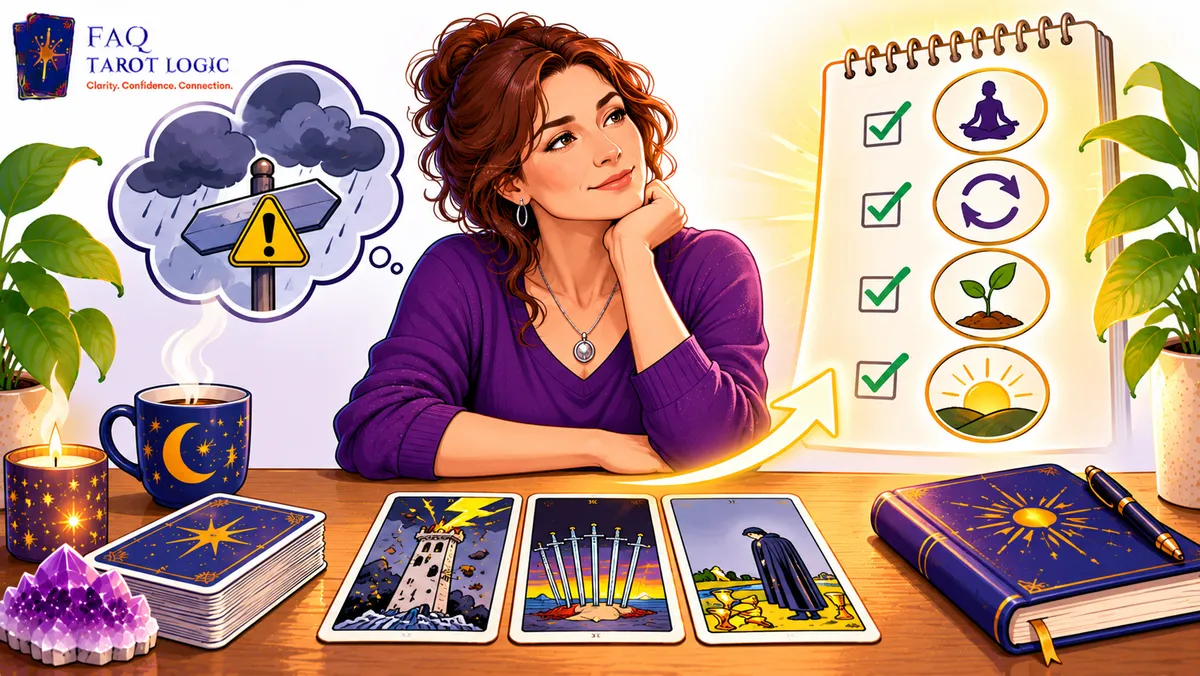
What Should You Do When a Tarot Reading Feels Too Negative?
TL;DR
When a tarot reading feels too negative, avoid assuming that difficult cards predict something unpleasant. Tarot cards often represent challenges, transitions, uncertainty or uncomfortable emotions rather than unavoidable outcomes.
Begin by examining the cards within the context of your question, considering their broader meanings and looking at how they relate to one another. If the reading leaves you feeling anxious or overwhelmed, it's reasonable to take a break. A balanced interpretation should help you explore a situation more clearly, not leave you feeling powerless or afraid.
IN SHORT
You've shuffled your tarot deck, asked your question and turned over the cards. Instead of finding something reassuring, you're looking at a spread filled with imagery that feels uncomfortable.
Perhaps the Tower has appeared alongside the Five of Cups, or you've drawn the Ten of Swords in a position that seems particularly important.
Your first reaction might be disappointment, concern or even fear.
Does this mean something bad is going to happen?
It's a question many tarot readers encounter, especially when they're still becoming familiar with the cards and their traditional meanings.
Some tarot cards have dramatic imagery, and their descriptions can sound unsettling when taken at face value. However, a challenging card doesn't automatically predict an unpleasant event, and a spread containing several difficult cards doesn't necessarily mean the entire reading is negative.
Learning to approach these interpretations calmly is an important part of developing confidence with tarot.
Rather than searching for the most alarming explanation, the aim is to understand what the cards might help you explore about your question and circumstances.
Why Do Some Tarot Readings Feel So Negative?
A tarot reading can feel negative for several reasons, and not all of them come from the cards themselves.
Sometimes the imagery is responsible. Cards such as Death, the Tower and the Ten of Swords contain powerful visual elements that can create an immediate emotional reaction.
At other times, the traditional meanings may seem uncomfortable. Themes such as disappointment, conflict, uncertainty or endings aren't always easy to consider, particularly when you're asking about something important.
Your emotional state can also influence how you interpret a spread.
If you're already worried about a situation, you may be more likely to concentrate on meanings that reflect those concerns. A card representing uncertainty might feel like confirmation that something is wrong, even when other interpretations are equally reasonable.
This doesn't mean your feelings should be ignored. It means they're worth recognising before deciding what the cards represent.
A reading that feels negative isn't necessarily a reading that predicts a negative outcome.
Understanding that distinction can help you approach difficult cards with greater confidence.
Start by Looking Beyond the Most Alarming Meaning
One of the most useful things you can do when a reading feels uncomfortable is to consider the full range of meanings associated with each card.
Many tarot cards have several traditional interpretations, and the most dramatic one isn't automatically the most appropriate.
Consider the Death card.
Its imagery can seem frightening, particularly to someone who hasn't encountered it before. However, in many tarot traditions, Death is associated with endings, transitions and the process of moving from one stage of life to another.
In a reading about changing careers, it might encourage reflection on leaving an established routine behind.
In a reading about personal development, it could suggest reconsidering habits or attitudes that are no longer useful.
Neither interpretation requires the card to predict a tragedy.
The Tower provides another example.
Although it is often associated with sudden disruption, its symbolism can also encourage reflection on unstable expectations, assumptions that need reconsidering or situations where change may be necessary.
The important thing is to consider which meanings fit the question and surrounding cards.
Avoid choosing an alarming interpretation simply because the imagery makes a strong impression.
Why Context Matters When Several Difficult Cards Appear
A spread containing several challenging cards can feel particularly concerning.
You might draw the Five of Cups, Nine of Swords and Four of Pentacles, then immediately assume that the reading is warning you about disappointment, anxiety and loss.
However, interpreting each card separately may create a more negative impression than examining the spread as a whole.
Suppose your original question was about managing stress during a demanding period.
The Five of Cups might encourage you to recognise disappointment without overlooking what remains positive. The Nine of Swords could highlight worry or unhelpful thinking patterns, while the Four of Pentacles might suggest examining your need for control or security.
Together, these cards could provide an opportunity to reflect on how you're responding to pressure.
The reading may still explore uncomfortable themes, but it doesn't have to be interpreted as a prediction that your circumstances will become worse.
Instead, it may help you recognise concerns that deserve attention.
The meaning of a tarot spread comes from the relationship between the question, the individual cards and the overall interpretation.
When you examine those elements together, challenging cards often become easier to understand.
Don't Ignore Difficult Meanings Just to Make the Reading Positive
Although it's important not to exaggerate negative interpretations, it's equally important not to dismiss every uncomfortable meaning.
Tarot can be useful for reflection precisely because it encourages you to consider perspectives you might otherwise overlook.
If a card raises questions about conflict, disappointment or an unhelpful habit, you don't necessarily need to replace that interpretation with something more reassuring.
Instead, consider whether the theme has any relevance to your circumstances.
For example, suppose the Five of Wands appears in a reading about working with other people.
You might initially feel disappointed because the card is commonly associated with competition, disagreement or conflicting priorities.
However, those themes could encourage you to consider whether expectations are clear or whether different people are approaching the same task in different ways.
That doesn't mean an argument is inevitable.
It simply provides a useful subject for reflection.
A balanced reading doesn't require every card to have a positive meaning. It requires you to consider challenging possibilities without treating them as unavoidable outcomes.
How Your Feelings Can Influence a Tarot Interpretation
Your emotional response to a reading can affect which meanings you notice and how strongly you react to them.
This is particularly relevant when you're asking about relationships, important decisions or situations that already feel uncertain.
Imagine you're worried about a disagreement with someone close to you.
You draw the Three of Swords and immediately associate it with heartbreak or emotional pain.
Because you're already concerned about the relationship, that interpretation may feel especially convincing.
However, the card could also encourage reflection on difficult communication, disappointment or emotions that need acknowledging.
The most appropriate interpretation depends on the question, context and other cards.
Recognising your feelings doesn't mean dismissing the reading. It means being aware that your expectations and concerns can influence the way you understand it.
If you're particularly upset, it may be helpful to wait until you feel calmer before deciding what the spread means.
→ Should You Read Tarot When You're Feeling Emotional?
Look for Questions Rather Than Predictions
When a reading feels negative, changing the way you approach its interpretation can make a significant difference.
Instead of asking what unpleasant event a card might be predicting, consider what question its symbolism encourages you to explore.
For example, the Nine of Swords might prompt you to ask whether worry is affecting your judgement.
The Five of Pentacles could encourage reflection on where you might need practical support or whether you're overlooking resources that are available.
The Eight of Cups might raise questions about whether a situation continues to meet your needs.
These interpretations don't remove the challenging aspects of the cards.
Instead, they turn the symbolism into something you can examine thoughtfully.
This approach is particularly useful when reading tarot for personal development or decision-making.
You may not be able to control every circumstance, but you can consider your priorities, recognise possible difficulties and decide what practical steps deserve attention.
A challenging card can encourage a useful question without predicting a difficult future.
What If Every Card in the Spread Seems Negative?
Sometimes a spread contains several cards that are traditionally associated with uncomfortable experiences.
When this happens, it can be tempting to assume that the cards are reinforcing one another and that the overall interpretation must be particularly serious.
However, a collection of challenging cards doesn't automatically create a more alarming prediction.
Begin by returning to the original question.
If you asked about a difficult situation, it isn't surprising that themes such as uncertainty, frustration or change might seem relevant.
Next, consider the role of each card.
One might represent the circumstances you're examining, another could highlight an emotional response, and a third might encourage you to consider a different approach.
For example, imagine drawing the Five of Cups, the Hanged Man and the Six of Swords in a reading about moving forward after disappointment.
The Five of Cups might reflect the difficulty of accepting what hasn't worked out. The Hanged Man could encourage a change in perspective, while the Six of Swords might suggest considering how to move towards a calmer situation.
Although the spread contains challenging themes, the overall interpretation doesn't need to be hopeless.
It may instead provide a framework for understanding a difficult experience and considering what comes next.
The key is to interpret the cards together rather than adding up their most negative meanings.
Avoid Drawing More Cards Just to Find a Better Answer
When a reading feels uncomfortable, you may be tempted to draw additional cards in the hope of finding something more reassuring.
Perhaps you decide that one more card will clarify the situation.
But if that card also feels challenging, you might draw another.
Before long, you're no longer exploring the original question. You're searching for a card that makes you feel better about the reading.
This can create confusion because each additional card introduces more possible meanings.
It can also make you less confident in your interpretation, particularly if you're repeatedly changing your conclusions.
Clarifying cards can be useful when you have a specific question that genuinely needs further exploration.
However, they aren't necessarily helpful when the purpose is to replace an interpretation you don't like.
If you recognise that you're drawing more cards simply to find reassurance, consider finishing the reading and returning to it later.
→ How Do You Read Tarot Without Looking for the Answer You Want?
Should You Take a Break From a Difficult Reading?
Yes. Sometimes taking a break is the most useful response to a reading that feels overwhelming.
You don't have to interpret every card immediately, and there's no requirement to continue when the process stops feeling constructive.
If you're becoming anxious, frustrated or increasingly uncertain, put the cards aside for a while.
You might make a brief note of the question and the cards drawn so you can return to them later.
When you revisit the reading, you may find it easier to consider alternative meanings or recognise how your emotional state influenced your initial interpretation.
You may also decide that the reading doesn't need further attention.
Both choices are reasonable.
Tarot should remain something you can approach thoughtfully and comfortably. If a particular question is causing significant distress, it may be better to step away from the cards and seek practical information or support relevant to the situation.
You don't need to finish a reading at the expense of your peace of mind.
Learning when to stop is part of developing a balanced tarot practice.
How to Find a More Balanced Interpretation
A balanced interpretation doesn't mean turning every difficult card into a positive one.
Instead, it means considering the full context and recognising that challenging themes can have several possible meanings.
Begin by identifying what the cards traditionally represent.
Then consider how those meanings relate to your question.
Look at the surrounding cards and whether they suggest different perspectives, responses or possibilities.
Finally, ask yourself whether your interpretation is reasonable or whether you've been influenced by fear, expectations or the card's dramatic imagery.
For example, if the Devil appears in a reading about personal habits, you might explore themes such as attachment, temptation or patterns that feel difficult to change.
You don't need to interpret the card as evidence that something terrible is happening.
Instead, its symbolism may encourage you to consider whether a particular habit or expectation deserves closer attention.
This approach allows you to acknowledge difficult themes without exaggerating their significance.
It also helps you become more confident when working with cards that initially seem intimidating.
Can Negative Readings Help You Develop as a Tarot Reader?
Although challenging readings can feel uncomfortable, they can also provide opportunities to improve your interpretation skills.
When you encounter a card that makes you uneasy, you're encouraged to explore its symbolism more carefully.
You may discover meanings that weren't immediately obvious or recognise how the same card can represent different themes depending on the question.
Over time, this can help you become less dependent on simple positive or negative labels.
For example, you might initially think of the Tower only as a card of disruption.
However, through repeated study and reflection, you may begin to recognise its associations with changing expectations, recognising unstable foundations or reconsidering assumptions.
This broader understanding makes it easier to interpret the card thoughtfully when it appears in future readings.
Keeping a tarot journal can be particularly helpful.
By recording your interpretations and reviewing them later, you can recognise how your understanding develops.
→ Should You Keep a Tarot Journal?
Remember That Tarot Doesn't Remove Your Choices
One of the most important things to remember when a reading feels negative is that the cards don't take away your ability to make decisions.
A tarot interpretation may encourage you to consider a challenge, recognise an emotional response or examine a possible direction.
However, it doesn't determine what must happen next.
For example, if a reading highlights uncertainty about a career decision, you can still gather information, speak to people with relevant experience and consider your practical circumstances.
If the cards raise questions about communication in a relationship, you can decide whether a conversation would be helpful.
The reading may contribute to your reflection, but it shouldn't replace your judgement or become the sole basis for an important decision.
This perspective can be particularly reassuring when you're working with challenging cards.
Rather than seeing the spread as something that controls your future, you can approach it as a way of considering possibilities.
The aim is to leave the reading with greater understanding, not less confidence in your ability to respond to life.
Coffee Cup Tip ☕
Try the Balanced Interpretation Check whenever a tarot spread feels particularly negative.
Before deciding what the cards mean, take a moment to consider four questions.
1. What is the traditional meaning?
Identify the card's established themes without immediately choosing the most alarming interpretation.
2. How does it relate to my question?
Consider whether the meaning genuinely fits the situation you're exploring.
3. What other perspectives are possible?
Look at the surrounding cards and consider whether the symbolism suggests reflection, change or a practical response rather than an unavoidable outcome.
4. What can I usefully take from this reading?
Identify one question, insight or consideration that could help you understand the situation more clearly.
If you still feel uncomfortable, record your observations and take a break.
You can return to the reading later, but there's no need to force an interpretation simply because the cards have already been drawn.
QUICK RECAP
A tarot reading that feels negative doesn't automatically predict an unpleasant outcome.
Challenging cards often explore themes such as change, uncertainty, disappointment or difficult emotions, but their meanings depend on the question and surrounding cards.
When a reading feels uncomfortable, remember to:
Look beyond the most alarming traditional meanings.
Interpret cards within the context of the whole spread.
Recognise how your emotional state may influence your interpretation.
Avoid turning every challenging card into a prediction.
Consider useful questions rather than searching for certainty.
Resist drawing additional cards simply to find reassurance.
Take a break if the reading becomes overwhelming.
Remember that tarot doesn't remove your ability to make choices.
A balanced interpretation doesn't ignore difficult themes. It considers them thoughtfully without exaggerating their significance.
With practice, you'll become more comfortable exploring challenging cards and recognising how their symbolism can contribute to useful reflection.
A difficult tarot reading doesn't have to leave you feeling discouraged. Sometimes its greatest value comes from helping you consider a situation from a different perspective.
NEXT STEP
Learning to approach challenging tarot cards calmly is an important part of developing your interpretation skills.
However, another difficulty can arise when a familiar card appears in an unfamiliar position.
You may understand its traditional meaning but struggle to decide how that meaning changes depending on where the card appears within a spread.
Recognising the relationship between card meanings and spread positions can help you develop more accurate, flexible interpretations.
Next topic: How Do You Interpret a Tarot Card Differently Depending on Its Position?
