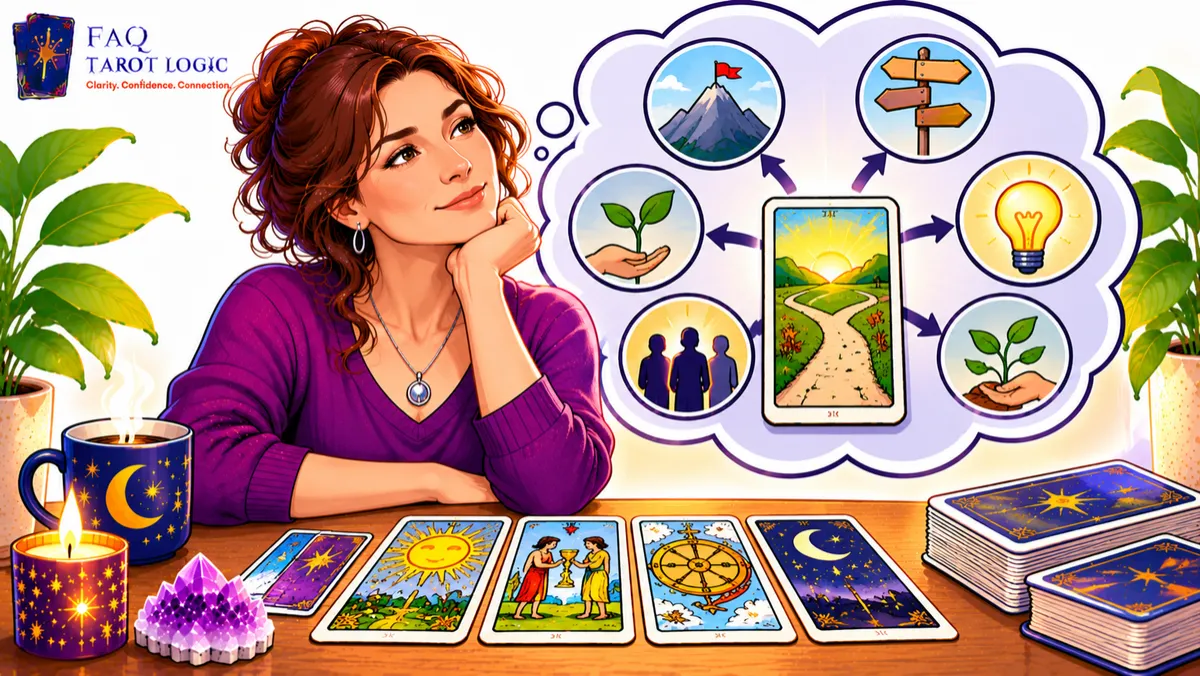
How Can Tarot Help You See a Situation From Another Perspective?
Tarot can help you see a situation from another perspective by encouraging you to explore possibilities, assumptions and emotions you may not have considered. The symbolism of the cards provides different ways of looking at familiar circumstances, helping you recognise alternative explanations and potential responses.
Rather than predicting what will happen or making decisions for you, tarot can be used as a reflective tool to broaden your understanding and approach situations with greater clarity.
IN SHORT
You've been thinking about a particular situation for several days, but you keep returning to the same conclusions.
Perhaps you're struggling with a decision, feeling frustrated by someone's behaviour or wondering whether you're approaching a problem in the right way.
You've considered the obvious possibilities, yet nothing seems to have changed.
Then you decide to explore the situation through a tarot reading.
A card appears that doesn't immediately match your expectations. Its traditional meaning encourages you to consider something you hadn't previously thought about.
Suddenly, you're looking at the situation from a slightly different angle.
How can tarot help you see a situation from another perspective?
One of the most useful aspects of tarot is its ability to introduce themes and questions that encourage reflection. A card may draw your attention to an overlooked possibility, challenge an assumption or help you recognise how your feelings are influencing your understanding.
This doesn't mean the cards possess information about the situation that you don't have. Instead, their symbolism provides a structured way to examine familiar circumstances through different ideas.
Learning to use tarot in this way can make your readings more thoughtful, particularly when you're dealing with uncertainty or trying to understand a complicated situation.
Why Is It Sometimes Difficult to See Another Perspective?
When you're personally involved in a situation, it's natural to develop an interpretation based on your experiences, expectations and emotions.
You may believe you understand why something happened or what another person intended. Once you've reached that conclusion, it can become difficult to recognise alternative explanations.
For example, imagine you've sent an important message to someone and haven't received a reply.
You might immediately assume they're unhappy with you or deliberately avoiding the conversation.
However, there could be several other explanations. They may be busy, uncertain how to respond or dealing with circumstances you know nothing about.
Your original interpretation isn't necessarily wrong, but it isn't the only possibility.
This is where reflective exercises can be helpful.
By introducing unfamiliar themes or questions, you give yourself an opportunity to consider explanations that weren't immediately obvious.
Tarot can provide one way of doing this because the cards contain a wide range of symbolic ideas, from patience and communication to uncertainty, responsibility and change.
The aim isn't to discover a hidden truth about someone else's thoughts. It's to recognise that your first interpretation may not be the only reasonable one.
How Tarot Cards Encourage Different Ways of Thinking
Every tarot card contains symbols and traditional meanings that can be explored in different contexts.
When you draw a card, you're encouraged to consider how those themes might relate to your question.
Sometimes the connection will be straightforward. At other times, the card may introduce an idea that seems unrelated to your original thinking.
That unexpected connection can be particularly useful.
Suppose you're frustrated because a project isn't progressing as quickly as you'd hoped.
You draw the Hanged Man.
This card is commonly associated with pausing, reconsidering circumstances and exploring alternative viewpoints.
Instead of concentrating entirely on how to make faster progress, you might begin asking whether your current approach needs reviewing.
Perhaps you're trying to solve a problem before gathering enough information, or maybe you've overlooked a simpler method.
The card hasn't provided a factual explanation for the delay.
Instead, its symbolism has encouraged you to consider a different question.
Sometimes the value of a tarot reading comes from changing the question you're asking rather than finding a new answer to the original one.
This is an important distinction when using tarot for reflection.
What Happens When a Card Challenges Your First Impression?
One of the most interesting experiences in tarot is drawing a card that doesn't seem to fit your understanding of a situation.
Your first reaction might be to dismiss it or search for a meaning that supports what you already believe.
However, taking a moment to explore the unfamiliar interpretation can sometimes reveal something useful.
Imagine you're considering whether to take on an additional responsibility.
You've already decided that accepting the opportunity would demonstrate commitment and help you make progress.
During your reading, you draw the Four of Swords.
Its associations with rest, recovery and reflection might initially seem unrelated to your question.
But rather than dismissing the card, you could consider whether you've given enough attention to your existing commitments.
Are you making the decision because the opportunity genuinely interests you, or because you feel uncomfortable saying no?
Do you have the time and energy to take on something new?
These questions don't mean the card is telling you to reject the opportunity.
They simply introduce considerations that may have been missing from your original assessment.
You can then combine those reflections with practical information before deciding what to do.
How Different Tarot Cards Can Represent Different Perspectives
A useful way to explore alternative viewpoints is to consider how several cards might represent different aspects of the same situation.
For example, suppose you're experiencing a disagreement with someone.
You draw the Five of Wands, Justice and Temperance.
The Five of Wands might encourage you to consider conflicting opinions or competing priorities.
Justice could introduce questions about fairness, responsibility and whether you've considered the available facts.
Temperance might encourage reflection on patience, compromise and finding a balanced response.
Together, these cards provide several perspectives on the disagreement.
Rather than concentrating entirely on who is right or wrong, you might begin considering why the disagreement developed and whether different expectations contributed to it.
You could also reflect on your own response and whether a calmer conversation might be helpful.
The cards don't establish what the other person is thinking, and they can't determine who is responsible for the disagreement.
Their value comes from helping you examine the situation through several different themes.
This approach can be particularly useful when a problem feels more complicated than it first appeared.
Can Tarot Help You Recognise Your Own Assumptions?
Yes. Tarot can provide opportunities to examine assumptions, particularly when you're willing to consider interpretations that differ from your expectations.
An assumption is something you believe to be true without necessarily having enough information to confirm it.
We all make assumptions in everyday life. They're part of how we interpret experiences and make decisions.
However, assumptions can sometimes limit our understanding.
Imagine you're thinking about starting something new but believe you aren't sufficiently experienced.
You draw the Magician, a card commonly associated with initiative, skills and making use of available resources.
Rather than interpreting the card as a promise of success, you might consider whether you're overlooking abilities you've already developed.
Perhaps you have relevant experience from another area of your life, or there are resources available that you haven't considered.
The card doesn't prove that you're ready.
Instead, it encourages you to examine whether your original assumption is supported by the facts.
This is where tarot can complement self-reflection.
By recognising the difference between what you know and what you're assuming, you may develop a more balanced understanding of your circumstances.
→ How Can Tarot Help You Develop Greater Self-Awareness?
Why Your Emotional State Can Influence Your Perspective
Emotions play an important role in how we understand situations.
When you're excited about an opportunity, you may concentrate on its advantages while overlooking possible difficulties.
When you're worried, you might focus on potential problems and find it harder to recognise encouraging possibilities.
Neither response is unusual.
However, recognising how you're feeling can help you understand why a particular interpretation seems convincing.
Suppose you're anxious about an upcoming conversation.
You draw the Nine of Swords and immediately associate it with worry, sleeplessness or distress.
Because those themes reflect your current feelings, the card may seem especially significant.
Rather than assuming it predicts a difficult conversation, you could use it to recognise how much uncertainty is affecting you.
You might then ask whether you have enough information to justify your concerns or whether you're imagining outcomes that haven't occurred.
This doesn't mean ignoring your feelings.
It means recognising that emotions provide important information about your experience without necessarily establishing what will happen.
Tarot can be useful when it encourages you to make that distinction.
→ Can Tarot Help You Understand Your Emotions?
How to Use Tarot to Explore Both Sides of a Situation
When you're struggling to understand a situation, it can help to deliberately consider more than one interpretation.
A simple three-card spread can provide a useful structure.
You might assign the positions My Current Perspective, Another Possible Perspective and What Deserves Further Consideration.
Imagine you're disappointed because a plan hasn't worked out as expected.
In the first position, you draw the Five of Cups. This might reflect your attention on what hasn't gone according to plan.
In the second position, you draw the Ace of Wands. Its associations with initiative and new possibilities could encourage you to consider whether the change has created opportunities you hadn't previously noticed.
In the third position, you draw the Two of Pentacles. This might highlight the importance of balancing practical responsibilities before deciding what to do next.
The spread doesn't tell you that the disappointment was necessary or that a better opportunity is guaranteed.
Instead, it encourages you to consider the situation from several angles.
You can acknowledge what hasn't worked while remaining open to possibilities that deserve further investigation.
This is particularly useful when your initial reaction has been strong and you want to develop a more balanced perspective.
Can Tarot Help You Understand Someone Else's Point of View?
Tarot can encourage you to consider how another person might experience a situation, but it cannot reliably reveal their private thoughts, feelings or intentions.
This distinction is important.
Suppose you've had a disagreement with a friend and want to understand why they responded differently from what you expected.
You could use tarot to explore themes such as communication, expectations and empathy.
For example, the Two of Swords might encourage you to consider whether the situation involves uncertainty or difficulty making a decision.
The Six of Pentacles could introduce questions about fairness, giving and receiving support.
The Page of Cups might encourage reflection on emotional expression or the possibility of approaching the conversation with greater openness.
These interpretations may help you consider different explanations, but they don't establish what your friend actually believes.
If you need to understand their perspective, a respectful conversation is more reliable than trying to interpret their thoughts through the cards.
Tarot can help you prepare for that conversation by encouraging you to recognise assumptions and consider how you might communicate more thoughtfully.
Understanding another perspective begins with being open to possibilities, not assuming you already know what someone else is thinking.
How Tarot Can Help When You're Facing a Difficult Decision
When you're considering an important decision, it's easy to become focused on one particular outcome.
Perhaps you already know which option you prefer, but you're uncertain whether you've considered everything that matters.
A tarot reading can provide a structured opportunity to examine different aspects of the choice.
For example, imagine you're deciding whether to continue with an existing project or begin something new.
You might draw the Seven of Pentacles, Two of Wands and Queen of Swords.
The Seven of Pentacles could encourage you to reflect on the progress you've already made and whether your efforts are producing worthwhile results.
The Two of Wands might highlight future possibilities and the importance of planning.
The Queen of Swords could introduce themes of clear thinking, objectivity and making decisions based on relevant information.
Together, these cards might encourage you to examine both your existing investment and the potential advantages of a different direction.
You could then compare practical considerations such as time, resources and likely consequences.
The cards don't determine which option is best.
Instead, they provide questions that may help you make a more informed decision.
→ Can Tarot Help With Decision-Making?
Avoid Looking Only for Interpretations That Support Your Opinion
One of the challenges of using tarot for reflection is the temptation to favour interpretations that confirm what you already believe.
If you're hoping for a particular outcome, you may concentrate on encouraging card meanings while dismissing those that introduce uncertainty.
Similarly, if you're worried about something, you might interpret neutral cards as evidence that your concerns are justified.
This can limit the usefulness of the reading.
For example, suppose you're considering a new opportunity and have already decided that it's the right choice.
You draw the Fool, which you associate with new beginnings and taking chances.
You might immediately interpret it as confirmation that you should proceed.
However, the Fool can also encourage reflection on preparation, uncertainty and the difference between openness to experience and acting without sufficient consideration.
Exploring those additional themes doesn't mean you must abandon your preferred option.
It simply helps you consider whether your decision has been examined carefully.
A balanced interpretation should allow room for possibilities you hadn't expected.
→ How Do You Read Tarot Without Looking for the Answer You Want?
What If a Different Perspective Doesn't Feel Relevant?
Not every interpretation will provide a useful connection with your circumstances.
Sometimes a card's symbolism may suggest an idea that doesn't seem particularly relevant, even after you've considered the question and surrounding cards.
That's perfectly reasonable.
You don't need to force a connection simply because the card has appeared.
For example, you might draw the Six of Cups during a reading about a practical work decision.
Its associations with memories and past experiences may encourage you to consider whether earlier experiences are influencing your judgement.
However, if that theme doesn't seem relevant, you don't need to invent a connection.
You can acknowledge the possibility and continue examining the rest of the spread.
The purpose of exploring different perspectives is to broaden your thinking, not to make every symbolic association fit.
Sometimes the most useful conclusion is that a particular interpretation doesn't add anything meaningful.
Recognising this can help you become more confident in your judgement and less dependent on finding a definite explanation for every card.
How to Turn a New Perspective Into Something Useful
Recognising an alternative viewpoint is valuable, but the next step is deciding whether it changes anything about how you understand the situation.
A tarot reading may introduce an interesting possibility, but that doesn't automatically mean you need to take action.
Begin by considering whether the new perspective is reasonable.
Does it fit the information you already have? Does it highlight something you've overlooked? Is there anything you could check or explore further?
For example, suppose a reading encourages you to consider whether a disagreement has developed because expectations weren't clearly communicated.
You might decide to revisit the original conversation or ask the other person what they understood.
Alternatively, a reading about personal priorities might encourage you to examine whether you're spending enough time on activities that matter to you.
You could review your schedule and consider whether small adjustments would be helpful.
The important thing is to connect reflection with practical judgement.
Tarot can introduce questions, but you decide which ideas deserve further consideration.
→ How Do You Turn Tarot Insights Into Positive Action?
Can Exploring Different Perspectives Improve Your Tarot Skills?
Learning to consider alternative interpretations can also help you become a more confident tarot reader.
When you're beginning, it's natural to rely heavily on familiar card meanings.
You might associate the Hermit with solitude, the Chariot with determination or the Four of Swords with rest.
These associations provide a useful foundation, but they don't represent every possible interpretation.
As you gain experience, you'll begin recognising how the same card can highlight different aspects of a situation.
The Hermit might encourage independent reflection in one reading and suggest seeking deeper understanding in another.
The Chariot could represent maintaining direction, managing competing priorities or considering how determination influences your response.
The Four of Swords might highlight the importance of recovery, taking time before making a decision or stepping away from unnecessary distractions.
Exploring these possibilities helps you develop flexibility without abandoning traditional meanings.
It also encourages you to consider the question, spread positions and surrounding cards rather than relying on a single memorised definition.
Over time, this can make your interpretations more thoughtful and better suited to the circumstances you're exploring.
Coffee Cup Tip ☕
Try the Three Perspectives Exercise the next time you feel stuck on a particular situation.
Choose a question that encourages reflection rather than asks for a definite prediction.
For example: What might help me understand this situation more clearly?
Shuffle your deck and draw three cards using these positions.
1. My Current Perspective
Consider how the card's symbolism relates to the way you're already viewing the situation. Does it reflect your concerns, expectations or priorities?
2. An Alternative Perspective
Explore whether the second card introduces a different explanation or possibility. Try to consider the interpretation without immediately deciding whether you agree with it.
3. What I Could Explore Further
Use the final card to identify a question, assumption or practical consideration that deserves more attention.
Once you've interpreted the spread, write a short paragraph comparing your original viewpoint with the alternatives you've considered.
You don't need to change your opinion simply because a card suggests another possibility.
The aim is to become more aware of the different ways a situation can be understood.
QUICK RECAP
Tarot can help you see a situation from another perspective by introducing symbolic themes that encourage reflection and alternative ways of thinking.
Rather than providing definite answers, the cards can help you explore assumptions, emotions and possibilities that may not have been obvious at first.
Remember that:
Your initial interpretation of a situation isn't always the only reasonable one.
Tarot symbolism can introduce questions you hadn't previously considered.
Unexpected cards may encourage useful reflection.
Different cards can highlight different aspects of the same situation.
Your emotional state can influence which interpretations feel convincing.
Tarot cannot reliably reveal another person's private thoughts or intentions.
Alternative perspectives should be considered alongside practical information.
You don't need to force every card into a meaningful connection.
Learning to explore different viewpoints can help you approach tarot with greater flexibility and confidence.
It can also encourage you to recognise when your assumptions deserve closer examination.
Sometimes the most valuable part of a tarot reading isn't discovering a new answer. It's recognising that there may be another way to understand the question.
NEXT STEP
Learning to explore different perspectives can help you develop more balanced and thoughtful tarot interpretations.
However, as your experience grows, you may encounter situations where your personal interpretation of a card differs from its traditional meaning.
Perhaps a symbol catches your attention or a card creates an impression that doesn't seem to match the description in your guidebook.
Understanding how to approach those differences can help you develop confidence without losing sight of the card's established symbolism.
Next topic: What Should You Do When Your Intuition Disagrees With a Card's Traditional Meaning?
