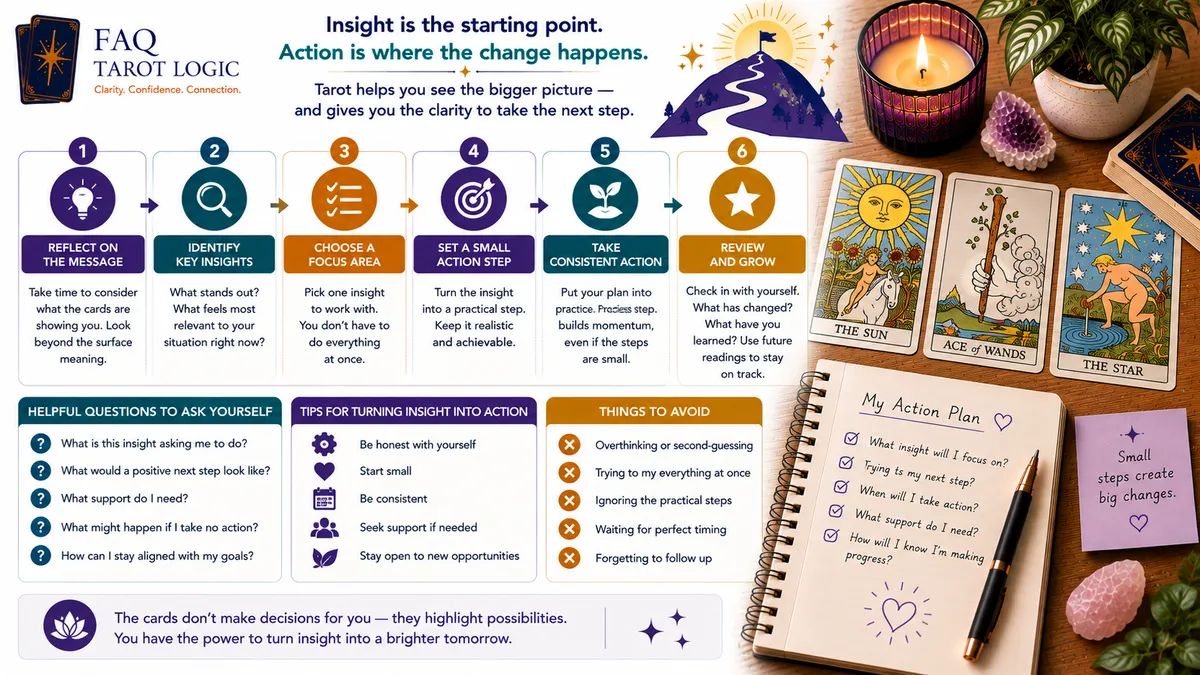
How Do You Turn Tarot Insights Into Positive Action?
TL;DR
Tarot insights become more useful when you turn them into small, realistic actions. After a reading, identify the main message, decide what part of the situation you can influence and choose one practical step you can take. Tarot doesn't need to tell you exactly what to do. Its value can come from helping you recognise what deserves your attention and encouraging you to act on what you've discovered.
IN SHORT
A tarot reading can give you plenty to think about.
You might recognise a pattern.
See a situation differently.
Understand why you've been hesitating.
Or realise something needs more attention.
But then what?
Insight is useful, but it becomes much more valuable when you decide what you're going to do with it.
That doesn't mean allowing the cards to control your decisions.
It means taking what you've learned from the reading and asking:
"What practical step could I take from here?"
Start With The Main Insight
Before deciding what action to take, identify what the reading actually helped you understand.
Try completing this sentence:
"The most useful thing I recognised during this reading was..."
Perhaps you realised:
You've been avoiding a conversation.
You need more information before deciding.
Fear is influencing your thinking.
You're taking on too much.
You've overlooked another option.
You're repeating an old pattern.
You need to give something more time.
Don't try to act on every card individually.
Find the central insight first.
Separate Insight From Instruction
There's an important difference between receiving an insight and treating a tarot card as an instruction.
Suppose a reading makes you realise you're unhappy at work.
The conclusion doesn't automatically have to be:
"The cards are telling me to quit my job."
A more useful response might be:
"This reading has made me realise how dissatisfied I've become. What could I do to understand my options?"
That might lead to researching other roles, updating your CV, discussing changes at work or thinking more carefully about what you actually want.
The tarot reading helped you recognise something.
You decide what to do about it.
This distinction is especially important when using tarot for choices.
→ Can Tarot Help With Decision-Making?
Focus On What You Can Influence
Some parts of a situation are outside your control.
You can't control:
What another person thinks.
Whether someone changes their behaviour.
Exactly how an opportunity develops.
Every future outcome.
How other people respond to your choices.
But you can often influence:
How you communicate.
What information you gather.
Which boundaries you establish.
How prepared you are.
What you choose to prioritise.
The next step you take.
Useful action usually begins by bringing the focus back to what you can actually do.
Turn A General Insight Into Something Specific
Tarot insights can sometimes feel too broad to act upon.
For example:
"I need more balance."
That's useful, but what does balance mean in practical terms?
Ask:
"What would greater balance actually look like this week?"
Perhaps it means:
Finishing work at a reasonable time.
Saying no to another commitment.
Setting aside time for something important.
Asking someone for help.
Taking a proper break.
The more specific the action becomes, the easier it is to follow through.
Choose One Small Step
Positive action doesn't need to mean making a major life change.
Often, a small step is better.
Suppose a reading suggests you've been avoiding an important decision.
You don't necessarily have to make that decision immediately.
Your first action could simply be:
"Tomorrow I'll spend 20 minutes writing down the advantages and disadvantages of each option."
Or:
"I'll find the information I'm missing before deciding."
A small action creates movement without forcing you to resolve everything at once.
Use Better Questions To Find The Next Step
Sometimes the original reading reveals a problem but doesn't make the next step obvious.
Instead of immediately drawing several clarifying cards, try asking yourself a practical question.
For example:
What can I realistically do about this?
What needs my attention first?
What information am I missing?
What conversation might help?
What can I change?
What should I stop doing?
What small step would create progress?
The quality of the question often determines how useful the reflection becomes.
→ How Can You Ask Better Questions During a Tarot Reading?
Don't Confuse Action With Urgency
Recognising something doesn't mean you need to act immediately.
Sometimes the most appropriate action is:
Wait.
Observe.
Gather more information.
Think.
Give yourself time.
A tarot reading might reveal that you're reacting emotionally or don't yet understand the situation clearly.
In that case, delaying a decision can itself be a positive action.
Movement isn't always progress.
Sometimes patience is.
Notice When Emotions Are Driving The Action
Suppose a reading brings up frustration.
You might immediately feel like sending a message, confronting someone or making a sudden decision.
Before doing so, ask:
"Am I responding to the insight, or reacting to the emotion it brought up?"
There's a difference.
Tarot can help you recognise emotions, but recognising them doesn't mean they should automatically determine your next move.
Giving yourself time to understand what you're feeling can lead to a much more considered response.
→ Can Tarot Help You Understand Your Emotions?
Write Down Your Intended Action
If a reading produces something useful, write down the next step.
Keep it simple.
Insight: I've been avoiding an important conversation.
Action: Decide what I actually want to say before speaking to the person.
Or:
Insight: I'm overwhelmed because I've taken on too much.
Action: Identify one commitment I can postpone or remove this week.
This creates a bridge between reflection and action.
It also gives you something concrete to review later.
Don't Create A Huge To-Do List
A tarot reading isn't a productivity exercise.
You don't need to turn every card into another task.
If your three-card spread produces eight new things you think you "must" do, you've probably gone too far.
Instead, ask:
"What's the one thing from this reading that would be most useful to act upon?"
One meaningful step is usually more valuable than a long list you never complete.
Revisit The Reading After Taking Action
One of the most useful learning habits is returning to a reading later.
Not to check whether the cards "came true."
Instead, ask:
Did I take the action I intended?
Did it help?
What happened afterwards?
Did my understanding of the reading change?
Would I respond differently now?
What did I learn about myself?
This turns your tarot journal into more than a record of cards.
It becomes a record of how reflection influenced your choices.
→ Should You Keep a Tarot Journal?
Look For Repeated Insights You Haven't Acted On
Sometimes the same theme appears across several readings because the situation hasn't changed.
Perhaps you repeatedly recognise that you need stronger boundaries.
Or that you're avoiding a conversation.
Or that you're spending too much time worrying about something outside your control.
Before asking the cards about it again, consider:
"Have I actually done anything with what I already recognised?"
Another reading may not be what you need.
The next step may be action.
Recognising recurring themes across readings can make this particularly clear.
→ How Do You Recognise Patterns Across Multiple Tarot Readings?
Action Can Include Changing Your Perspective
Not every useful outcome needs to involve doing something externally.
Sometimes the positive action is internal.
You might decide to:
Stop assuming the worst.
Give yourself more time.
Question an old belief.
Accept that you can't control an outcome.
Be more realistic about your expectations.
Recognise something you've handled well.
A change in perspective can affect what you do later.
Reflection and action aren't always separate processes.
Don't Use Tarot To Avoid Making The Decision
There is an interesting trap here.
Tarot can help you explore decisions, but it can also become another way of delaying them.
You draw cards.
Think about them.
Draw another spread.
Read another interpretation.
Ask the question differently.
Eventually, you're no longer gaining new insight.
You're postponing the point where you need to decide what you're going to do.
If you notice this happening, put the cards aside and ask:
"Do I already have enough information to take the next step?"
Often, you do.
Let Experience Teach You What Works
Not every action inspired by a reading will turn out exactly as you expected.
That's okay.
The goal isn't to prove the tarot was right.
It's to become better at reflecting, deciding and learning from experience.
Over time, you may discover which kinds of readings produce useful insights for you and which questions tend to send you in circles.
That's part of developing your own relationship with tarot.
Coffee Cup Tip ☕
At the end of a reading, write down just two things:
What I recognised:
One sentence describing the main insight.
What I'll do:
One realistic action you can take.
If you can't identify an action, that's fine.
Sometimes:
"I'll think about this for a few days before deciding"
is a perfectly useful next step.
QUICK RECAP
You can turn tarot insights into positive action by:
Identifying the main insight from the reading.
Separating reflection from instruction.
Focusing on what you can influence.
Turning broad insights into specific ideas.
Choosing one manageable next step.
Asking practical follow-up questions.
Remembering that action doesn't always mean urgency.
Recognising when emotions are influencing your response.
Writing down what you intend to do.
Reviewing what happened afterwards.
Noticing repeated insights you haven't acted upon.
Recognising that a change in perspective can also be action.
Knowing when to stop reading and start deciding.
Tarot can help you see something differently.
But the cards don't need to take the next step.
You do.
NEXT STEP
That brings us to the end of this part of Applying Tarot.
Next, we move into Series 4 – Developing Your Reading Style, where we'll look at what happens as experience begins shaping the way you personally work with the cards.
Next:
→ How Do You Refine Your Tarot Reading Style Through Experience?
