When Are You Ready to Read Tarot for Other People?
TL;DR
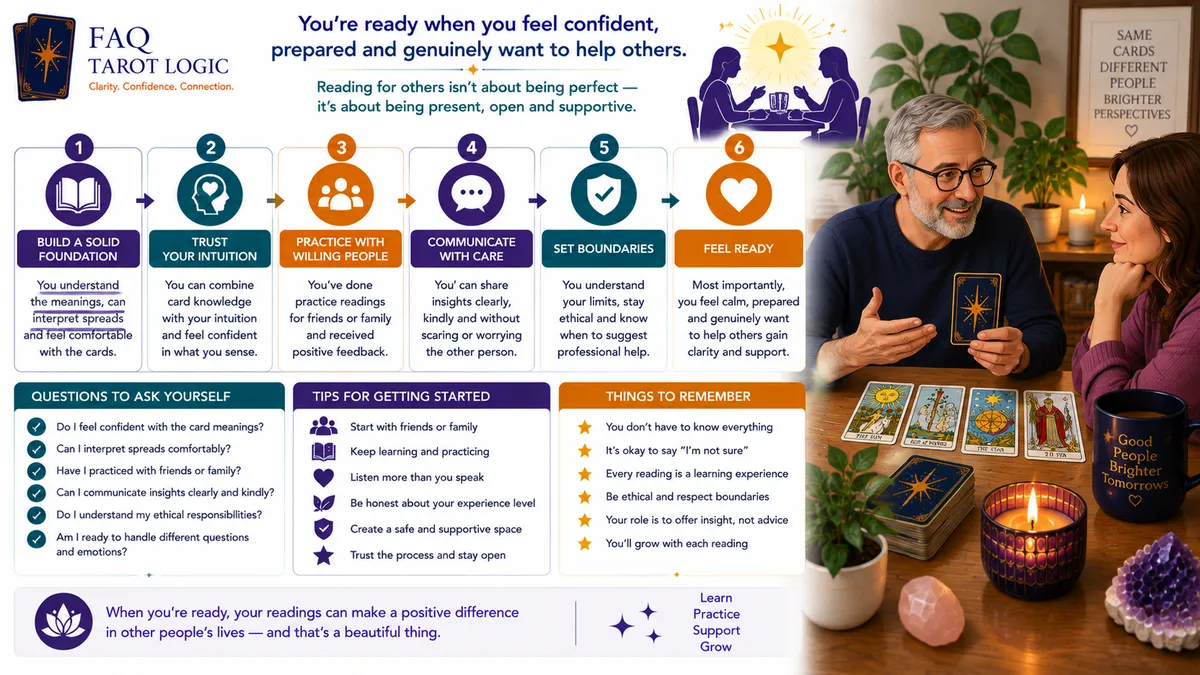
You're ready to start reading tarot for other people when you understand the basic card meanings, can interpret simple spreads, feel comfortable explaining your reasoning and can admit when something isn't immediately clear. You don't need to know every card perfectly or consider yourself an expert. Start with supportive friends or family, keep the readings simple and treat each one as an opportunity to practise communicating what you see in the cards.
IN SHORT
Reading tarot for yourself and reading for someone else can feel surprisingly different.
When you're reading alone, you can:
Take your time.
Check a guidebook.
Change your interpretation.
Sit quietly with a confusing card.
Return to the reading later.
Put another person in front of you and suddenly you may feel as though you're expected to know everything immediately.
You're not.
Being ready to read for someone else isn't about reaching a particular level of expertise.
It's about having enough understanding to explore the cards thoughtfully while being comfortable saying:
"Let me think about this for a moment."
You Don't Need To Know Every Card Perfectly
One of the biggest reasons people delay reading for others is the belief that they must know all 78 cards inside out.
You don't.
You should have a reasonable understanding of the deck, but forgetting part of a card's meaning doesn't mean you're not ready.
Even experienced readers sometimes:
Check a detail.
Look again at the imagery.
Consider several interpretations.
Take time to understand an unfamiliar combination.
What's more important is being able to work with the card rather than simply recite a definition.
If memorising every meaning is still worrying you:
→ Should You Memorise Tarot Card Meanings?
Start With Reading Comfortably For Yourself
Before reading for other people, it helps to feel reasonably comfortable performing your own readings.
That doesn't mean every reading needs to be perfectly clear.
Ask yourself:
Can I choose a suitable spread?
Can I interpret individual cards?
Can I relate cards to the question?
Can I recognise connections between cards?
Can I explain why I've reached an interpretation?
If you can usually do those things, you've already developed many of the skills you'll use when reading for somebody else.
You Should Be Able To Read Cards Together
Reading for someone else becomes much easier when you can move beyond giving separate definitions for each card.
Suppose you draw three cards.
Rather than saying:
"Card one means this. Card two means that. Card three means something else."
you want to begin recognising how they form a wider message.
Do they reinforce one another?
Does one card challenge the others?
Is there a repeated theme?
Does the spread appear to move from one situation towards another?
This helps the reading feel connected rather than like three separate guidebook entries.
→ How Do You Interpret Multiple Tarot Cards Together?
Practise Explaining What You See
Reading for yourself happens largely inside your head.
Reading for another person requires you to communicate your interpretation.
That's a separate skill.
A useful practice is to perform a reading for yourself and explain it aloud as though someone were sitting opposite you.
Instead of thinking:
"This card is about change,"
say:
"I'm interpreting this as change because of the card's traditional meaning, but the surrounding cards suggest this may be a gradual transition rather than something sudden."
Explaining why you've reached an interpretation helps you become clearer and more confident.
Start With Someone Supportive
Your first reading for another person doesn't need to be for a complete stranger.
Start with someone who knows you're learning.
A friend or family member can be ideal.
Tell them:
"I'm practising reading for other people, so I'd like to try a simple reading with you."
That removes the pressure to perform like an expert.
You're practising a skill, and the other person understands that from the beginning.
Keep Your First Readings Simple
There's no need to begin with an elaborate ten-card spread.
A three-card reading is often enough.
For example:
Situation.
What to consider.
Possible next step.
Or:
What you know.
What you may be overlooking.
What deserves attention.
Small spreads are easier to interpret and give you more space to discuss each card.
The aim of your first readings isn't to impress someone with complexity.
It's to communicate a useful interpretation clearly.
Encourage Better Questions
The person you're reading for may initially ask:
"Will I get the job?"
"Will my relationship work?"
"What's going to happen?"
You don't have to accept the first wording.
Help them create a question that's more useful to explore.
For example:
"What should I consider as I prepare for this job opportunity?"
or:
"What could help me understand this relationship more clearly?"
This gives you a stronger foundation for the reading and keeps the focus on reflection rather than certainty about future events.
→ How Can You Ask Better Questions During a Tarot Reading?
Don't Pretend To Know More Than You Do
Sometimes a card won't immediately make sense.
That's okay.
You don't need to hide that by producing an interpretation you don't believe.
You can say:
"I'm not immediately seeing how this card fits. Let's look at it alongside the others."
Or:
"There are a couple of ways I could interpret this. Let's see which fits the question better."
That isn't a weakness.
It's a thoughtful way to read.
Confidence doesn't require pretending to be certain.
Don't Feel Pressured To Make Predictions
Someone may expect tarot to tell them exactly what's going to happen.
You don't have to read that way.
You can explain from the beginning that your approach is about:
Exploring the situation.
Recognising patterns.
Considering different perspectives.
Identifying what deserves attention.
Helping them reflect on their choices.
Setting that expectation makes the reading more comfortable for both of you.
It also prevents you from feeling that you need to produce dramatic predictions simply because someone expects them.
Let The Other Person Participate
A tarot reading doesn't have to be a performance where you speak and the other person silently listens.
If a card seems important, you might ask:
"Does that idea connect with the situation you're describing?"
Or:
"What stands out to you in this card?"
Their response may provide useful context.
You're not asking them to interpret the reading for you.
You're recognising that they understand their own situation better than you do.
That can make the reading more relevant and reflective.
Be Careful With Sensitive Subjects
When reading for someone else, you may encounter questions involving serious personal concerns.
You don't need to have an answer for everything.
Tarot isn't a substitute for qualified medical, legal, financial or mental health advice.
If someone asks a question that requires professional expertise, it's reasonable to explain that tarot isn't the appropriate tool for making that decision.
You can sometimes help them reframe the question towards something reflective that remains within sensible boundaries.
Knowing what not to read about is part of reading responsibly.
Avoid Fear-Based Interpretations
Dramatic-looking cards can make new readers nervous, particularly when another person is sitting in front of them.
Don't assume a challenging card predicts something terrible.
Return to:
The question.
The card's position.
The surrounding cards.
The wider context.
A card associated with endings may describe a transition.
A card showing conflict may highlight disagreement or internal tension.
A card associated with disruption may simply suggest that something needs to change.
Avoid turning symbolic imagery into frightening predictions.
→ How Do You Avoid Fear-Based Tarot Reading?
Respect The Other Person's Choices
A reading can offer perspectives.
It shouldn't remove someone's responsibility for their own decisions.
Try to avoid statements such as:
"You need to do this."
or:
"The cards say you shouldn't do that."
Instead, you might say:
"This seems to be highlighting..."
or:
"One possibility these cards suggest is..."
The distinction matters.
You're sharing an interpretation, not issuing instructions.
The person receiving the reading remains responsible for deciding what makes sense for them.
Don't Worry If They See Something Different
Occasionally, the person you're reading for will notice something in a card that you hadn't considered.
That's not a problem.
Perhaps a symbol immediately reminds them of their situation.
You can explore that observation together.
You don't have to abandon your own interpretation, but you also don't need to insist that yours is the only possible one.
Tarot interpretation depends heavily on context.
Different perspectives can sometimes deepen the reading.
→ Why Does Context Matter More Than Individual Card Meanings?
Ask For Feedback Afterwards
When you're practising, feedback is valuable.
You might ask:
Was the reading easy to follow?
Did anything feel unclear?
Did I explain the cards well?
Was there anything you'd have liked me to explore more?
Did the reading give you something useful to think about?
You're not asking:
"Was I right?"
You're trying to improve the quality of your reading and communication.
That distinction helps you learn much more.
Review The Reading Yourself
Afterwards, spend a few minutes thinking about how the reading went.
Ask yourself:
Which parts felt natural?
Where did I hesitate?
Did I explain my interpretations clearly?
Did I rely too much on individual meanings?
Did I listen properly to the other person?
Did I draw unnecessary clarifying cards?
What would I do differently next time?
This turns each reading into practical experience.
Don't Compare Yourself With Professional Readers
Someone who has performed hundreds or thousands of readings will naturally appear more comfortable than someone doing their first few.
They've had more practice.
That doesn't mean they possess something you're missing.
Instead of asking:
"Why can't I read like that?"
ask:
"What can I learn from the way they approach a reading?"
Experience develops gradually.
Your goal isn't to sound like somebody else.
It's to become increasingly comfortable with your own way of interpreting and communicating the cards.
Know The Difference Between Nervous And Unready
Feeling nervous before your first reading for someone else doesn't necessarily mean you're not ready.
Nerves are normal whenever you try a developing skill in front of another person.
You may be ready if you can:
Understand the basic cards.
Work with a simple spread.
Relate cards to a question.
Explain your interpretation.
Admit when you're unsure.
Avoid making claims you can't support.
Respect the other person's choices.
You don't need perfect confidence before you begin.
Some confidence only develops because you begin.
Coffee Cup Tip ☕
Before your first few readings for other people, remind yourself:
"I don't have to prove anything. I'm here to explore the cards thoughtfully and explain what I see."
That removes much of the pressure to produce the perfect interpretation.
QUICK RECAP
You may be ready to read tarot for other people when you can:
Understand the basic meanings of the cards.
Perform simple readings comfortably.
Interpret cards together.
Explain why you've reached an interpretation.
Help someone ask a useful question.
Admit when something isn't immediately clear.
Avoid unnecessary predictions.
Include the other person in the conversation.
Handle sensitive subjects responsibly.
Avoid fear-based interpretations.
Respect the other person's decisions.
Ask for constructive feedback.
Learn from each reading afterwards.
You don't need to know everything before reading for someone else.
You need a reasonable foundation, a thoughtful approach and a willingness to keep learning.
NEXT STEP
Reading for other people gives you a different kind of experience from reading only for yourself.
It helps you practise communicating interpretations, responding to unfamiliar questions and working with situations you may never have encountered personally.
Over time, those experiences can help you recognise the habits that make readings clearer, calmer and more useful — the same habits experienced tarot readers gradually develop through practice.
