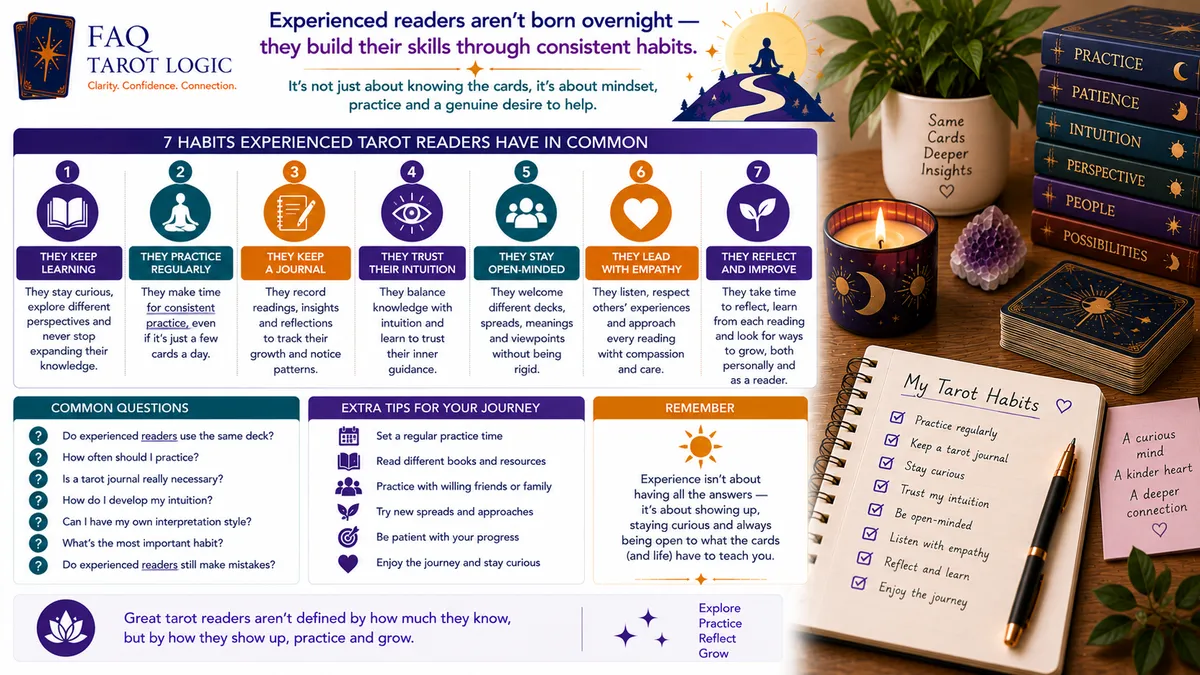
What Habits Do Experienced Tarot Readers Have in Common?
TL;DR
Experienced tarot readers don't all read the same way, but many develop similar habits. They practise regularly, ask clear questions, interpret cards in context, stay curious, review their readings and accept that they won't understand every card immediately.
They also become comfortable trusting their interpretations without assuming they're always right. Experience comes less from memorising more information and more from consistently applying, reviewing and refining what you've already learned.
IN SHORT
Experienced tarot readers can sometimes make reading the cards look effortless.
They notice connections quickly.
Explain interpretations clearly.
And seem comfortable when an unexpected card appears.
But that confidence usually isn't the result of knowing some secret technique.
It comes from habits developed through repeated practice.
Those habits don't make every reading perfect.
They simply make it easier to work thoughtfully with whatever appears on the table.
They Read Regularly
Experience requires experience.
That sounds obvious, but it's easy to spend more time learning about tarot than actually reading tarot.
Experienced readers have usually performed many readings.
Some will have read professionally.
Others may only read for themselves, friends or family.
The important part is regular contact with the cards.
Each reading gives you another opportunity to practise:
Interpreting familiar cards in new situations.
Recognising combinations.
Working with different questions.
Noticing recurring themes.
Explaining what you see.
Handling cards that initially seem confusing.
You don't need to read every day.
Consistency matters more than frequency.
→ What Habits Help You Become a Better Tarot Reader?
They Start With The Question
Experienced readers rarely interpret a card as though it appeared in isolation.
They return to the question.
A card associated with independence could have very different implications depending on whether you're exploring:
A relationship.
A career decision.
A personal goal.
A difficult conversation.
A period of change.
The traditional meaning provides the foundation.
The question helps determine how that meaning applies.
This habit prevents readings from becoming a collection of disconnected definitions.
They Look At The Whole Spread
Beginners naturally concentrate on individual cards.
Experienced readers tend to move more easily between the individual cards and the spread as a whole.
They might notice:
Several cards expressing similar ideas.
A progression from one card to another.
A repeated suit.
Contrasting cards.
Strong Major Arcana presence.
Visual similarities.
A theme that connects the entire spread.
Instead of asking only:
"What does each card mean?"
they also ask:
"What are these cards saying together?"
→ How Do You Interpret Multiple Tarot Cards Together?
They Don't Rush To The Guidebook
Experienced readers still use guidebooks.
The difference is that they don't necessarily reach for one the moment they're uncertain.
They may first:
Look more closely at the card.
Return to the question.
Examine the surrounding cards.
Consider the card's position.
Notice the symbolism.
Think about alternative interpretations.
If the card still feels unclear, checking a guidebook can provide another perspective.
The habit is not never use a guidebook.
It's think before using one.
They Stay Curious About Familiar Cards
Seeing The Fool for the hundredth time doesn't mean there's nothing left to notice.
Experienced readers often remain curious about familiar cards.
They may ask:
"Why is this card appearing in this reading?"
rather than immediately repeating its standard meaning.
A familiar card can behave differently depending on its position, surrounding cards and the question being explored.
Curiosity keeps interpretation flexible.
→ Why Does Context Matter More Than Individual Card Meanings?
They Ask Better Questions
Experience often changes the questions a reader asks.
Rather than:
"Will this happen?"
they may ask:
"What should I understand about this situation?"
Rather than:
"Which choice is right?"
they might explore:
"What should I consider about each option?"
Better questions create more useful readings because they encourage exploration rather than demanding certainty.
Experienced readers also become better at recognising when a question is too broad, too restrictive or based on an assumption.
→ How Can You Ask Better Questions During a Tarot Reading?
They Accept That Some Readings Take Time
Not every spread makes sense immediately.
Experienced readers know this.
A confusing card doesn't automatically trigger panic.
Instead, they may:
Sit with the reading.
Look for connections.
Write it down.
Return to it later.
Accept that part of the message isn't clear yet.
This willingness to tolerate uncertainty is an important habit.
It prevents the reader from forcing an interpretation simply because they feel they should have an immediate answer.
They Don't Draw Endless Clarifying Cards
One confusing card can easily become five more cards.
Experienced readers are often more selective.
Before drawing a clarifier, they ask whether another card is genuinely necessary.
Could the original card make more sense when considered alongside the question?
Does another card in the spread already provide the context?
Would more time help?
Clarifying cards can be useful.
But repeatedly drawing until an interpretation feels comfortable can make the reading harder rather than easier.
They Notice Their Own Reactions
Experienced reading isn't only about noticing the cards.
It's also about noticing yourself.
Perhaps a particular card immediately creates anxiety.
Maybe you're strongly hoping for one interpretation.
Or you feel disappointed by what appears.
An experienced reader learns to ask:
"Is this interpretation coming from the card, or from how I'm feeling about the situation?"
That doesn't mean emotions should be ignored.
It means recognising when they may be influencing the reading.
→ What Is the Difference Between Intuition and Fear?
They Explain Why An Interpretation Makes Sense
Experienced readers don't necessarily have more dramatic interpretations.
Often, they're simply better at explaining them.
Instead of:
"This card means you need patience,"
they might say:
"I'm reading this as patience because of the card's traditional meaning, its position as guidance and the slower energy appearing across the rest of the spread."
That explanation shows how the interpretation was reached.
It's particularly useful when reading for other people because it makes the process clearer and more grounded.
They Keep Learning
Experience doesn't mean finishing tarot.
Experienced readers may still:
Study symbolism.
Explore unfamiliar decks.
Revisit card meanings.
Try different spreads.
Read books.
Compare interpretations.
Learn from other readers.
Review their own readings.
The difference is that new information is being added to an existing foundation.
They can compare new ideas with what they've already discovered through practice.
They Review Their Readings
One of the most valuable habits is looking backwards.
An experienced reader may revisit a previous reading and ask:
What did I interpret well?
What did I overlook?
Did the question work?
Was I influenced by what I wanted to hear?
Did the cards make more sense later?
Would I interpret them differently now?
This turns every reading into more than a one-time event.
It becomes part of the learning process.
→ Should You Keep a Tarot Journal?
They Recognise Patterns Over Time
Regular review also makes recurring patterns easier to see.
Perhaps a particular card repeatedly appears when you're dealing with uncertainty.
Maybe certain questions keep returning.
Or you notice that one interpretation consistently causes confusion.
Patterns can reveal both how you use tarot and how your interpretation skills are developing.
The longer you read, the more useful this accumulated experience becomes.
They Develop Personal Preferences
Experienced readers don't necessarily follow exactly the same methods.
One may love large structured spreads.
Another may use three cards for almost everything.
Some use reversals.
Others don't.
Some shuffle until a card jumps out.
Others draw deliberately from the deck.
The important thing is that their preferences have usually developed through experience rather than because they believe there's only one correct method.
→ How Do You Refine Your Tarot Reading Style Through Experience?
They Know When To Stop
Knowing when to finish a reading is a skill.
Sometimes the cards have already provided enough to consider.
Drawing more cards doesn't always produce more clarity.
Experienced readers become better at recognising the point where additional cards are likely to add noise rather than insight.
They can say:
"That's enough for now."
Then give the reading time to settle.
They Don't Expect Tarot To Make Decisions For Them
Experience often brings clearer boundaries around what tarot can and cannot do.
A thoughtful reader can use tarot to:
Explore choices.
Recognise patterns.
Consider another perspective.
Reflect on emotions.
Identify what deserves attention.
But the cards don't need to make the final decision.
Experienced readers generally become more comfortable using tarot as part of reflection rather than handing responsibility for their choices to the deck.
→ Can Tarot Help With Decision-Making?
They Learn From Mistakes Without Dwelling On Them
Every tarot reader misinterprets cards sometimes.
They overlook connections.
Ask poor questions.
Use spreads that don't suit the situation.
Draw too many clarifiers.
Allow assumptions to influence a reading.
Experience doesn't eliminate mistakes.
It changes your relationship with them.
Instead of treating a confusing reading as proof that you're a poor reader, you can ask:
"What can this teach me?"
Then use that lesson in the next reading.
They Trust Themselves Without Becoming Overconfident
Experienced readers tend to become more comfortable with their own interpretations.
But useful confidence still leaves room for uncertainty.
There's a big difference between:
"I trust my ability to interpret this reading."
and:
"My interpretation must be correct."
The first allows curiosity.
The second closes it down.
Strong readers can trust what they see while remaining willing to reconsider it when the wider context suggests another possibility.
→ How Do You Trust Your Tarot Interpretation?
They Let Their Practice Evolve
A habit that worked perfectly when you started may not suit you forever.
Your preferred deck might change.
Your spreads may become simpler.
Your questions may become more reflective.
You may pay more attention to symbolism than you once did.
Experienced readers allow their practice to evolve rather than preserving every early habit simply because it's familiar.
Tarot remains something they're learning rather than something they've completed.
Coffee Cup Tip ☕
Choose one habit from your own readings that you'd like to improve.
Not five.
Just one.
For example:
"Before drawing a clarifying card, I'll spend another minute looking at the cards already on the table."
Practise that consistently for several readings.
Small changes repeated regularly are often what create noticeable improvement.
QUICK RECAP
Experienced tarot readers often:
Read regularly.
Begin with a clear question.
Look at the whole spread.
Think before reaching for a guidebook.
Stay curious about familiar cards.
Ask more useful questions.
Accept that some readings take time.
Use clarifying cards selectively.
Notice their own emotional reactions.
Explain why an interpretation makes sense.
Continue learning.
Review previous readings.
Recognise patterns over time.
Develop personal preferences.
Know when to stop.
Keep responsibility for their own decisions.
Learn from mistakes.
Trust themselves without assuming they're always right.
Allow their practice to evolve.
There isn't one habit that suddenly turns someone into an experienced tarot reader.
Experience is built from many small habits repeated over time.
NEXT STEP
Every reading gives you another opportunity to practise those habits.
Even a reading that feels confusing, incomplete or different from what you expected can teach you something about the cards and about the way you interpret them.
The next step is learning how to use each reading as part of your continuing development.
