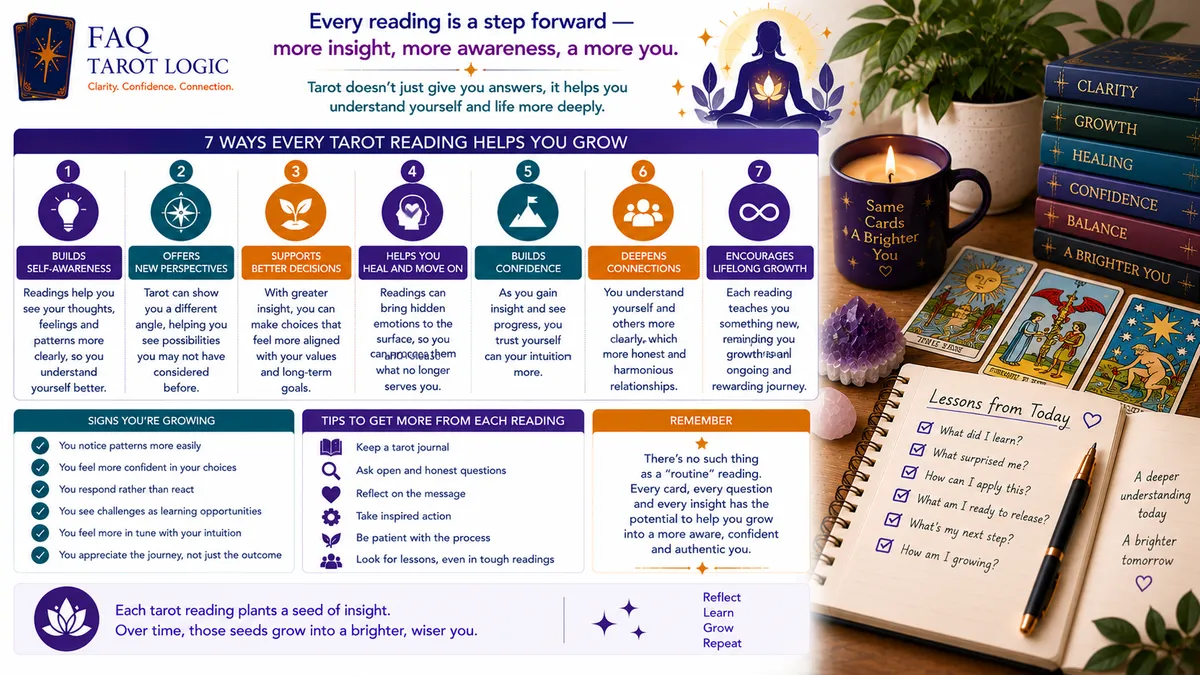
How Can Every Tarot Reading Help You Grow?
TL;DR
Every tarot reading can help you grow because each one gives you an opportunity to practise interpretation, recognise patterns, understand your reactions and learn from experience. A reading doesn't have to feel accurate, profound or immediately clear to be useful.
By reviewing what worked, what confused you and what you might approach differently next time, even an imperfect reading can help you become a more thoughtful and confident tarot reader.
IN SHORT
It's easy to learn from a tarot reading that feels clear.
The cards connect.
The interpretation makes sense.
You finish feeling as though everything came together.
But what about the readings that don't?
The confusing ones.
The ones where a card seems completely out of place.
The ones you understand differently a week later.
Those readings can teach you just as much.
Every time you work with the cards, you gain another piece of experience.
The important part is learning how to use it.
Don't Judge A Reading Only By How Clear It Feels
A clear reading feels satisfying.
That doesn't necessarily mean it taught you more than a difficult one.
Suppose you draw three cards and immediately understand how they fit together.
Excellent.
You've reinforced skills you already possess.
But suppose another spread leaves you wondering:
"How on earth do these cards connect?"
Now you have an opportunity to practise:
Looking at context.
Finding relationships between cards.
Considering alternative meanings.
Examining symbolism.
Sitting with uncertainty.
Difficulty can create learning.
→ Why Do Tarot Readings Sometimes Feel Confusing?
Every Reading Builds Familiarity
Tarot becomes easier partly because the cards stop feeling unfamiliar.
You've seen them before.
Not only in a guidebook, but in actual readings.
You've seen The Hermit appear in a career question.
The Fool in a relationship reading.
The Tower in a situation that had nothing to do with catastrophe.
Each encounter adds another layer to your understanding.
Over time, you stop remembering only what a card should mean and begin remembering how you've seen it behave in different contexts.
That's experience.
Notice What You Did Well
Growth isn't only about finding mistakes.
After a reading, ask:
"What worked particularly well?"
Perhaps:
You asked a clear question.
You recognised a pattern quickly.
You interpreted several cards together.
You trusted an interpretation without immediately checking the guidebook.
You resisted drawing unnecessary clarifiers.
You explained your reasoning clearly.
Recognising what worked helps you repeat useful habits.
If you only look for problems, you can easily overlook how much progress you're already making.
Notice What Was Difficult
Now consider what challenged you.
Perhaps:
One card didn't seem to fit.
You couldn't connect two cards.
You relied heavily on keywords.
You weren't sure whether an interpretation was intuition or fear.
You kept changing your mind.
You drew too many cards.
The original question wasn't clear enough.
Don't turn these into criticisms.
Turn them into learning questions.
For example:
"Why was that card difficult for me to interpret?"
That's much more useful than:
"Why am I bad at reading this card?"
Return To Difficult Cards
If one card regularly causes problems, spend some time with it outside a reading.
Look at:
Its traditional meaning.
Its imagery.
Its symbols.
How the figures are behaving.
What emotions the card creates.
Different ways its central theme might appear in everyday life.
Then consider previous readings where you've encountered it.
Repeated exposure gradually makes difficult cards less intimidating.
Review The Reading Later
You don't have to understand everything immediately.
Record the reading and return to it later.
A day, week or even month can change your perspective.
You may suddenly realise why two cards appeared together.
Perhaps something you originally interpreted literally now seems more symbolic.
Or you may recognise that your emotional state influenced how you interpreted the spread.
Reviewing readings gives you something that a guidebook can't:
your own history with the cards.
→ Should You Keep a Tarot Journal?
Compare Your Original Interpretation
When revisiting a reading, don't immediately rewrite your original interpretation.
Read what you thought at the time.
Then ask:
Would I interpret this differently now?
What did I overlook?
Which part still makes sense?
Did the surrounding cards provide a clue I missed?
Was I too rigid with one meaning?
Did I assume something because I wanted a particular answer?
You're not trying to prove that the original interpretation was wrong.
You're seeing how your thinking has developed.
Learn From Cards That Seem To Contradict Each Other
Contradictory cards can be particularly valuable learning opportunities.
Suppose one card appears to encourage action while another suggests waiting.
At first, that can feel frustrating.
But perhaps the combined message is:
"Move forward, but don't rush."
Or:
"Take action on what you can control while allowing the wider situation more time."
Learning to reconcile apparent contradictions develops your ability to read cards as a group rather than as separate definitions.
→ What Should You Do When Tarot Cards Seem to Contradict Each Other?
Look For Patterns Across Several Readings
One reading teaches you about one moment.
A collection of readings can teach you about patterns.
You may notice:
Cards that repeatedly appear.
Questions you keep returning to.
Themes that recur.
Situations where you tend to doubt yourself.
Cards you consistently find difficult.
Reading habits that regularly create confusion.
These patterns can reveal both personal themes and areas where your tarot skills are developing.
→ How Do You Recognise Patterns Across Multiple Tarot Readings?
Pay Attention To Your Questions
Sometimes the biggest lesson from a reading is that the question wasn't very useful.
Perhaps it was too broad.
Maybe it contained an assumption.
Or perhaps you were really asking for reassurance rather than insight.
When reviewing the reading, ask:
"If I were doing this reading again, would I ask the same question?"
If not, how would you improve it?
Learning to recognise weak questions is itself an important reading skill.
Notice Your Emotional Reactions
Tarot readings can reveal how you respond to uncertainty.
Perhaps you become anxious when a difficult-looking card appears.
Maybe you're relieved when a positive card turns up.
Or you immediately reject an interpretation because it isn't what you hoped to see.
Those reactions are useful information.
You don't need to suppress them.
Simply notice them.
Then ask:
"How much did my reaction influence the way I interpreted this card?"
This can help you distinguish thoughtful interpretation from fear or wishful thinking.
→ What Is the Difference Between Intuition and Fear?
Learn When To Trust Yourself
Growth also happens when you discover that your first interpretation was reasonable.
Perhaps you resisted checking the guidebook and worked through the card yourself.
Later, when you reviewed the reading, your interpretation still made sense.
Those experiences build confidence.
Not because they prove you're always right.
They show that you're capable of thinking through the cards independently.
Confidence develops from accumulated evidence that you can work with uncertainty.
→ How Do You Trust Your Tarot Interpretation?
Learn When To Change Your Mind
Trusting yourself doesn't mean stubbornly defending every interpretation.
Sometimes you'll revisit a reading and think:
"I don't think I'd read that card that way now."
That's growth too.
Changing your interpretation because you've noticed something new isn't failure.
It means your understanding has developed.
Experienced readers don't need every previous interpretation to remain permanently correct.
They're willing to learn.
Reading For Other People Creates Different Lessons
Reading for yourself teaches you a great deal, but reading for another person introduces different challenges.
You encounter:
Questions you wouldn't normally ask.
Situations you haven't personally experienced.
Different reactions to card imagery.
The need to explain interpretations clearly.
Unexpected follow-up questions.
These experiences can expand your understanding of familiar cards.
A meaning you had never considered may suddenly make perfect sense within someone else's situation.
→ When Are You Ready to Read Tarot for Other People?
Don't Measure Growth By Accuracy Alone
It's tempting to judge your development by asking:
"Was the reading accurate?"
But accuracy can be difficult to define, particularly when tarot is being used for reflection rather than prediction.
Other measures can be more useful.
Ask:
Was my interpretation clear?
Did I consider the context?
Did I explain why the cards suggested that interpretation?
Did the reading encourage useful reflection?
Did I avoid forcing a meaning?
Did I recognise uncertainty where it existed?
Those questions tell you more about your development as a reader.
Track How Your Reading Style Changes
Over time, you may notice that you read differently.
Perhaps you:
Use fewer cards.
Ask more thoughtful questions.
Depend less on guidebooks.
Notice symbolism more quickly.
Read combinations more naturally.
Feel less anxious about confusing cards.
Use clarifiers more selectively.
Explain your interpretations more clearly.
These small changes can be difficult to notice from one day to the next.
Looking back over several months makes them much easier to see.
→ How Can You Track Your Progress as a Tarot Reader?
Don't Turn Every Reading Into A Test
There's one important caution.
If every reading becomes:
"Let's see whether I'm improving,"
tarot can start feeling like an examination.
You don't need to analyse your performance every time you pick up the cards.
Sometimes simply read.
Enjoy the process.
Be curious.
Then occasionally look back and see what you've learned.
Growth tends to happen through regular practice, not constant self-assessment.
There Are No Wasted Readings
A reading that makes perfect sense gives you experience.
A confusing reading gives you experience.
A card you interpret confidently gives you experience.
A card you need to look up gives you experience.
A reading you later reconsider gives you experience.
Even recognising:
"That question wasn't very good"
gives you experience.
Not every reading needs to produce a major insight.
Sometimes its value is simply another opportunity to work with the cards.
Growth Happens Gradually
You probably won't notice yourself becoming a better reader from one reading to the next.
The changes are usually smaller.
You hesitate less.
Notice connections faster.
Reach for the guidebook less often.
Become more comfortable saying:
"I'm not sure yet."
Then one day you look back at an old reading and realise how differently you'd approach it now.
That's often when progress becomes visible.
Coffee Cup Tip ☕
At the end of an occasional reading, write down three short sentences:
What worked: One thing you did well.
What challenged me: One thing that wasn't immediately clear.
What I learned: One thing you'll remember for another reading.
That's enough.
You don't need to turn every reading into a detailed review.
QUICK RECAP
Every tarot reading can help you grow because it gives you an opportunity to:
Become more familiar with the cards.
Recognise what you're doing well.
Identify areas that challenge you.
Revisit difficult cards.
Review interpretations later.
Learn from contradictory cards.
Recognise patterns across readings.
Improve the questions you ask.
Understand your emotional reactions.
Develop trust in your interpretations.
Become comfortable changing your mind.
Learn from reading for other people.
Measure progress by more than accuracy.
Notice how your reading style evolves.
Gain experience even when a reading feels unclear.
You don't become an experienced tarot reader because every reading goes perfectly.
You become experienced because you keep learning from the readings you do.
NEXT STEP
As your experience grows, improvement becomes less about collecting more card meanings and more about deepening the way you work with what you already know.
The next stage is learning how to keep developing without rushing the process, beginning with one of the most easily overlooked tarot skills: patience.
