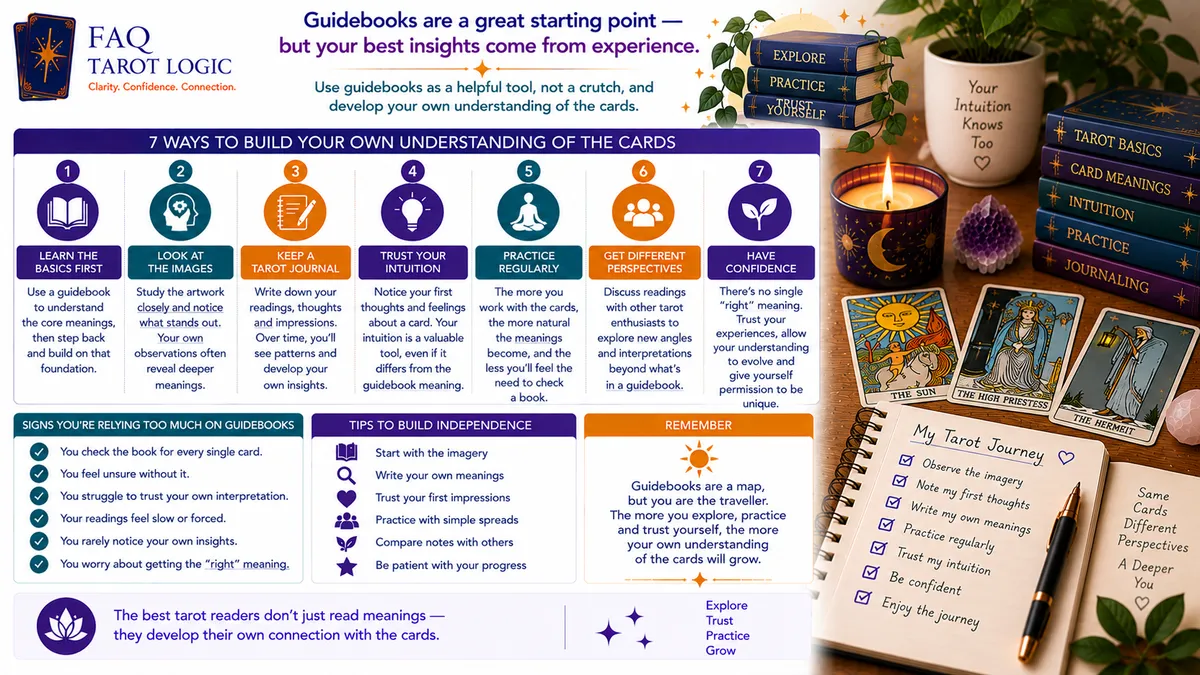
How Do You Avoid Relying Too Much on Guidebooks?
TL;DR
You can avoid relying too much on tarot guidebooks by trying to interpret each card yourself before looking it up. Start with what you already know, study the imagery, consider the question and look at how the card connects with the rest of the spread.
Guidebooks remain valuable learning tools, but they work best when they expand your interpretation rather than replace it. Over time, this approach helps you build confidence and develop a more flexible understanding of the cards.
IN SHORT
Guidebooks are incredibly useful when you're learning tarot.
They introduce you to traditional meanings.
Explain symbolism.
Help you understand unfamiliar cards.
And give you somewhere to turn when you're completely stuck.
The problem isn't using a guidebook.
The problem comes when you feel unable to interpret anything without one.
The goal isn't to stop using guidebooks.
It's to reach the point where you can think about a card yourself before asking a book to tell you what it means.
Start With What You Already Know
When you turn over a card, resist the urge to immediately look it up.
Give yourself a moment.
Ask:
What do I already know about this card?
What is its central theme?
What stands out in the image?
How might it relate to the question?
How does it connect with the other cards?
You don't need a complete interpretation.
Even identifying one useful idea gives you somewhere to begin.
Then, if necessary, you can check the guidebook afterwards.
Look At The Card Before Reading About It
One of the easiest ways to become less dependent on guidebooks is to spend more time actually looking at the cards.
Notice:
The people.
Their expressions.
The colours.
The objects.
The landscape.
Where figures are looking.
Whether the scene feels active or still.
Symbols that attract your attention.
Ask yourself:
"If I knew nothing about this card, what might this picture be showing me?"
You're not trying to replace traditional meanings with guesswork.
You're learning to engage with the card directly.
→ How Do You Read Tarot Symbolism?
Learn The Core Idea Rather Than Every Keyword
Trying to remember a long list of keywords for every card can make tarot harder.
Instead, begin with the card's central idea.
If you understand the basic theme, you can adapt it to different situations.
For example, rather than trying to remember six separate meanings for a card associated with choice, understand choice first.
Then ask how choice relates to:
A relationship.
A career.
A personal goal.
A difficult conversation.
A decision.
That gives you a flexible foundation rather than a script.
→ Should You Memorise Tarot Card Meanings?
Consider The Question
A guidebook usually can't know why you've drawn the card.
That's one of the biggest reasons you shouldn't rely on its definition alone.
Suppose a card has themes of rest and withdrawal.
In response to:
"How can I improve my productivity?"
it might suggest taking proper breaks rather than constantly pushing harder.
In response to:
"What should I understand about this relationship?"
the same card might suggest a need for space or reflection.
The basic meaning hasn't disappeared.
The context has changed how you apply it.
→ Why Does Context Matter More Than Individual Card Meanings?
Look At The Card's Position In The Spread
Spread position also gives you information that a general guidebook definition can't provide.
A card appearing as:
Challenge
may be interpreted differently from the same card appearing as:
Advice
or:
What to focus on next.
Before reaching for the book, combine three things:
Card + Question + Position
That alone can often narrow down the most relevant interpretation.
Read The Cards Together
Another way to move beyond guidebook dependence is to stop treating every card as a separate definition.
Suppose you have three cards.
If you look each one up individually, you may end up with three paragraphs of information that don't seem connected.
Instead, ask:
What idea appears across the spread?
Do the cards reinforce one another?
Does one card change the tone of another?
Is there a progression?
Is there a contrast?
Are particular suits or themes repeating?
The relationship between cards often provides the clarity you're looking for.
→ How Do You Interpret Multiple Tarot Cards Together?
Try An Interpretation Before Checking
A simple habit can make a big difference.
Before opening the guidebook, say or write down your interpretation.
For example:
"I think this card is suggesting that I need to slow down and reconsider what I'm doing before making another decision."
Then check the book.
You may discover that your interpretation is close to the traditional meaning.
Or the guidebook may introduce another aspect you hadn't considered.
Either way, you've practised thinking independently first.
Don't Treat The Guidebook As The Correct Answer
A guidebook offers an interpretation.
It doesn't necessarily provide the interpretation.
Different authors can describe the same card differently.
One may emphasise its emotional meaning.
Another may focus on practical circumstances.
A third may explore its symbolism in greater depth.
This doesn't mean one of them must be wrong.
Tarot cards contain broad themes that can be expressed in different ways.
Use guidebooks to expand your understanding rather than searching for a single officially correct sentence.
Compare What You Saw With What You Read
After checking a guidebook, don't simply replace your interpretation with the author's.
Compare them.
Ask:
What did I notice that the book also mentioned?
What did the author see that I missed?
Does that additional meaning fit this reading?
Did I notice something useful that isn't mentioned?
Which interpretation best fits the question?
This turns guidebook use into active learning.
You're interacting with the information rather than simply copying it.
Give Yourself Time To Think
Sometimes reaching for a guidebook is just a habit.
Silence feels uncomfortable.
You turn over a card, don't immediately know what to say and think:
"I'd better look this up."
Instead, give yourself another minute.
Look at the card.
Look at the rest of the spread.
Return to the question.
Often, an interpretation begins to emerge once you stop demanding an instant answer.
→ Why Is Patience Important When Learning Tarot?
Practise With Familiar Cards
You don't have to practise independent interpretation using the cards you find most difficult.
Start with cards you already know reasonably well.
Draw one and ask yourself:
"How many different situations could this card describe?"
Then create examples.
How might it apply to:
Work?
Relationships?
Money?
Personal development?
A decision?
A new opportunity?
This teaches you that understanding a card is more useful than memorising a fixed definition.
Use Your Own Words
If you've learned that a card means:
"Transition, release, transformation and endings,"
ask yourself what that actually means in ordinary language.
You might say:
"Something may have reached the point where holding onto it is making it harder to move forward."
That's no longer just a list of keywords.
It's an interpretation.
Putting meanings into your own words helps them become part of your understanding rather than something you're trying to recall from a page.
Study One Difficult Card At A Time
If certain cards always send you straight to the guidebook, don't try to master them all at once.
Choose one.
Spend time exploring:
Its traditional meaning.
Its symbolism.
Situations where it might appear.
Previous readings where you've drawn it.
How other readers describe it.
Then use what you've learned the next time the card appears.
Gradually, the number of cards that feel unfamiliar begins to shrink.
Keep Notes On Your Own Interpretations
A tarot journal can become your personal guidebook.
When a card appears in an interesting context, make a brief note.
For example:
Six of Swords — appeared when I was considering whether to leave an old project behind. Felt more like gradual transition than sudden change.
Over time, you'll build a record of how you've actually experienced the cards in readings.
Those examples can be easier to remember than generic keywords.
→ Should You Keep a Tarot Journal?
Don't Ban Yourself From Using Guidebooks
Trying to stop using guidebooks completely can create a different problem.
You may start guessing because you think checking a meaning somehow proves you haven't learned enough.
There's nothing wrong with looking something up.
Experienced people use reference materials in almost every field.
The difference is how you use them.
Instead of:
Card → Guidebook → Interpretation
aim for:
Card → Your thoughts → Context → Guidebook if needed → Refined interpretation
That small change keeps you actively involved in the reading.
Use More Than One Source Occasionally
If you always use the same guidebook, it's easy to start believing its interpretation is the only possible one.
Occasionally compare two or three sources.
You may notice that they share a central theme but emphasise different aspects.
That can help you separate the core meaning from the author's particular way of explaining it.
You don't need to do this for every card.
Use it when you're studying or when a card repeatedly causes difficulty.
Trust What Fits The Reading
Suppose your first interpretation fits the question, the card position and the surrounding cards.
Then you check a guidebook and find several additional meanings.
You don't have to squeeze them all into the reading.
More information doesn't automatically create a better interpretation.
Ask:
"Which part is actually relevant here?"
Learning what to leave out is part of developing your reading skills.
Accept That Independence Develops Gradually
You probably won't decide one day:
"I don't need my guidebook anymore."
Instead, you'll notice small changes.
You interpret three cards before checking one.
Then an entire simple spread.
You remember meanings more naturally.
You start using the book to confirm or deepen an interpretation rather than create one.
Eventually, the guidebook becomes a resource sitting beside your tarot practice rather than something controlling it.
Guidebooks Can Grow With You
A beginner may use a guidebook to answer:
"What does this card mean?"
A more experienced reader might use the same book to ask:
"Is there another aspect of this card I haven't considered?"
That's an important shift.
The book hasn't become less useful.
You've changed the way you use it.
Coffee Cup Tip ☕
For your next few readings, introduce a simple two-minute rule.
When a card confuses you, spend two minutes exploring it yourself before checking the guidebook.
Look at the imagery, question, position and surrounding cards.
If you're still stuck after that, look it up.
You're not trying to prove you don't need help.
You're simply giving your own interpretation a chance to appear first.
QUICK RECAP
To avoid relying too much on guidebooks:
Start with what you already know.
Look closely at the card before reading about it.
Learn core themes rather than endless keywords.
Consider the question.
Use the card's position in the spread.
Read cards in relation to one another.
Make your own interpretation before checking.
Don't treat a guidebook as the only correct answer.
Compare your interpretation with what you read.
Give yourself time to think.
Practise with familiar cards.
Put meanings into your own words.
Study difficult cards individually.
Record useful interpretations.
Keep using guidebooks when they genuinely help.
Occasionally compare different sources.
Use only the meanings that fit the reading.
The goal isn't to get rid of your guidebook.
It's to make sure you're learning to read the cards rather than simply reading the book.
NEXT STEP
As you become less dependent on guidebooks, there will still be readings that leave you puzzled.
That's normal.
The important skill isn't being able to understand every spread immediately. It's knowing what to do when the cards don't seem to make sense without forcing an interpretation just to reach an answer.
→ What Should You Do If a Tarot Reading Doesn't Make Sense Straight Away?
