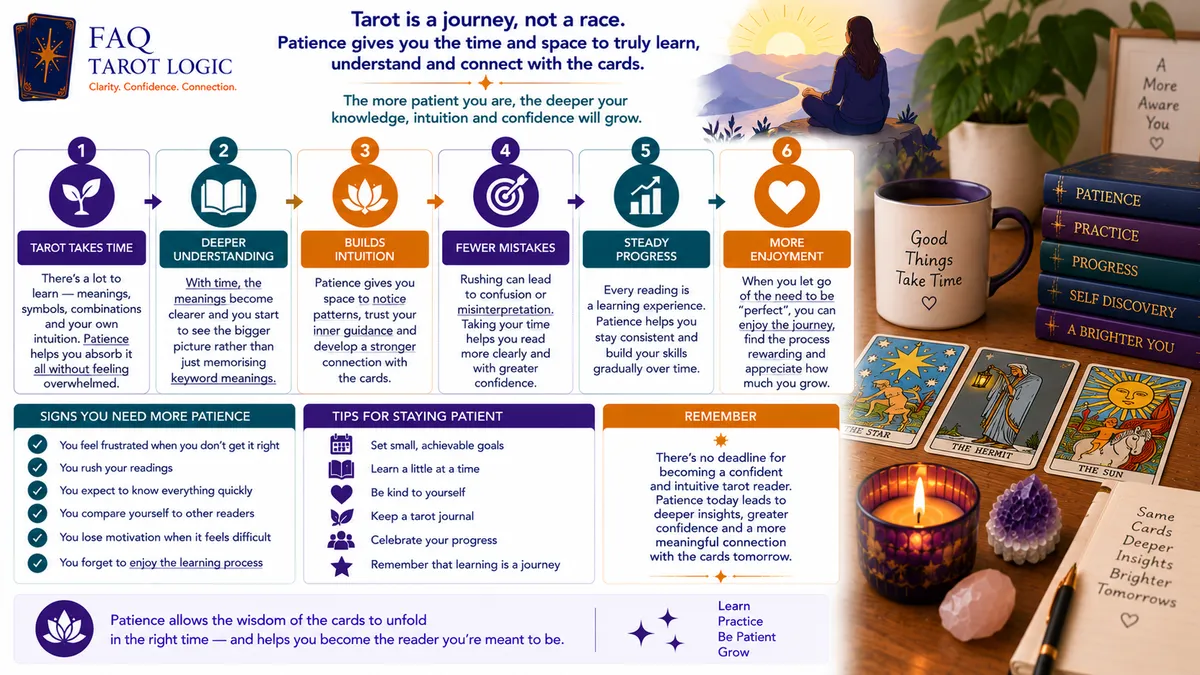
Why Is Patience Important When Learning Tarot?
TL;DR
Patience is important when learning tarot because confidence and understanding develop through experience, not simply by memorising 78 card meanings. Some cards will make sense quickly, while others may take many readings before they feel familiar.
Giving yourself time to practise, make mistakes, revisit interpretations and recognise patterns helps you develop a more natural and confident reading style without putting unnecessary pressure on yourself.
IN SHORT
When you first start learning tarot, it's easy to feel as though you should be progressing faster.
You might wonder why you still need to check a guidebook.
Why certain cards never seem to make sense.
Or why someone else appears able to look at a spread and immediately understand it.
But tarot isn't a skill you need to master quickly.
It develops gradually.
The more readings you do, the more connections you begin to recognise, and the less pressure you feel to have an immediate answer for everything.
Patience gives that learning process time to happen.
You Don't Need To Learn Everything At Once
A tarot deck contains 78 cards.
Each card can have:
Traditional meanings.
Symbolism.
Different meanings depending on context.
Relationships with surrounding cards.
Different implications depending on the question.
Personal associations you develop through experience.
Trying to master all of that immediately would overwhelm almost anyone.
Instead, allow your understanding to develop layer by layer.
You don't need complete knowledge before you can start reading.
→ What Should Beginners Learn First in Tarot?
Memorising The Cards Isn't The Finish Line
Learning the basic meanings gives you a useful foundation.
But knowing that The Hermit can relate to introspection or that The Fool can suggest a new beginning doesn't automatically tell you how either card applies to a particular reading.
That comes from practice.
The same card can appear in questions about:
Relationships.
Work.
Personal development.
Difficult decisions.
New opportunities.
Over time, you begin to see how its central meaning adapts to different situations.
That's something experience teaches far better than memorisation alone.
→ Should You Memorise Tarot Card Meanings?
Some Cards Will Take Longer Than Others
Most readers have cards they understand almost immediately.
They also have cards that seem determined to remain confusing.
That's normal.
You might understand a card perfectly in one reading and struggle with it in another.
Rather than thinking:
"I should know this by now,"
try asking:
"What am I not seeing yet?"
Look at the question.
Look at the card's position.
Look at the surrounding cards.
Look at the imagery.
Sometimes understanding develops because you spend more time with a difficult card rather than trying to force an instant interpretation.
Your Understanding Changes With Experience
The way you interpret a card after six months may be very different from the way you interpreted it during your first week.
That's not because your original understanding was necessarily wrong.
You've simply accumulated more experience.
You've seen the card in different spreads.
You've encountered it alongside different cards.
You've noticed symbolism you previously overlooked.
You've seen how context changes its emphasis.
Experience adds depth to what you already know.
→ How Does Experience Change the Way You Read Tarot?
Don't Compare Your Beginning With Someone Else's Experience
Watching an experienced tarot reader can make the process look deceptively easy.
They may move through a spread naturally, recognise connections quickly and explain their interpretation without constantly stopping.
What you don't see are the hundreds or thousands of readings that helped them develop those skills.
Comparing your early readings with someone else's years of practice isn't particularly useful.
Instead, compare your reading today with how you approached the cards several months ago.
That's a much better measure of progress.
Give Yourself Permission To Use A Guidebook
Needing a guidebook doesn't mean you're failing to learn tarot.
Guidebooks exist to help you learn.
If you're unsure about a card, look it up.
Then ask:
"How does this meaning relate to the question I'm exploring?"
That second step is important.
You're not simply copying a definition.
You're learning how to apply it.
As you gain experience, you'll probably find yourself checking guidebooks less frequently without deliberately trying to stop.
Don't Rush To Abandon The Basics
Once beginners become comfortable with simple readings, there's sometimes a temptation to make everything more complicated.
Larger spreads.
More decks.
More advanced systems.
More symbolism.
More techniques.
There's nothing wrong with exploring those things, but complexity doesn't automatically mean progress.
A simple three-card spread can teach you an enormous amount about interpretation, context and card relationships.
Strong foundations make more advanced techniques easier later.
Allow Confusing Readings To Be Confusing
One of the hardest things to learn is that you don't always need an immediate answer.
Sometimes a spread simply doesn't make sense yet.
Your instinct may be to:
Draw more cards.
Check several guidebooks.
Change the question.
Start the reading again.
Keep interpreting until something feels right.
But sometimes the better response is:
"I'm not sure what this means yet."
Then leave the reading alone for a while.
Being patient with uncertainty is part of becoming a stronger reader.
→ Why Do Tarot Readings Sometimes Feel Confusing?
Avoid Drawing Card After Card For Clarity
When you're impatient for an answer, clarifying cards can quickly multiply.
One card doesn't make sense, so you draw another.
That one creates another question, so you draw a third.
Before long, the original three-card spread has become ten cards and you're more confused than when you started.
Before drawing a clarifier, spend more time with the cards already on the table.
Ask whether the information you need may already be there.
Sometimes clarity comes from looking more carefully, not drawing more cards.
Give Patterns Time To Appear
Patterns aren't always obvious from individual readings.
They become clearer when you have enough readings to compare.
Perhaps one card appears repeatedly when you're facing a certain type of decision.
Maybe you notice that particular combinations tend to appear around periods of uncertainty.
Or you recognise that you consistently struggle with one suit.
These patterns require time and repeated experience.
You can't rush them into existence.
→ How Do You Recognise Patterns Across Multiple Tarot Readings?
Don't Expect Confidence To Arrive All At Once
Confidence doesn't usually appear one morning when you suddenly realise:
"Now I can read tarot."
It develops quietly.
You notice that you:
Reach for the guidebook less often.
Recognise cards more quickly.
See connections between cards.
Feel calmer when a difficult card appears.
Explain interpretations more clearly.
Trust your first impressions more often.
Accept uncertainty without panicking.
Those small changes accumulate.
Eventually, you realise you're reading very differently from when you started.
Mistakes Are Part Of Learning
You will misinterpret cards.
You will ask questions that aren't particularly useful.
You will choose spreads that don't suit the situation.
You may draw unnecessary clarifying cards.
You may realise later that you overlooked something obvious.
None of those things mean you're failing.
They're part of gaining experience.
Instead of asking:
"How did I get that wrong?"
try:
"What would I do differently next time?"
That turns mistakes into useful information.
Keep Your Practice Manageable
You don't need to study tarot for hours every day.
A manageable practice is more likely to continue.
You might:
Perform one reading each week.
Study one card at a time.
Keep brief notes about your readings.
Revisit an older reading occasionally.
Practise interpreting two or three cards together.
Regular small amounts of practice can teach you more than an intense burst of study followed by weeks of doing nothing.
Notice Your Progress
When development happens gradually, it's easy to miss.
This is where keeping even simple notes can help.
Look back at a reading from several months earlier.
You may notice:
Your interpretations were shorter.
You relied heavily on keywords.
You treated cards separately.
You drew more clarifiers.
You doubted yourself more often.
You overlooked relationships between cards.
Seeing that difference can remind you how much you've already learned.
→ How Can You Track Your Progress as a Tarot Reader?
Patience Helps Your Own Style Develop
If you're constantly trying to read like someone more experienced, you may never give your own approach enough time to emerge.
Your reading style develops through discovering:
Which spreads work well for you.
How you prefer to shuffle.
Which symbolism catches your attention.
How much structure you like.
How you balance traditional meanings with intuition.
How you explain interpretations.
These preferences become clearer through repeated experience.
You don't need to decide what your reading style should be.
Give it time to develop.
Learning Tarot Doesn't Really End
Even experienced readers continue learning.
A familiar card can reveal something different in a new context.
A new deck can make you notice symbolism you've overlooked.
Reading for another person can introduce you to situations you've never considered.
An old reading can make more sense when revisited months later.
The goal isn't to reach a point where there's nothing left to learn.
It's to become increasingly comfortable with the learning process itself.
→ How Can Every Tarot Reading Help You Grow?
Coffee Cup Tip ☕
The next time you catch yourself thinking:
"I should know this by now,"
replace it with:
"What can I learn from this card today?"
That small change turns frustration into curiosity.
And curiosity is far more useful for learning tarot than trying to rush towards mastery.
QUICK RECAP
Patience matters when learning tarot because:
You don't need to learn everything at once.
Memorising meanings is only the beginning.
Some cards naturally take longer to understand.
Your interpretations develop through experience.
Comparing yourself with experienced readers can create unnecessary pressure.
Using a guidebook is part of learning.
More complicated readings aren't automatically better.
Confusing readings don't always need immediate answers.
Patterns take time to become visible.
Confidence develops gradually.
Mistakes provide useful experience.
Regular practice matters more than rushing.
Looking back helps you recognise progress.
Your personal reading style develops over time.
There will always be something new to learn.
Tarot isn't a race to see how quickly you can memorise 78 cards.
Give yourself enough time to understand how the cards work together, and your confidence can develop naturally alongside your experience.
NEXT STEP
As you gain experience, you'll probably notice that you reach for your guidebook less often.
That doesn't mean guidebooks stop being useful. It means you're beginning to use what you've learned before immediately looking for someone else's interpretation.
The next step is finding the balance between using guidebooks as a learning resource and trusting yourself to explore the cards independently.
