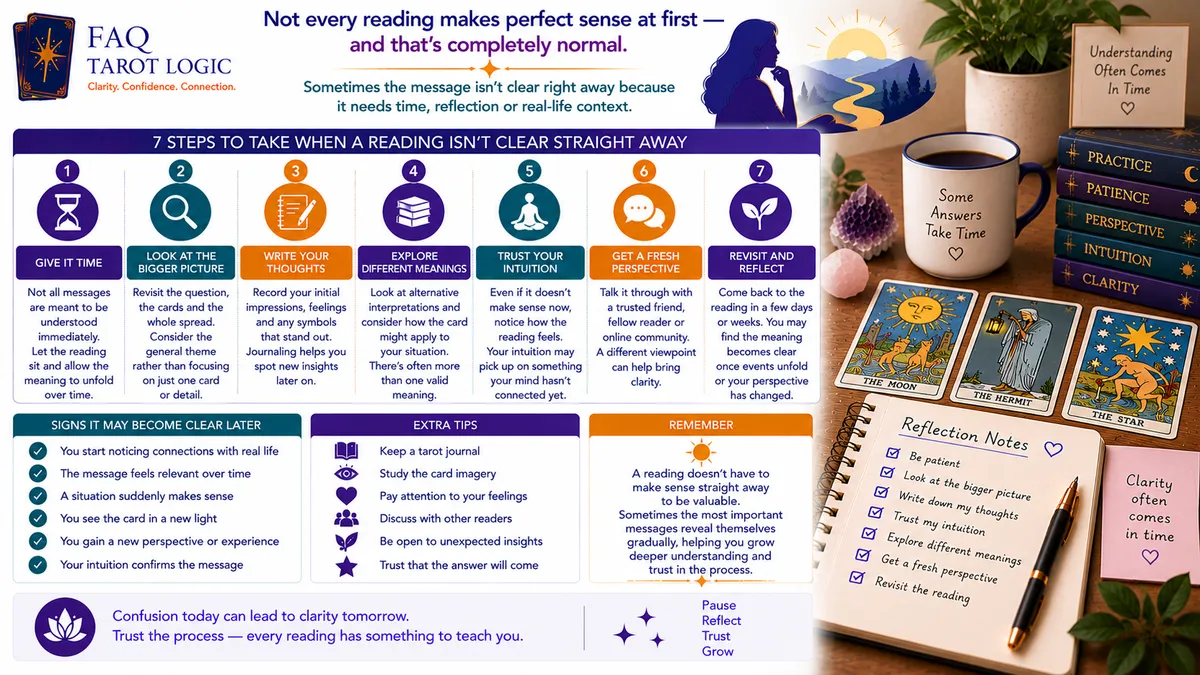
What Should You Do If a Tarot Reading Doesn't Make Sense Straight Away?
TL;DR
If a tarot reading doesn't make sense straight away, don't force an interpretation. Return to the original question, examine each card's position, look for connections across the spread and give yourself time to think.
You can check a guidebook or draw a clarifying card if genuinely necessary, but sometimes the most useful thing you can do is record the reading and return to it later. Not understanding a spread immediately doesn't mean you've done anything wrong.
IN SHORT
You turn over the cards.
Look at the spread.
And think:
"I have absolutely no idea what this is trying to say."
Almost every tarot reader experiences this.
It can happen when you're learning, and it can still happen after you've gained plenty of experience.
The mistake is assuming you must make the reading make sense immediately.
You don't.
Sometimes clarity comes from looking more carefully.
Sometimes it comes from asking a better question.
And sometimes it comes from simply giving the reading more time.
Don't Assume You've Done Something Wrong
A confusing reading doesn't mean:
You shuffled incorrectly.
You chose the wrong cards.
You're not intuitive enough.
You've forgotten how to read tarot.
The deck isn't working.
You need to start again.
It simply means you haven't found a useful interpretation yet.
That small word — yet — matters.
Instead of treating confusion as failure, treat it as part of the reading process.
→ Why Do Tarot Readings Sometimes Feel Confusing?
Return To The Original Question
Before analysing the cards again, look at the question you asked.
Is it clear?
Is it specific enough?
Does it contain several questions at once?
Does it assume something that may not be true?
For example:
"When will I find a new job and will it be better than my current one?"
actually contains several different questions.
A clearer question might be:
"What should I consider as I explore new career opportunities?"
Sometimes the cards aren't the confusing part.
The question is.
Ask What Each Card Is Doing
Rather than immediately asking:
"What does this card mean?"
ask:
"What is this card doing in this position?"
If the position represents a challenge, advice or something you're overlooking, that gives the card a job within the reading.
This can narrow down the possible interpretations considerably.
A card with many potential meanings becomes easier to understand when you know what role it's playing.
Look At The Spread As A Whole
When a reading feels confusing, beginners often focus even harder on the individual cards.
Sometimes the opposite helps.
Move back and look at the entire spread.
Ask:
Is there a dominant suit?
Are several cards expressing similar ideas?
Are there lots of Major Arcana cards?
Does one card seem different from everything else?
Is there movement from one idea towards another?
Are particular symbols repeated?
Do the cards appear to support or challenge each other?
You may not understand every card individually yet, but you might still recognise the overall theme.
→ How Do You Interpret Multiple Tarot Cards Together?
Look For The Simplest Connection First
You don't need to uncover a complicated hidden message.
Suppose three cards suggest:
Planning → Difficulty → Persistence
You already have the beginning of an interpretation.
Perhaps the reading is describing a situation where progress is possible, but not without obstacles.
Start there.
Once the basic story makes sense, you can explore the cards in greater depth.
Simple connections are often more useful than complicated interpretations created because you feel the reading ought to be profound.
Consider The Context
A card doesn't have exactly the same significance in every reading.
Its meaning depends partly on what you're asking about.
A card suggesting withdrawal could mean:
Taking time to think.
Stepping away from conflict.
Needing rest.
Creating emotional distance.
Working independently.
Which interpretation fits depends on the question, position and surrounding cards.
When a card seems completely out of place, ask whether you're holding too tightly to one familiar meaning.
→ Why Does Context Matter More Than Individual Card Meanings?
Check Whether The Cards Really Contradict Each Other
Sometimes a reading feels confusing because two cards appear to say opposite things.
One seems to encourage action.
Another appears to suggest waiting.
That doesn't necessarily mean the reading has failed.
Perhaps the combined idea is:
"Take the first step, but don't rush the outcome."
Or one card may describe your instinct while another offers advice.
Before deciding the cards contradict each other, look at their positions and ask whether they could be describing different parts of the situation.
→ What Should You Do When Tarot Cards Seem to Contradict Each Other?
Pay Attention To The Card That Bothers You
Sometimes most of the spread makes sense except for one card.
That's useful information.
Rather than allowing that card to make the whole reading feel confusing, isolate it.
Ask:
What is its basic theme?
What does the imagery suggest?
How does its position affect the meaning?
Which card does it seem most closely connected with?
Am I overlooking an alternative interpretation?
One awkward card doesn't invalidate the rest of the spread.
It may simply need more attention.
Look At The Imagery
If traditional meanings aren't helping, return to what you can actually see.
What is happening in the card?
What appears to be changing?
Where is the figure looking?
What seems important?
How does the image make you feel?
Does anything in one card visually connect with another?
Symbolism can sometimes provide a route into a reading when memorised meanings feel disconnected.
→ How Do You Read Tarot Symbolism?
Use Your Guidebook Thoughtfully
There is nothing wrong with checking a guidebook when you're stuck.
The important thing is how you use it.
Don't search through definitions until you find one that produces the answer you want.
Instead, compare the guidebook with what you've already noticed.
Ask:
"Is there an aspect of this card I've overlooked?"
The guidebook should help you explore the card, not replace the process of interpreting it.
→ How Do You Avoid Relying Too Much on Guidebooks?
Don't Keep Adding Cards Automatically
A confusing reading often creates the urge to draw another card.
Then another.
And another.
Soon, a three-card spread has become a table full of clarifiers.
More cards mean more information to interpret.
If the original reading isn't clear, additional cards can make the problem worse.
Before drawing a clarifier, ask:
"What exactly am I trying to clarify?"
If you can't answer that question, another card probably isn't what you need.
If You Draw A Clarifier, Make It Specific
Clarifying cards can be useful when they have a clear purpose.
Suppose one card doesn't make sense in the advice position.
Instead of vaguely asking:
"What does this mean?"
you could ask:
"What aspect of this card should I pay most attention to?"
Now the clarifier has a specific job.
One carefully chosen clarifying card is usually more useful than repeatedly drawing cards until something feels comfortable.
Check Your Emotional State
Sometimes the cards aren't especially confusing.
You're simply too emotionally involved to interpret them calmly.
Perhaps you're hoping for a particular answer.
Maybe you're worried about what a card could mean.
Or you're asking about something that's making you anxious.
Ask yourself:
"Would I interpret these cards differently if they belonged to somebody else's reading?"
That question can reveal when fear or wishful thinking may be influencing your interpretation.
→ What Is the Difference Between Intuition and Fear?
Don't Force The Reading To Match Your Expectations
Suppose you expected a positive reading but drew several challenging cards.
It can be tempting to search for interpretations that make the spread more comfortable.
The opposite can happen too.
If you're already worried, you may interpret neutral cards negatively.
Try to work with what's actually present rather than what you expected to see.
The aim isn't to make the reading positive or negative.
It's to understand it as clearly as you can.
Say "I Don't Know Yet"
This may be one of the most useful sentences a tarot reader can learn:
"I don't know what this means yet."
It removes the pressure to manufacture an interpretation.
You can leave the cards on the table for a while.
Make a cup of tea.
Do something else.
Then return with a fresh perspective.
Not knowing immediately doesn't mean the reading has failed.
Sometimes you're simply too close to it.
Write The Reading Down
If clarity still doesn't come, record:
The question.
The cards.
Their positions.
Your initial thoughts.
What confused you.
Then leave it.
When you return later, don't look at your previous interpretation immediately.
Look at the cards again and see what you notice.
Afterwards, compare your new thoughts with your original notes.
This can show you how much perspective affects interpretation.
Return To It Later
Some readings become clearer after a few hours.
Others after several days.
You may recognise a connection you couldn't see before.
A card may suddenly make more sense within the wider situation.
Or you may realise that you were overcomplicating something simple.
This is one reason patience becomes such an important tarot skill.
→ Why Is Patience Important When Learning Tarot?
Consider Whether You Need An Answer At All
Sometimes repeated confusion is telling you something about how you're using tarot.
Perhaps you're asking the same question repeatedly.
Maybe you're trying to make tarot remove uncertainty from a decision that only you can make.
Or perhaps you're looking for reassurance rather than reflection.
In those situations, the best response may not be another interpretation.
It may be to put the cards away and allow yourself time to think without them.
Don't Repeat The Reading Immediately
Starting again can feel tempting.
You might think:
"I'll reshuffle and see if I get a clearer answer."
But repeating the same question immediately can create more confusion.
Now you have two spreads to compare.
If they appear different, you may want a third.
Instead, work with the original reading as far as you reasonably can.
If it still doesn't make sense, leave it and return another time.
Learn From The Reading Afterwards
A confusing reading can teach you more than you realise.
Later, ask:
Was my question clear?
Was the spread appropriate?
Which card caused the difficulty?
Was I relying too heavily on one meaning?
Did I become impatient?
Did my emotions influence the interpretation?
Did I draw unnecessary clarifiers?
What eventually helped the reading make sense?
Those answers can improve future readings.
Confusing Readings Become Less Intimidating
Experience doesn't guarantee that every reading will make immediate sense.
What changes is how you respond.
Instead of thinking:
"I can't read these cards,"
you begin thinking:
"Okay, I haven't understood this yet. Let's see what's going on."
That's a significant difference.
Confusion stops feeling like evidence that you're doing something wrong.
It becomes another part of the reading process.
Coffee Cup Tip ☕
When a reading doesn't make sense, try this simple sequence before doing anything else:
Question → Position → Context → Connections → Time
Return to the question.
Check each card's position.
Consider the situation.
Look for connections between the cards.
Then give yourself time.
Only after that should you decide whether you genuinely need a guidebook or clarifying card.
QUICK RECAP
If a tarot reading doesn't make sense straight away:
Don't assume you've done something wrong.
Return to the original question.
Check what each card is doing in its position.
Look at the spread as a whole.
Find the simplest connection first.
Consider the wider context.
Explore apparent contradictions.
Pay attention to the card causing difficulty.
Study the imagery and symbolism.
Use your guidebook thoughtfully.
Avoid automatically drawing more cards.
Make clarifying questions specific.
Notice whether emotions are influencing you.
Don't force the cards to match your expectations.
Allow yourself to say, "I don't know yet."
Record the reading.
Return to it later.
Avoid immediately repeating the same reading.
Use the experience to improve your next one.
A tarot reading doesn't have to make perfect sense the moment you turn over the cards.
Sometimes becoming a better reader means learning to stay with the question a little longer instead of rushing towards an answer.
NEXT STEP
As your tarot skills develop, confusing readings become less frustrating because you learn that uncertainty can be part of the process.
You begin to trust that not every card needs an instant explanation and not every reading needs an immediate conclusion.
That shift opens the door to something even more valuable: treating tarot as an ongoing learning practice rather than something you eventually finish learning.
