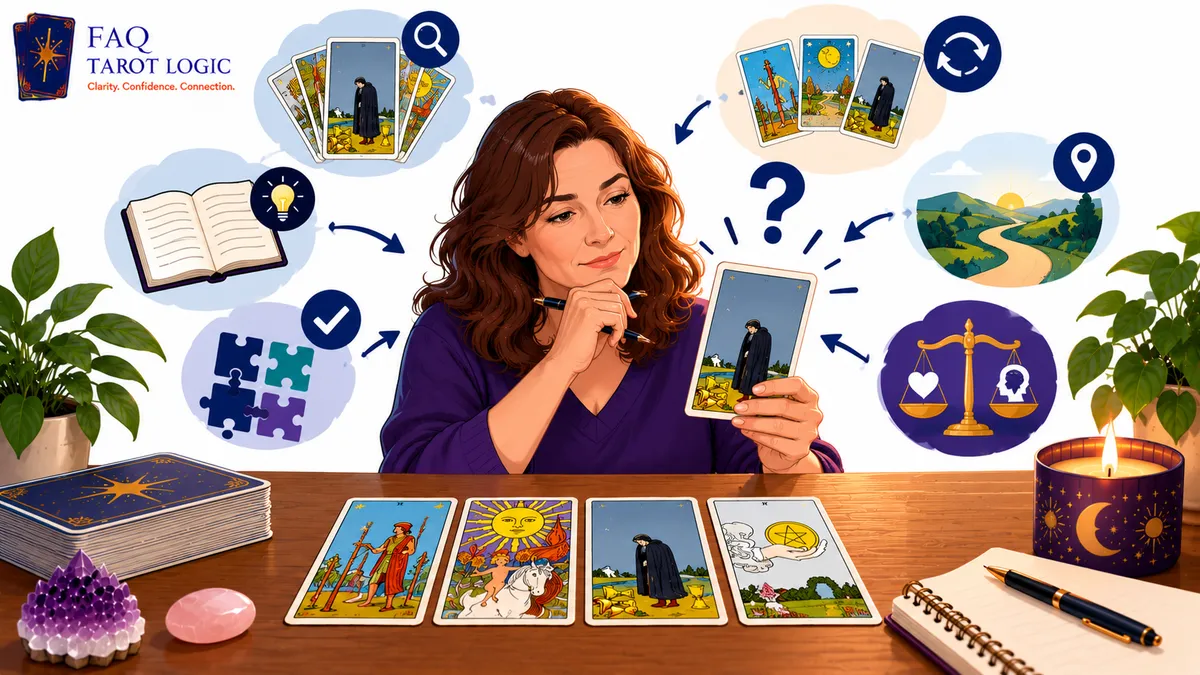
How Do You Read a Tarot Card That Seems Out of Place?
TL;DR
When a tarot card seems out of place, don't immediately dismiss it or draw another card. Return to the question, consider the card's position, look at the surrounding cards and explore meanings beyond the first one that comes to mind.
Sometimes an unexpected card highlights something you've overlooked, challenges an assumption or connects to the situation in a less obvious way. Give the card time before deciding it doesn't belong.
IN SHORT
Most tarot readings contain cards that make reasonable sense fairly quickly.
Then occasionally you turn over a card and think:
"What has that got to do with anything?"
It can feel completely disconnected from the question.
Your first instinct might be to draw another card.
But an apparently misplaced card can sometimes be one of the most useful cards in the reading.
Before replacing or clarifying it, ask:
"What am I not seeing yet?"
Don't Assume The Card Is Wrong
When a card doesn't make sense, it's easy to think something went wrong.
Perhaps you shuffled badly.
Maybe the card wasn't meant to appear.
Or perhaps you should put it back and draw another.
But difficulty interpreting a card doesn't mean the card is useless.
It simply means you haven't found a convincing connection yet.
Give yourself permission not to understand it immediately.
Return To The Original Question
Before searching for obscure meanings, read your question again.
Suppose you asked:
"What should I consider before accepting this new opportunity?"
Most cards seem to relate to work, progress and decisions.
Then a card appears that you strongly associate with relationships.
It seems misplaced.
But perhaps the opportunity will affect:
Your family.
Your available time.
An important partnership.
Your support network.
Your relationship with someone involved.
Returning to the question can reveal possibilities you overlooked the first time.
Check The Card's Position
In a structured spread, the position matters.
The same card can perform a completely different job depending on where it appears.
A card in:
"What is helping me?"
needs to be considered differently from the same card in:
"What am I overlooking?"
Don't interpret the card in isolation.
Ask:
"What is this card supposed to be telling me about?"
Sometimes the position provides the missing connection.
Look Beyond Your First Meaning
We naturally develop favourite meanings for familiar cards.
That's useful because it makes reading faster.
But it can also create a blind spot.
If your usual meaning doesn't fit, don't conclude that the card doesn't fit.
Ask:
"What else can this card represent?"
A card associated with endings might also involve:
Transition.
Release.
Completion.
Making space.
Accepting change.
You don't need to invent a meaning.
You're exploring the wider range of meanings already associated with the card.
→ Why Do Tarot Cards Have Different Meanings?
Look At The Cards Around It
A card that seems strange on its own may become much clearer when you look at its neighbours.
Suppose two cards suggest rapid progress, but the middle card suggests patience.
Initially, the patience card may feel contradictory.
But together the cards might suggest:
Progress is possible, but rushing could create problems.
The card that appeared not to fit may actually be modifying the others.
This is why reading combinations can be more useful than treating every card as a separate message.
→ How Do You Interpret Multiple Tarot Cards Together?
Ask Whether The Card Is Challenging The Story
Sometimes a card seems out of place because you've already decided what the reading is saying.
The first few cards appear positive.
You begin constructing an encouraging interpretation.
Then another card introduces caution.
It feels inconvenient.
But perhaps that's precisely its purpose within the reading.
Instead of asking:
"How do I make this card fit my interpretation?"
try:
"Does this card change my interpretation?"
That's a very different question.
Don't Force Every Card To Agree
A coherent reading doesn't mean every card needs to say the same thing.
Real situations contain contradictions.
You can feel excited about an opportunity and nervous about it.
A decision can have advantages and disadvantages.
A relationship can contain affection and frustration.
So a tarot spread can contain different perspectives without being inconsistent.
An apparently out-of-place card may simply be showing another side of the situation.
→ What Should You Do When Tarot Cards Seem to Contradict Each Other?
Consider The Wider Context
Individual card meanings don't exist separately from the situation being explored.
Imagine drawing a card associated with rest.
If you're asking about recovering from a stressful period, the connection may be obvious.
If you're asking about growing a business, it may initially seem strange.
But within that context, it might encourage you to consider:
Burnout.
Unsustainable workload.
Delaying a decision.
Taking time to review.
Creating space before expanding.
Context helps turn a general card meaning into a relevant interpretation.
→ Why Does Context Matter More Than Individual Card Meanings?
Look At The Imagery
If traditional meanings aren't helping, look at the card itself.
What catches your attention?
Perhaps it's:
A figure looking away.
A doorway.
A mountain.
Water.
An animal.
An object being held.
The direction someone is facing.
A contrast between light and darkness.
Then ask:
"How could this detail relate to the question?"
You don't have to decode every symbol.
One visual detail may be enough to create a useful connection.
→ How Do You Read Tarot Symbolism?
Notice Your Reaction To The Card
Sometimes the interesting part isn't the card.
It's your reaction to it.
Did you immediately think:
"I don't want that card here"?
Did it disappoint you?
Confuse you?
Make you uncomfortable?
Challenge what you hoped the reading would say?
Your reaction doesn't automatically reveal the correct interpretation, but it can show you where you have expectations about the reading.
That becomes especially important when you're emotionally involved in the question.
→ Should You Read Tarot When You're Feeling Emotional?
Ask Whether You're Interpreting Too Literally
A card may feel misplaced because you're taking its imagery or traditional title too literally.
For example, a card depicting conflict doesn't necessarily mean an argument is about to happen.
Depending on the question, it might represent:
Competing priorities.
Internal conflict.
Different opinions.
Frustration.
A need to defend an idea.
Too many demands at once.
Moving from literal imagery to underlying themes can make an unfamiliar connection easier to see.
Consider Whether It's Highlighting Something Missing
An unexpected card may introduce something that hasn't appeared elsewhere in the spread.
Suppose your reading is entirely focused on practical considerations.
Then a strongly emotional card appears.
Perhaps the reading is encouraging you to consider how you actually feel about the situation.
Or perhaps a very practical card appears in an emotional reading.
That might draw attention towards something concrete that needs to be done.
The difference may be exactly what makes the card useful.
Don't Reach For The Guidebook Immediately
A guidebook can help.
But first, spend a little time with the card yourself.
Ask:
What do I already know about it?
What does the imagery suggest?
How could its central theme relate to the question?
How does it interact with the other cards?
Then consult the guidebook.
This gives you a chance to develop your own interpretation before seeing somebody else's.
→ How Do You Avoid Relying Too Much on Guidebooks?
Use The Guidebook To Expand, Not Replace
If you do look up the card, don't simply search until you find a meaning that fits.
Instead, compare the guidebook's ideas with what you've already considered.
You might discover an aspect of the card you'd forgotten.
That can open another possibility.
The aim isn't to find the one sentence that proves what the card means.
It's to broaden your understanding until you find a reasonable interpretation within the context of the reading.
Give The Card Time
Not every card needs to make sense immediately.
You may finish the rest of the spread and suddenly understand it.
Or you may return to the reading later and see the connection.
This becomes easier as you gain experience because you become more comfortable saying:
"I'm not sure about this card yet."
Uncertainty doesn't mean the reading has failed.
Be Careful With Clarifying Cards
Drawing a clarifying card can be useful.
But don't make it your automatic response whenever something feels unclear.
If every difficult card receives another card, you can quickly turn a five-card reading into ten or fifteen cards.
Now you have even more relationships to interpret.
Before drawing a clarifier, ask:
"Have I properly explored the original card first?"
Often you won't need another one.
If You Clarify, Ask A Specific Question
If the card still feels genuinely unclear, give the clarifying card a clear job.
Instead of:
"What does this card mean?"
try:
"What aspect of this card is most relevant to my question?"
or:
"What is this card asking me to consider?"
A focused clarification is more useful than simply adding another unexplained card to the spread.
Don't Replace The Original Card
If you draw a clarifier, keep the original card in the reading.
The clarifier should help you understand it, not erase it.
Otherwise, you risk repeatedly replacing cards until you get something easier or more comfortable to interpret.
The difficult card was part of the original spread.
Work with it.
Consider The Possibility That The Question Is The Problem
Sometimes the card isn't unclear because of the card.
The original question may be too vague.
For example:
"Tell me what I need to know."
could potentially relate to almost anything.
When an unexpected card appears, you have very little context for interpreting it.
Clearer questions create boundaries that help you understand why a particular card may be relevant.
→ How Can You Ask Better Questions During a Tarot Reading?
Don't Turn One Difficult Card Into A Crisis
A single confusing card doesn't invalidate an otherwise useful reading.
If four cards make sense and one doesn't, work with what you understand.
You can note the difficult card and return to it later.
There's no rule saying every reading must produce complete clarity immediately.
Sometimes understanding develops after the reading ends.
Review The Card Later
If you keep a tarot journal, mark the card that felt out of place.
Then return to the reading after a few days or weeks.
Ask:
"Does this card make more sense now?"
You may have gained new information.
The situation may have developed.
Or simply having some distance may allow you to interpret it without the assumptions you brought to the original reading.
These are valuable readings to review because they show how interpretation can change with context and experience.
Let Difficult Cards Improve Your Reading Skills
The cards that make immediate sense don't always teach you the most.
The difficult ones force you to:
Explore alternative meanings.
Examine context.
Read card combinations.
Notice symbolism.
Question assumptions.
Sit with uncertainty.
Explain your reasoning.
Those are exactly the skills that help you move beyond basic card meanings.
A card that initially appears to be the problem can therefore become one of the most useful learning opportunities in the spread.
Coffee Cup Tip ☕
When a card seems completely out of place, don't draw another card immediately.
Give yourself three questions first:
1. What else can this card mean?
2. What do the surrounding cards add to it?
3. What might I be overlooking about the original question?
Only after exploring those three questions should you decide whether a clarifying card would genuinely help.
QUICK RECAP
When a tarot card seems out of place:
Don't assume the card is wrong.
Return to the original question.
Check the card's spread position.
Explore meanings beyond your first association.
Look at the surrounding cards.
Consider whether it challenges your existing interpretation.
Don't expect every card to agree.
Use the wider context.
Look at the imagery.
Notice your emotional reaction.
Avoid interpreting too literally.
Ask whether the card highlights something missing.
Explore the card before reaching for a guidebook.
Use guidebooks to expand your interpretation.
Give the card time.
Don't automatically draw clarifiers.
Give clarifying cards a specific purpose.
Keep the original card in the reading.
Check whether the question itself is too vague.
Don't let one confusing card invalidate the whole spread.
Review difficult cards later.
A card that seems out of place isn't necessarily interrupting the reading.
It may be the card asking you to look at the situation from an angle you hadn't considered.
NEXT STEP
Learning to work with unexpected cards makes individual readings stronger.
The next challenge is making that thoughtful approach something you can repeat from one reading to another.
Consistency doesn't mean producing identical interpretations every time. It means developing a reliable process that helps you ask clear questions, examine context and understand how you reached your conclusions.
→ How Can You Make Your Tarot Readings More Consistent?
