How Can Tarot Become a Lifelong Learning Practice?
TL;DR
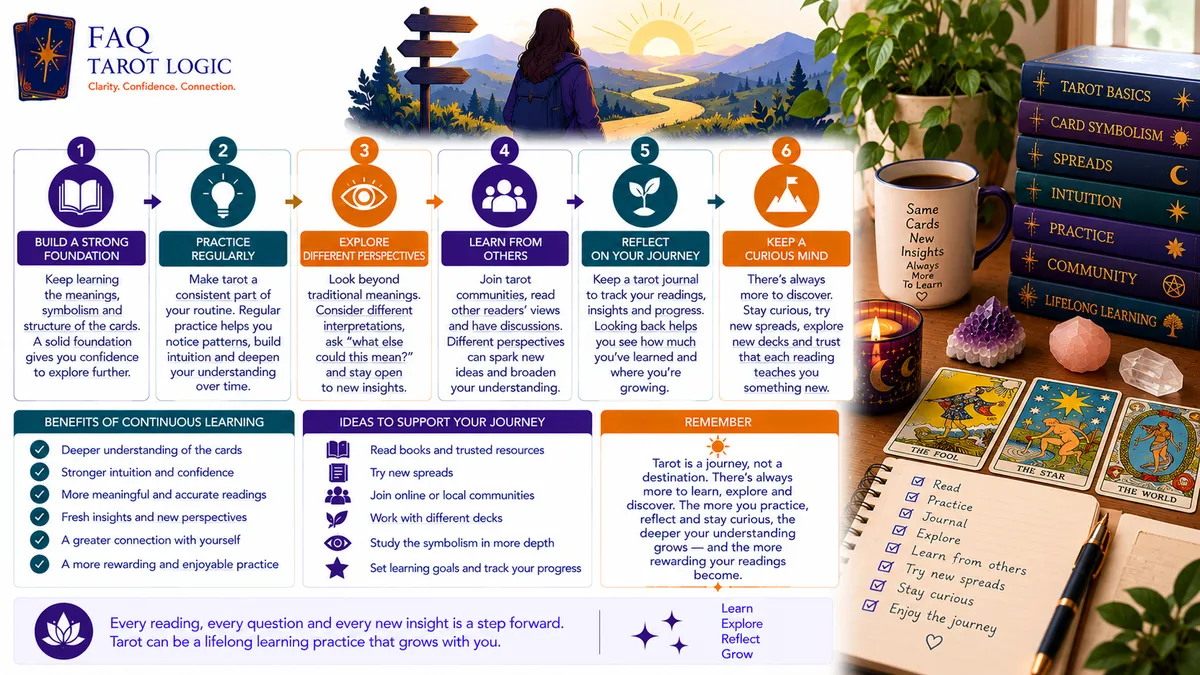
Tarot can become a lifelong learning practice when you stop treating it as something you need to finish learning. Your understanding of the cards develops through experience, changing circumstances, reflection and repeated readings.
Familiar cards can reveal different meanings in new contexts, while reviewing old readings can show how your interpretation skills have changed. The aim isn't to reach a point where you know everything about tarot, but to remain curious and continue learning from the cards and from yourself.
IN SHORT
When you first learn tarot, there's often an obvious goal.
Learn the cards.
Understand some spreads.
Practise interpreting them.
Become more confident.
But what happens when you've learned the basics?
You discover there isn't really a finishing line.
The same cards you've used for years can still make you stop and think.
A familiar combination can mean something different in a new situation.
And your understanding changes because you change too.
That's what allows tarot to become more than something you learn.
It can become something you continue learning through.
Stop Trying To Finish Learning Tarot
Beginners naturally want to reach the point where they can say:
"I know tarot now."
But what would that actually mean?
Knowing all 78 traditional meanings?
Being able to perform different spreads?
Reading without a guidebook?
Reading confidently for other people?
Those are useful milestones, but none represents the end of learning.
Tarot combines symbolism, context, interpretation, intuition and personal experience.
There's always another layer you can explore.
Once you accept that, learning becomes much less pressured.
Let The Cards Change With The Context
One reason tarot remains interesting is that a card doesn't have to say exactly the same thing every time it appears.
Imagine drawing a card associated with independence.
At one stage of your life, you might connect it with building confidence.
Years later, the same card could make you think about creating boundaries.
In another situation, it could relate to becoming more self-reliant.
The card hasn't necessarily changed.
The context has.
→ Why Does Context Matter More Than Individual Card Meanings?
Allow Your Own Experience To Add Meaning
Guidebooks give you a starting point.
Experience adds depth.
Suppose you've encountered a particular card dozens of times.
You begin remembering how it appeared in previous readings.
You know situations where one aspect of its meaning was particularly relevant.
You recognise which other cards seem to alter its emphasis.
Those experiences become part of your understanding.
This doesn't mean abandoning traditional meanings.
It means adding your own practical experience to them.
Keep Asking Better Questions
Your questions can develop alongside your reading skills.
A beginner may ask:
"Will this work?"
With experience, you might instead ask:
"What factors could influence whether this works?"
Later, you may ask:
"What am I overlooking that could affect the decision I'm making?"
The cards haven't become more advanced.
The quality of the reflection has.
Learning how to ask better questions can keep familiar cards useful because you're exploring them from different angles.
→ How Can You Ask Better Questions During a Tarot Reading?
Use Tarot To Explore Rather Than Confirm
Long-term tarot practice becomes more useful when you're willing to encounter perspectives you weren't expecting.
If you only use the cards to confirm what you already believe, there's very little to learn.
Instead of asking:
"Can the cards prove I'm making the right decision?"
you might ask:
"What haven't I considered about this decision?"
That invites reflection.
Sometimes the most useful reading isn't the one that reassures you.
It's the one that makes you think differently.
Revisit Old Readings
One of the simplest ways to turn tarot into a long-term learning practice is to keep some record of your readings.
Then occasionally look back.
You may discover that:
You'd interpret a card differently now.
You missed an obvious connection.
A confusing card later became clearer.
Your questions have improved.
You use fewer clarifying cards.
Your explanations have become more detailed.
You trust your interpretations more.
Old readings give you evidence of how your approach has developed.
→ Should You Keep a Tarot Journal?
Don't Only Review The Successful Readings
It's tempting to preserve the readings that felt particularly insightful and forget the ones that made no sense.
But confusing readings can be valuable learning material.
Look back and ask:
Why did I struggle?
Was the question unclear?
Did I interpret the cards too literally?
Was I emotionally attached to a particular answer?
Did I ignore the wider context?
Did I draw too many cards?
Would I approach the spread differently now?
You're not looking for mistakes to criticise.
You're looking for lessons you can use.
Notice How Your Interpretations Change
Growth often becomes visible when you compare your current thinking with older interpretations.
Perhaps you once relied heavily on keywords.
Now you notice:
Card relationships.
Symbolism.
Patterns.
Context.
Emotional reactions.
The overall story of the spread.
You may also be more comfortable admitting:
"I'm not sure what this card means here yet."
That's not a step backwards.
Being comfortable with uncertainty can be a sign that you've stopped forcing interpretations simply because you think you should have an answer.
Stay Curious About Familiar Cards
It's easy to assume the cards you know best have nothing left to teach you.
Try looking at them differently.
Take a familiar card and ask:
What have I stopped noticing?
Which symbol have I rarely considered?
How could this card express itself positively?
How could its strength become excessive?
What might it mean in an unfamiliar situation?
How does another deck portray the same idea?
You don't need to invent new meanings.
You're exploring the range already contained within the card.
Explore Different Decks Without Chasing Novelty
A new tarot deck can sometimes help you see familiar cards differently.
Different artwork may emphasise:
A symbol you'd previously overlooked.
A different emotional tone.
Another aspect of the traditional meaning.
Relationships between characters.
Movement or stillness within the scene.
But you don't need a constant supply of new decks to keep learning.
Sometimes spending years with one familiar deck teaches you more than repeatedly starting again with another.
→ Should You Change Tarot Decks as You Gain Experience?
Learn From Other Readers Without Copying Them
Other tarot readers can introduce you to interpretations and approaches you've never considered.
You might learn from:
Books.
Articles.
Courses.
Videos.
Discussions.
Example readings.
But learning from someone doesn't mean adopting everything they do.
Ask:
"Why does this approach work for them?"
Then consider whether it fits your own practice.
The goal isn't to become a copy of another reader.
It's to expose yourself to ideas that help you think more deeply about your own approach.
Let Your Reading Style Develop
Your approach to tarot will probably change over time.
Perhaps you begin with large spreads but eventually prefer three cards.
Maybe you start by reading strictly from traditional meanings and gradually become more comfortable with symbolism.
Or perhaps you discover you like structured spreads more than completely open readings.
There isn't necessarily one final reading style you're working towards.
Your approach can continue evolving as you gain experience.
→ How Do You Refine Your Tarot Reading Style Through Experience?
Use Real Decisions As Learning Opportunities
Tarot becomes especially useful as a continuing practice when you connect readings with situations you genuinely need to think through.
For example:
"What should I consider before committing to this project?"
or:
"What am I overlooking in this situation?"
You can then compare the reading with what actually happens and what you eventually decide.
This gives you something concrete to reflect on later.
You're learning about the cards while also learning how you approach decisions.
Keep Responsibility For Your Choices
A lifelong tarot practice shouldn't mean becoming increasingly dependent on the cards.
Ideally, experience does the opposite.
You become better at using tarot to explore:
Possibilities.
Assumptions.
Emotions.
Patterns.
Consequences.
Different perspectives.
But you remain responsible for deciding what to do.
Tarot can contribute to the thinking process without becoming the decision-maker.
→ Can Tarot Help With Decision-Making?
Turn Insights Into Action
Reflection becomes more useful when something happens afterwards.
Suppose a reading helps you recognise that you've been avoiding a difficult conversation.
The learning doesn't have to end with:
"That's interesting."
You can ask:
"What small action could I take because I've recognised this?"
Perhaps it's preparing what you want to say.
Perhaps it's setting a boundary.
Perhaps it's deciding that no action is needed yet.
Connecting insight with action helps tarot become part of practical personal development rather than an endless cycle of readings.
→ How Do You Turn Tarot Insights Into Positive Action?
Accept That Your Life Changes The Questions
The questions that matter to you today may be completely different in five or ten years.
Your circumstances change.
Your responsibilities change.
Your priorities change.
Your relationships change.
And your perspective changes.
That means even if the deck remains exactly the same, you're bringing different experiences to it.
Tarot can continue offering material for reflection because you're not the same person asking the questions.
Give Yourself Periods Away From Tarot
A lifelong practice doesn't mean reading constantly.
There may be times when you use tarot frequently.
There may also be weeks or months when you barely touch the cards.
That's okay.
You don't lose everything you've learned because you take a break.
Sometimes stepping away can even help.
When you return, you may notice your habits and assumptions more clearly.
Consistency can be useful, but longevity doesn't require constant activity.
Don't Measure Progress By How Much You Know
You could read dozens of tarot books and still struggle to apply what you've learned.
Knowledge matters.
But experience also involves:
Asking useful questions.
Recognising context.
Making connections.
Communicating interpretations.
Handling uncertainty.
Reflecting on your own reactions.
Knowing when to stop reading.
Progress isn't simply accumulating more information.
It's becoming more thoughtful about how you use what you already know.
Let Difficult Readings Teach You
Some readings will still confuse you.
That doesn't stop when you become experienced.
What changes is how you respond.
Instead of assuming:
"I must be doing something wrong,"
you may become more comfortable asking:
"What can I learn from why this feels difficult?"
Perhaps you need more context.
Maybe you're too emotionally involved.
Or perhaps the reading simply needs time.
→ What Should You Do If a Tarot Reading Doesn't Make Sense Straight Away?
Keep Beginner's Curiosity
One of the most useful qualities you can keep isn't expertise.
It's curiosity.
Beginners naturally ask:
"Why does this card mean that?"
"Why did these cards appear together?"
"What does that symbol represent?"
"Could there be another interpretation?"
Those questions shouldn't disappear as you become more experienced.
If anything, they become more useful because you have a stronger foundation from which to explore them.
Coffee Cup Tip ☕
Once a month, choose one tarot reading you've already completed and revisit it.
Don't redraw the cards.
Don't change the question.
Simply look at the original spread and ask:
"What can I see now that I didn't notice then?"
That one habit can show you how both your tarot skills and your perspective are developing over time.
QUICK RECAP
Tarot can become a lifelong learning practice when you:
Stop trying to finish learning it.
Allow context to deepen card meanings.
Add personal experience to traditional knowledge.
Keep improving the questions you ask.
Use tarot to explore rather than confirm.
Revisit old readings.
Learn from confusing readings as well as clear ones.
Notice how your interpretations change.
Stay curious about familiar cards.
Explore other decks thoughtfully.
Learn from other readers without copying them.
Allow your reading style to evolve.
Connect readings with real decisions.
Keep responsibility for your choices.
Turn useful insights into practical action.
Accept periods when you read less often.
Measure progress by more than knowledge.
Remain curious even after gaining experience.
There doesn't have to be a point where you finally declare that you've learned tarot.
The cards can continue giving you something to explore because your experience, questions and perspective continue changing too.
NEXT STEP
Once you've learned the basics, the challenge changes.
You no longer need to concentrate entirely on remembering what every card means. Instead, you can focus on strengthening your interpretation skills, recognising your habits and discovering where your own tarot practice can develop next.
