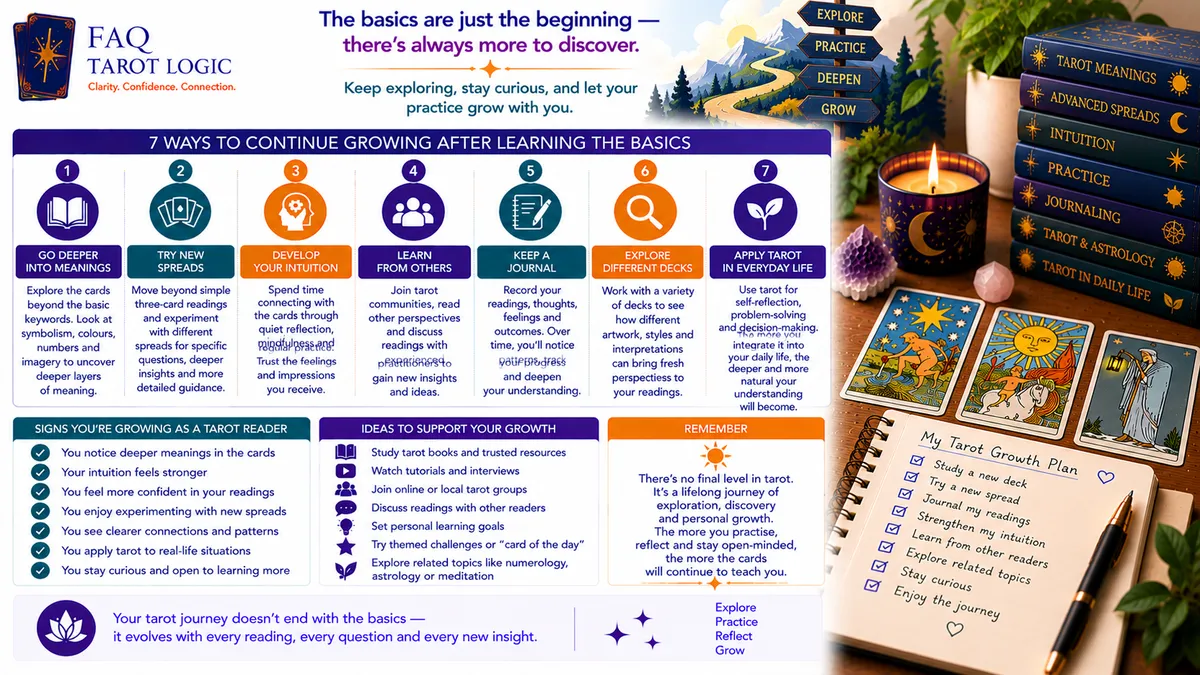
How Do You Continue Growing After Learning the Basics?
TL;DR
You continue growing as a tarot reader by moving beyond simply learning card meanings and paying more attention to context, combinations, symbolism, questions and your own interpretation process.
Regular practice, reviewing previous readings, exploring difficult cards and noticing where you still hesitate can all show you what to work on next.
Growth after the basics isn't about collecting more information. It's about developing greater depth, flexibility and confidence with what you already know.
IN SHORT
Learning the basics of tarot gives you a foundation.
You know the cards.
You understand simple spreads.
You can perform a reading.
You no longer need to look up every card you draw.
So what comes next?
This is where tarot becomes particularly interesting.
Instead of asking:
"What does this card mean?"
you begin asking:
"Why does this card mean that here?"
That's a small change in the question.
But it's a big change in the way you read.
Move From Meanings To Interpretation
When you're learning tarot, individual card meanings naturally receive most of your attention.
You need that foundation.
But eventually, knowing that a card represents change, choice, patience or conflict isn't enough.
You need to apply that idea to the reading.
For example:
What kind of change?
A choice about what?
Why might patience be necessary?
Where is the conflict coming from?
That's the difference between recognising a meaning and creating an interpretation.
→ How Can You Improve Your Tarot Interpretation Skills?
Start Looking At Relationships Between Cards
Once individual cards feel familiar, spend more time examining how they interact.
Perhaps two cards reinforce the same theme.
Maybe one challenges another.
One card might explain why another has appeared.
Or three cards may form a clear progression.
Instead of reading:
Card one → meaning
Card two → meaning
Card three → meaning
begin asking:
"What happens when I put these three ideas together?"
That's where readings start becoming more connected.
→ How Do You Interpret Multiple Tarot Cards Together?
Pay More Attention To Context
A card can have several perfectly reasonable interpretations.
Context helps you decide which is most relevant.
Consider:
The question.
The spread position.
The surrounding cards.
The situation being explored.
The overall theme.
This prevents you from trying to squeeze every possible meaning into one reading.
You don't need everything you know about a card.
You need the part that's useful here.
→ Why Does Context Matter More Than Individual Card Meanings?
Explore Symbolism More Deeply
Once you're comfortable with traditional meanings, symbolism gives you another layer to explore.
You may start noticing:
Colours.
Animals.
Landscapes.
Objects.
Numbers.
Direction.
Facial expressions.
Repeated visual themes.
You don't need to analyse every tiny detail.
Instead, notice what naturally catches your attention.
Then ask:
"Why might that matter in this reading?"
Symbolism can help you move beyond memorised definitions without abandoning the card's traditional foundation.
→ How Do You Read Tarot Symbolism?
Identify The Cards You Still Avoid
Most readers have cards they don't particularly enjoy seeing.
Not necessarily because the cards are negative.
Sometimes they're simply difficult to interpret.
Make a list of the cards that regularly make you hesitate.
Then explore them one at a time.
Look at:
Their central theme.
Their imagery.
Previous readings where they appeared.
Different situations they could represent.
How other readers interpret them.
The cards you find most difficult may show you exactly where your next stage of learning lies.
Stop Reaching For A Guidebook Automatically
Guidebooks remain useful long after you've learned the basics.
But try giving yourself an opportunity to interpret the card first.
Ask:
"What do I think this means here?"
Then check the book if you need another perspective.
That order matters.
You're training yourself to develop an interpretation rather than waiting for someone else's.
→ How Do You Avoid Relying Too Much on Guidebooks?
Improve The Questions You Ask
Better tarot reading isn't only about becoming better at interpreting cards.
It's also about becoming better at asking questions.
Compare:
"Will this work?"
with:
"What could help this work?"
Or:
"What will happen?"
with:
"What should I understand about what may happen next?"
A thoughtful question gives the reading somewhere useful to go.
As your reading skills improve, your questioning skills should develop alongside them.
Experiment With Different Spread Sizes
You don't necessarily need larger spreads to become a better reader.
In fact, smaller spreads can sometimes teach you more.
Try exploring the same type of situation with:
One card.
Two cards.
Three cards.
A larger structured spread.
Notice how the amount of information changes the reading.
You may discover that three carefully chosen positions provide more clarity than ten loosely defined cards.
Experimenting helps you understand what works best for you.
Practise Explaining Your Interpretation
A useful way to test your understanding is to explain a reading aloud.
Even if you're reading for yourself.
Instead of thinking:
"I know what this means,"
try explaining:
"I'm interpreting this card this way because..."
You may discover that an interpretation you thought was clear becomes harder to explain.
That's useful.
It shows you where your reasoning may need more thought.
Read For Other People
Reading for yourself is valuable, but reading for other people introduces new challenges.
They ask questions you wouldn't ask.
Their circumstances are different from yours.
They may notice details in cards that you overlook.
And you need to communicate your interpretation clearly enough for someone else to understand it.
You don't need to become a professional reader.
Even occasional practice with supportive friends or family can broaden your experience considerably.
→ When Are You Ready to Read Tarot for Other People?
Review Your Previous Readings
One of the best ways to continue growing is to look backwards.
Choose a reading from several months ago.
Before reading your old interpretation, look at the cards again.
What would you say now?
Then compare the two.
You may notice that:
You see more connections.
Your interpretation is less rigid.
You rely less on keywords.
You notice symbolism more naturally.
You explain the cards more clearly.
You use context more effectively.
That difference shows you how your reading skills are developing.
Keep Track Of What Confuses You
You don't need to record every reading in detail.
But it can help to note recurring difficulties.
Perhaps you regularly struggle with:
Court cards.
Reversals.
Certain suits.
Large spreads.
Relationship questions.
Conflicting cards.
Knowing when to stop.
Trusting your first interpretation.
Patterns like these give you a practical learning plan.
Instead of vaguely thinking:
"I need to get better at tarot,"
you know exactly what to practise.
Let Confusing Readings Teach You
After learning the basics, confusing readings can become especially valuable.
They expose the limits of familiar interpretations.
Perhaps a card doesn't seem to fit.
Maybe the cards appear contradictory.
Or the entire spread seems disconnected from the question.
Instead of abandoning the reading, investigate why.
You may discover that you were interpreting a card too narrowly or overlooking an important connection.
→ What Should You Do If a Tarot Reading Doesn't Make Sense Straight Away?
Develop Your Own Reading Style
As you gain experience, you'll naturally develop preferences.
You may discover that you prefer:
Smaller spreads.
Particular decks.
Reading without reversals.
Structured questions.
More conversational readings.
Starting with traditional meanings before exploring intuition.
These preferences aren't rules everyone else needs to follow.
They're simply the methods that help you read clearly.
Your reading style develops by noticing what consistently works.
→ How Do You Refine Your Tarot Reading Style Through Experience?
Don't Confuse Complexity With Progress
It's easy to think becoming more advanced means making tarot more complicated.
It doesn't.
You don't need increasingly elaborate spreads, obscure systems or dozens of decks to prove you're developing.
Sometimes progress looks like using fewer cards.
Asking a clearer question.
Spotting the central theme more quickly.
Or recognising that you don't need another clarifier.
Greater skill often creates simplicity rather than complexity.
Become More Comfortable With Uncertainty
Beginners often feel they need to know exactly what every card means.
Experience teaches you that sometimes you won't.
A card may remain unclear.
A reading may have several reasonable interpretations.
You may need more context.
Or you may need to return later.
Being able to say:
"I'm not sure yet"
without assuming you've failed is a valuable reading skill.
Confidence doesn't mean having an instant answer for everything.
Learn To Separate Intuition From Reaction
As you become more confident, you'll probably pay greater attention to your first impressions.
That's useful.
But not every immediate reaction is intuition.
Sometimes it's:
Fear.
Hope.
Assumption.
Habit.
Personal preference.
A developing reader learns to pause and ask:
"Why am I interpreting the card this way?"
That question can help you distinguish a useful intuitive impression from an emotional reaction.
→ What Is the Difference Between Intuition and Fear?
Notice How Your Confidence Changes
Progress isn't always about learning something new.
Sometimes it's about noticing what no longer feels difficult.
Perhaps you can now:
Read three cards without a guidebook.
Handle unfamiliar combinations.
Explain interpretations more clearly.
Sit with uncertainty.
Read for another person.
Recognise when you're overcomplicating things.
Those are meaningful improvements.
Don't overlook them simply because you haven't learned another technique.
Continue Learning Without Collecting Information
There will always be another tarot book, course, video, deck or system you could explore.
Some will be useful.
But consuming more information isn't automatically the same as improving.
Ask:
"Can I apply what I've already learned?"
If the answer is no, more information may not be what you need.
Practice may be more valuable.
Learning becomes deeper when knowledge is tested through actual readings.
Allow Your Practice To Change
The way you read tarot today doesn't have to be the way you read forever.
You may change decks.
Stop using a favourite spread.
Become more interested in symbolism.
Use fewer cards.
Read less frequently but more thoughtfully.
Or discover that an approach you once dismissed now makes sense.
Growth requires enough flexibility to change when experience gives you a reason to.
Keep Learning From Every Reading
A reading doesn't have to be remarkable to teach you something.
A straightforward reading reinforces what you know.
A difficult reading challenges you.
An unexpected card expands your understanding.
A poor question teaches you how to ask a better one.
A reading you later reconsider shows how your interpretation has developed.
The more you treat experience as part of learning, the less pressure there is to make every reading perfect.
→ How Can Every Tarot Reading Help You Grow?
Coffee Cup Tip ☕
Instead of asking:
"What should I learn next?"
try asking:
"What part of my tarot reading still feels least comfortable?"
Your answer may give you a much better direction.
If card combinations are difficult, practise combinations.
If questions are difficult, work on questions.
If confidence is the problem, review older readings and look at how far you've already come.
Let your actual experience guide what you learn next.
QUICK RECAP
After learning the tarot basics, you can continue growing by:
Moving from card meanings to interpretation.
Reading relationships between cards.
Paying closer attention to context.
Exploring symbolism.
Studying cards you find difficult.
Becoming less dependent on guidebooks.
Improving the questions you ask.
Experimenting with different spreads.
Explaining interpretations aloud.
Reading occasionally for other people.
Reviewing previous readings.
Tracking recurring difficulties.
Learning from confusing readings.
Developing your own reading style.
Avoiding unnecessary complexity.
Becoming comfortable with uncertainty.
Separating intuition from emotional reaction.
Recognising how your confidence has grown.
Applying what you've learned before collecting more information.
Allowing your practice to change.
Learning the basics gives you the tools to read tarot.
What happens next is learning how to use those tools with greater depth, flexibility and confidence.
NEXT STEP
Once the basics feel comfortable, you don't need to rush towards something more advanced.
A better next step is to pay attention to the parts of your readings that still make you stop and think.
That might be choosing the right spread, interpreting an unexpected card, recognising when emotions are affecting a reading or simply knowing when you've drawn enough cards.
Each of those situations gives you another opportunity to deepen the skills you've already built.
